All species › Woodpeckers and allies › Woodpeckers › Cream-backed Woodpecker
Cream-backed Woodpecker | Campephilus leucopogon
Crèmerugspecht | Carpintero lomo blanco | Pica-pau-de-costas-brancas
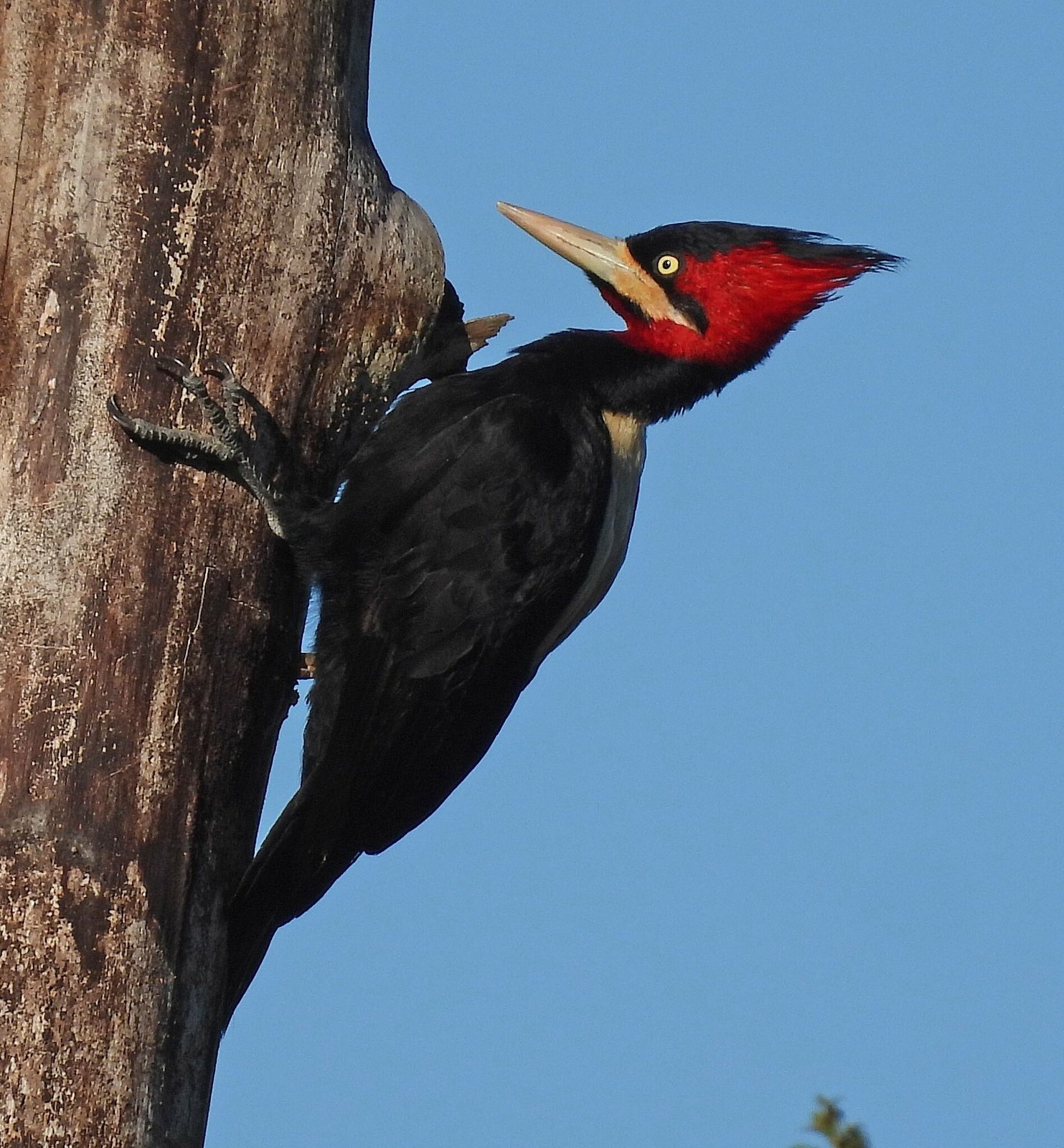
The Cream-backed Woodpecker is a large black woodpecker with a red crest and a creamy white patch on the lower back, found in dry Chaco forest and the dry forests at the foot of the Andes. In the guide area it occurs only in southern and south-eastern Bolivia. Like all Campephilus woodpeckers it drums with a characteristic double knock.
Voice
A short, nasal, somewhat harsh call, often repeated a few times. It drums with a powerful double knock, tok-tok, typical of the genus.
Recording: Luciano Buck — CC BY-NC-SA 4.0 · xeno-canto
Identification
28–30 cm, with a strong, straight, pale bill and a pointed crest. The body, wings and tail are black; the mid and lower back are creamy white to pale yellowish, which shows especially in flight and on birds clinging to a trunk. The underparts are dark, with pale barring on the belly. The male has an all-red head with a small black-and-white spot on the ear coverts. The female has a red crest, a black forehead and a broad pale stripe from the bill base across the cheek. In flight the underwings are partly white.
Confusion species
Black-bodied Woodpecker Dryocopus schulzii, in the same Chaco forest, has an all-black back and a narrow white stripe along the head. Lineated Woodpecker Dryocopus lineatus has white scapular stripes and a barred, pale belly. Crimson-crested Woodpecker Campephilus melanoleucos has a white V on the back and a barred belly. Red-necked Woodpecker Campephilus rubricollis has rufous underparts and a black back, and lives in humid lowland forest.
Habitat
Dry Chaco forest, semi-dry lowland forest and dry forest in the valleys and on the lower slopes of the Andes, in the guide area from the lowlands to about 2000 m, locally higher. It searches trunks and large branches for beetle larvae and other insects, which it digs out of the wood. It nests in a self-excavated cavity in a tree.
Where the bird is most at home, classified by the vegetation units of the Andes and the west coast.


Range and movements
In Bolivia in the south and south-east: the Chaco and dry forests of Santa Cruz, Chuquisaca and Tarija, and the dry valleys on the eastern slope of the Andes. Absent from Colombia, Ecuador, Peru and the Galápagos. Outside the guide area in western Paraguay, northern Argentina and locally in Uruguay and extreme southern Brazil.
- Resident
- dark = core range, pale = thinly spread
How and when to look
Search tracts of Chaco and dry forest with old trees in south-eastern Bolivia and listen for the double-knock drumming. Pairs and family groups often work the same trunk for a long time.
Conservation status
Least Concern. Its habitat is, however, shrinking through clearance of Chaco forest for farming and cattle ranching.
Scientific name
Campephilus leucopogon | (Valenciennes, 1826)
Valenciennes described the species in 1826 as Picus leucopogon; because it was later moved to another genus, the author and year stand in brackets. The genus Campephilus was introduced in 1840 by Gray. The genus name combines Greek kampē, 'caterpillar', with philos, 'loving'. The species name combines Greek leukos, 'white', with pōgōn, 'beard', meaning 'white-bearded'. The specimen the first description was based on came from Brazil.