All species › Woodpeckers and allies › Woodpeckers › Guayaquil Woodpecker
Guayaquil Woodpecker | Campephilus gayaquilensis
Guayaquilspecht | Carpintero guayaquileño | Pica-pau-de-guayaquil
The Guayaquil Woodpecker is the western counterpart of the Crimson-crested Woodpecker and lives in dry and humid forest west of the Andes, from south-western Colombia to north-western Peru. It often forages in pairs in the canopy and tolerates some degree of degraded forest and old secondary forest.
Voice
A liquid, rolling kwee-kwee-kweh-rrrrr; when excited also kwik-kwik-kwikerrr and kik-kwiddit. It drums briefly, with four to seven raps in about one second, the first the loudest.
Recording: José María Loaiza B. — CC BY-NC-SA 4.0 · xeno-canto
Identification
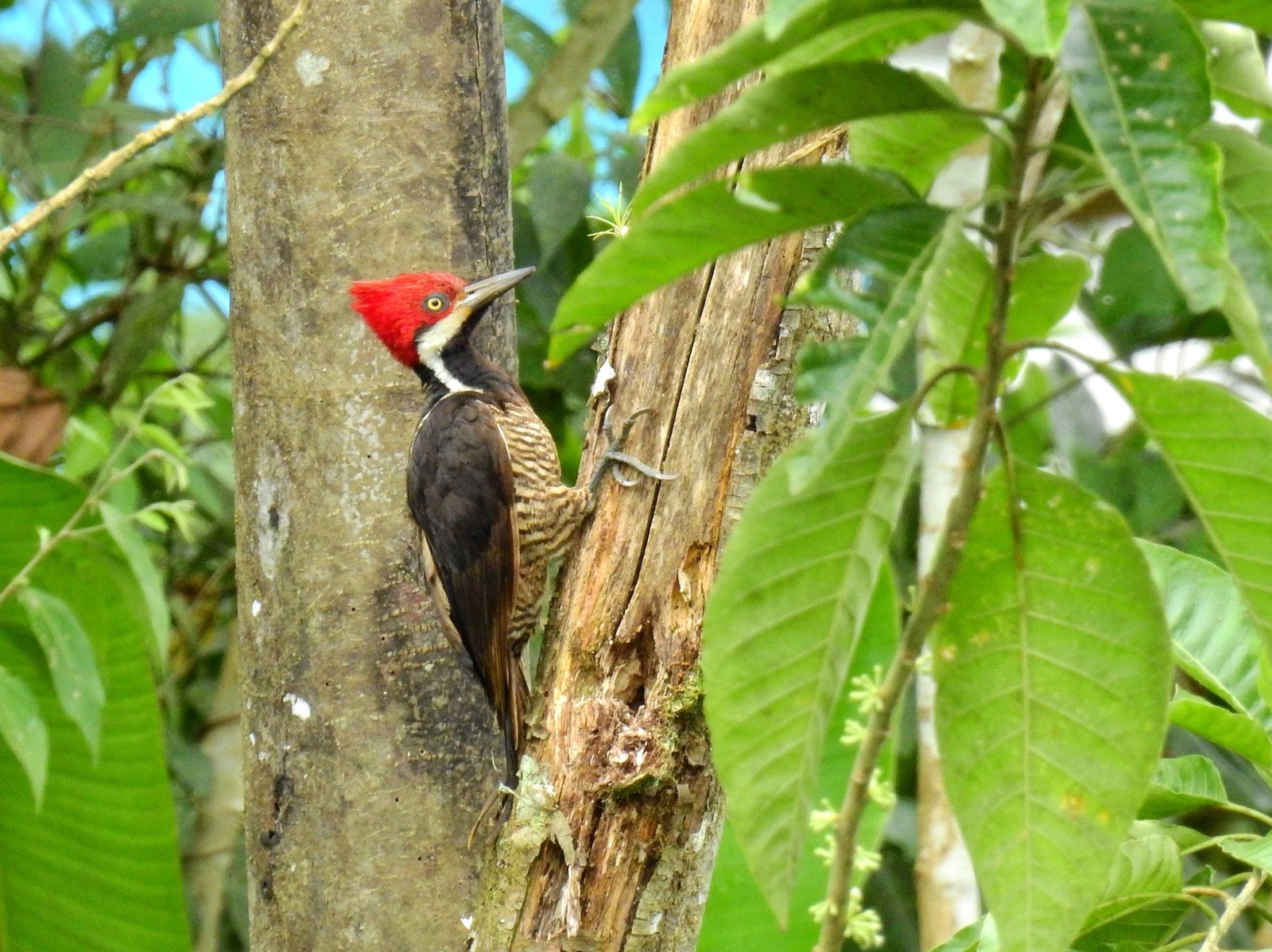
33–36 cm, with a long, straight, pale bill and a pointed red crest. The upperparts are black; white stripes along the side of the neck form a white V on the back. The throat and upper breast are black, the rest of the underparts whitish buff to cinnamon with dark barring. The male has an all-red head with a small black-and-white spot on the ear coverts. The female lacks this spot and has a broad, black-edged creamy stripe from the bill to the ear coverts.
Confusion species
Crimson-crested Woodpecker Campephilus melanoleucos lives east of the Andes and in northern Colombia and has a paler belly; in the guide area the two species hardly overlap. Lineated Woodpecker Dryocopus lineatus has white back stripes that do not meet and, in the male, only a red crown and malar stripe. Splendid Woodpecker Campephilus splendens in the humid Chocó forest has red underparts and a red rump.
Habitat
The interior and edges of dry to humid deciduous and semi-evergreen forest and old secondary forest, from the lowlands to about 1100 m in Colombia and 1500 m in Ecuador and Peru, but mostly below 800 m. It forages in pairs, often in the canopy, searching trunks and branches for beetle larvae and other insects. It nests in a self-excavated cavity in a tree.
Where the bird is most at home, classified by the vegetation units of the Andes and the west coast.


Range and movements
In Colombia in the south-west, from Cauca southwards. In Ecuador throughout the west. In Peru in the north-west, south to about Cajamarca. Absent from Bolivia and the Galápagos. It does not occur outside the guide area.
- Resident
- dark = core range, pale = thinly spread
How and when to look
In remnants of dry and humid forest in western Ecuador and north-western Peru, for example in protected forest areas, look for pairs foraging high in the trees. The rolling call and the short drum often give the birds away.
Conservation status
Least Concern. The population is declining through the clearing and fragmentation of forest for farming and ranching, but the species tolerates some forest degradation and occurs in several protected areas in Ecuador and Peru.
Scientific name
Campephilus gayaquilensis | (Lesson, 1845)
Lesson described the species in 1845 as Picus Gayaquilensis; because it was later moved to another genus, the author and year stand in brackets. The genus Campephilus was introduced in 1840 by Gray. The genus name combines Greek kampē, 'caterpillar', with philos, 'loving'. The species name means 'of Guayaquil'; it refers to that city in Ecuador, not necessarily the type locality. The specimen the first description was based on came from Guayaquil, Ecuador.