All species › Passerines › Tyrant flycatchers and allies › Acre Tody-Tyrant
Acre Tody-Tyrant | Hemitriccus cohnhafti
Acretodietiran | Titirijí de Acre | Maria-do-acre
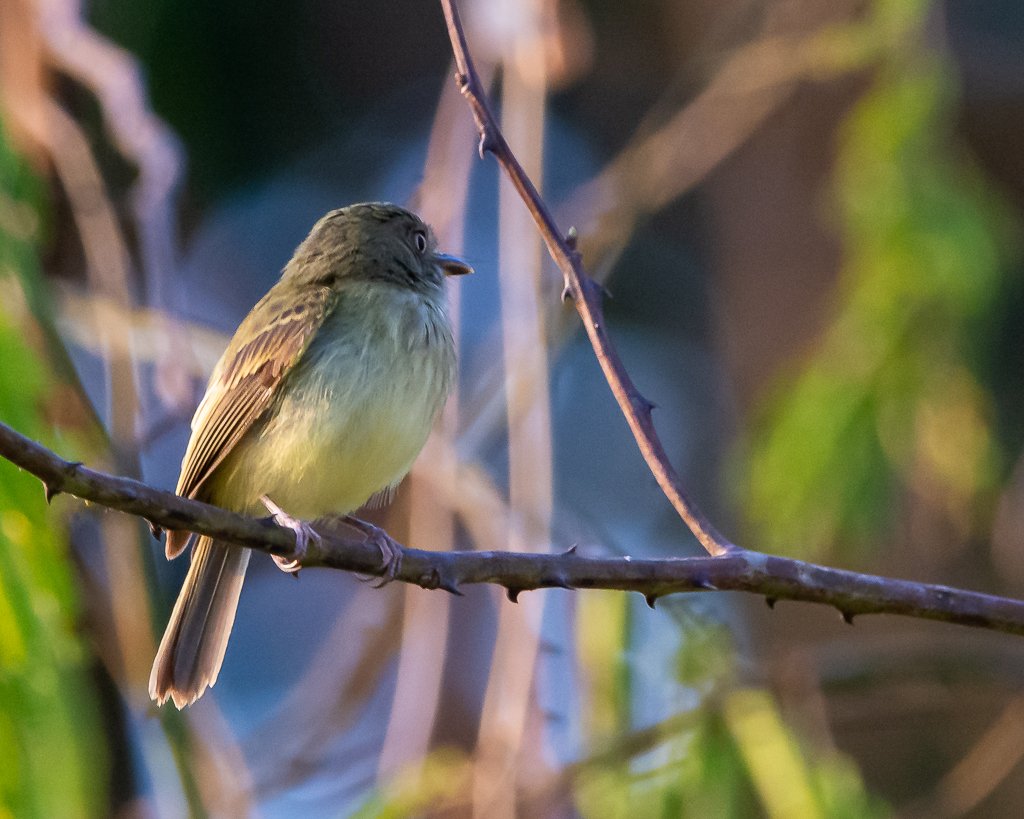
The Acre Tody-Tyrant is a small tyrant described only in 2013, named after the Brazilian state of Acre. It lives in low secondary forest on nutrient-poor sandy soils in the border region of Brazil, Peru and Bolivia and is known from only a few localities.
Voice
The song is a rattle of tick notes, shorter and lower than in related tody-tyrants and usually without introductory notes; also single skep or keek calls and a lower kup.
Recording: Jacob Wijpkema — CC BY-NC-SA 4.0 · xeno-canto
Identification
11 cm, with a flat, black bill with a cream base. The head, nape, back and rump are greenish olive, with dark streaks on the crown; the lores and face have a tawny wash. The wings are blackish with yellow outer edges and two buff wing bars. The throat and breast are olive-green with creamy yellow streaks, the lower belly and undertail coverts sulphur-yellow. The iris is cream to pale brown. The sexes are alike.
Confusion species
Snethlage's Tody-Tyrant Hemitriccus minor lacks the tawny wash on the face and has fainter wing bars. Johannes's Tody-Tyrant Hemitriccus iohannis lives mainly in várzea and along rivers and has a greyer breast. White-eyed Tody-Tyrant Hemitriccus zosterops and White-bellied Tody-Tyrant Hemitriccus griseipectus live in tall terra firme forest.
Habitat
Mainly secondary forest on poor sandy soils with a canopy usually lower than 12 m; in Brazil often where Guadua bamboo is dying back. Not known from várzea or tall terra firme forest. Only below about 300 m. It forages for insects in dense vegetation.
Where the bird is most at home, classified by the vegetation units of the Andes and the west coast.


Range and movements
Peru: the south-east, adjoining the Acre localities, including Madre de Dios. Bolivia: the north, in Pando. Absent from Colombia, Ecuador and the Galápagos. Outside the guide area in south-eastern Acre and adjacent Amazonas in Brazil.
- Resident
- dark = core range, pale = thinly spread
How and when to look
Listen in low secondary forest on sandy soils and near dying bamboo in the border region of Madre de Dios and Pando for the short, low rattle of tick notes.
Conservation status
Near Threatened. The population is unknown but probably not large and is declining; the main threat is large-scale clearing for cattle pasture. Its preference for secondary and shrubby vegetation may help it survive some degradation.
Scientific name
Hemitriccus cohnhafti | Zimmer, Whittaker, Sardelli, Guilherme & Aleixo, 2013
Zimmer, Whittaker, Sardelli, Guilherme & Aleixo described the species in 2013 and placed it straight away in the genus where it still stands. The genus Hemitriccus was introduced in 1860 by Cabanis & Heine. The genus name comes from Greek hēmi-, 'half, small', and trikkos, an unidentified small bird, used by ornithologists for tyrant flycatchers. The species name honours Mario Cohn-Haft, an ornithologist working in Brazilian Amazonia and a colleague of the describers. The specimen the first description was based on came from Assis Brasil, Acre, Brazil.