All species › Passerines › Tyrant flycatchers and allies › Flammulated Bamboo Tyrant
Flammulated Bamboo Tyrant | Hemitriccus flammulatus
Gestreepte todietiran | Titirijí flamulado | Maria-de-peito-machetado
The Flammulated Bamboo Tyrant is a small, brownish tyrant of the bamboo forests of south-western Amazonia. It lives almost exclusively in dense stands of Guadua bamboo. The species is noticed mainly by its dry, ticking call; the bird itself usually stays inside the bamboo.
Voice
A rapid, dry series of ticking notes that may turn into a short rattle, and single sharp pik calls.
Recording: Felipe Arantes — CC BY-NC-SA 4.0 · xeno-canto
Identification
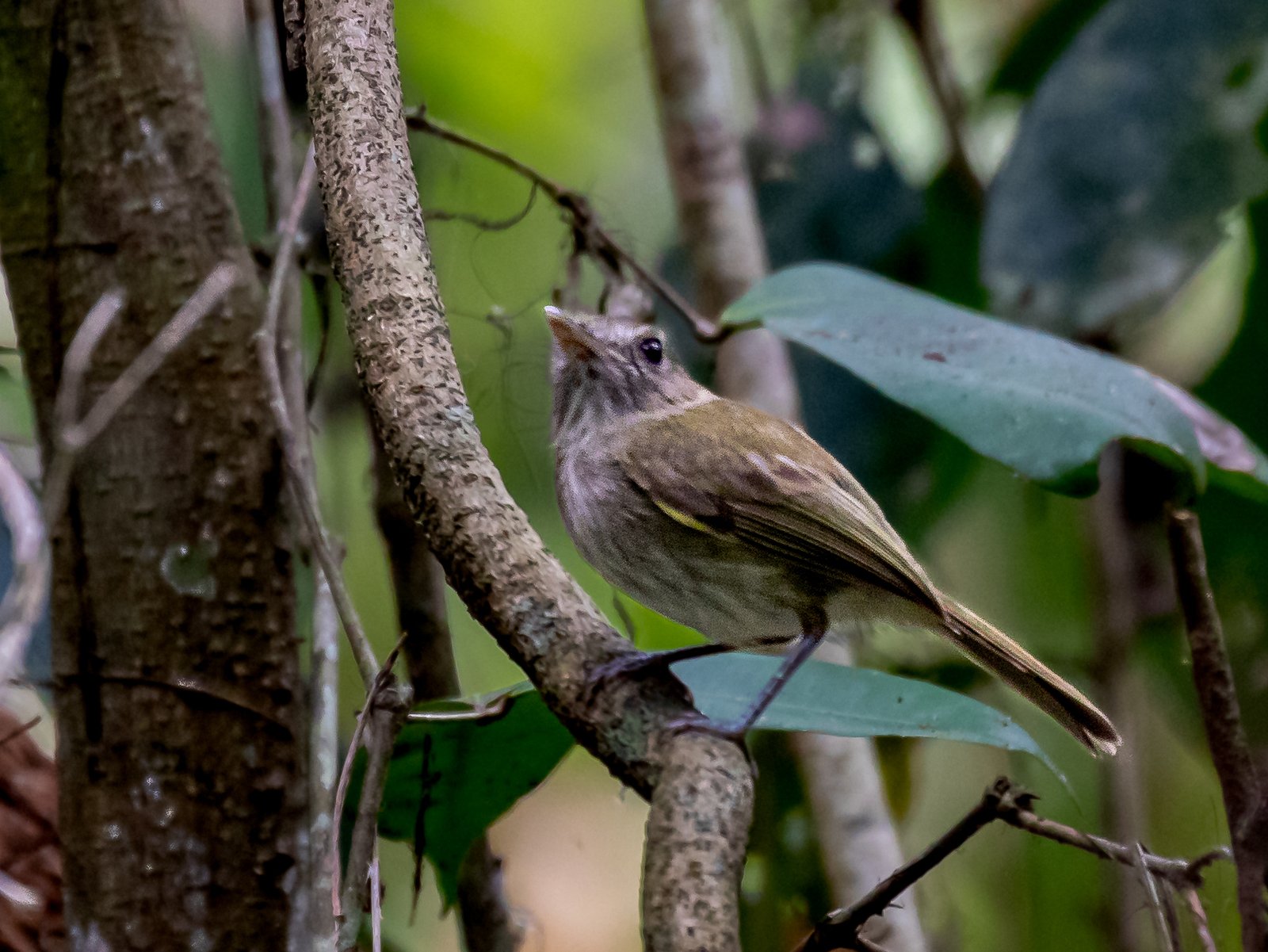
11 cm, with a fairly long, flat bill and a fairly long tail. The upperparts are brownish olive, the wings with indistinct pale edgings. The sides of the head and the lores are pale brown to cinnamon, the throat is white. The breast and flanks have diffuse grey-brown streaks (the 'flammulations' of the name), the belly is whitish. The sexes are alike.
Confusion species
Long-crested Pygmy Tyrant Lophotriccus eulophotes also lives in bamboo, but has a long crest and a greyer, less brown tone. White-cheeked Tody-Flycatcher Poecilotriccus albifacies has a rufous crown and white sides to the head. White-bellied Tody-Tyrant Hemitriccus griseipectus is greener above, has yellow wing bars and lives in tall forest away from bamboo.
Habitat
Dense stands of Guadua bamboo in humid lowland and foothill forest, also bamboo along forest edges and in secondary forest, up to about 1500 m. It forages alone or in pairs low to mid-level in the bamboo for insects, which it picks from leaves with short sallies.
Where the bird is most at home, classified by the vegetation units of the Andes and the west coast.


Range and movements
Peru: in the south-east (Madre de Dios, Cusco, Puno) and locally north to the centre of the country. Bolivia: in the north and along the foot of the Andes (Pando, Beni, La Paz, Cochabamba, Santa Cruz). Absent from Colombia, Ecuador and the Galápagos. Outside the guide area in western Brazil.
- Resident
- dark = core range, pale = thinly spread
How and when to look
Search extensive bamboo forest in Madre de Dios or in the Bolivian lowlands; listen for the ticking series low in the bamboo and wait for the bird to appear at the edge of a bamboo stand.
Conservation status
Least Concern. The species is tied to bamboo forest, but this is widespread in south-western Amazonia.
Scientific name
Hemitriccus flammulatus | Berlepsch, 1901
Berlepsch described the species in 1901 and placed it straight away in the genus where it still stands. The genus Hemitriccus was introduced in 1860 by Cabanis & Heine. The genus name comes from Greek hēmi-, 'half, small', and trikkos, an unidentified small bird, used by ornithologists for tyrant flycatchers. The species name comes from Latin flammulatus, 'flammulated', referring to the streaks on breast and throat. The specimen the first description was based on came from San Mateo, Cochabamba, Bolivia.