All species › Passerines › Tyrant flycatchers and allies › White-eyed Tody-Tyrant
White-eyed Tody-Tyrant | Hemitriccus zosterops
Witoogtodietiran | Titirijí ojiblanco | Maria-de-olho-branco
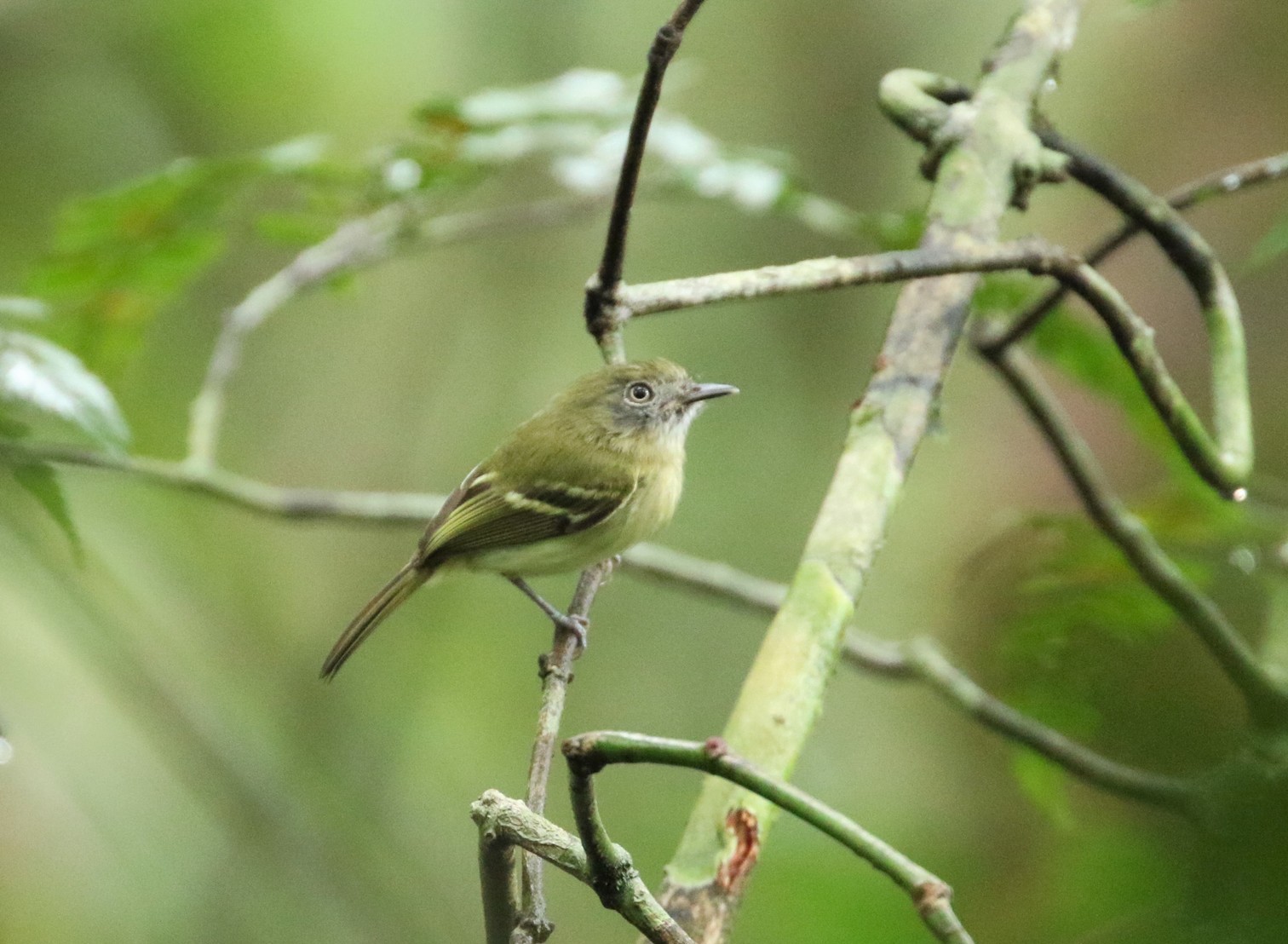
The White-eyed Tody-Tyrant is a small, olive-green tyrant of Amazonian forest north of the Amazon. It lives in the middle levels of tall forest and is usually noticed by its dry, ticking call. The name refers to the pale ring around the eye.
Voice
Short series of dry, ticking notes, often ending in a short rattle, from the middle levels of the forest.
Recording: Jarol Fernando Vaca — CC BY-NC-SA 4.0 · xeno-canto
Identification
10 cm, with a flat bill and a fairly short tail. The upperparts are olive-green, the crown slightly greyer. A narrow whitish eye-ring and pale lores give a spectacled face. The wings are dark with two yellow wing bars and yellow edgings. The throat is whitish, the breast greyish olive with faint streaks, the belly pale yellow. The sexes are alike.
Confusion species
White-bellied Tody-Tyrant Hemitriccus griseipectus lives south of the Amazon and has whiter underparts with little yellow. Stripe-necked Tody-Tyrant Hemitriccus striaticollis has distinct black streaks on the throat and breast and lives in forest edge and scrub. Zimmer's Tody-Tyrant Hemitriccus minimus is smaller and has paler wing bars and edges to the tertials.
Habitat
Tall humid terra firme lowland forest and foothill forest, less in old secondary forest, up to about 1000 m. It forages alone or in pairs in the middle levels and the lower canopy for insects, which it picks from the undersides of leaves with short sallies.
Where the bird is most at home, classified by the vegetation units of the Andes and the west coast.


Range and movements
Colombia: in the Amazonian lowlands in the south-east. Ecuador: in the eastern lowlands and foothills. Peru: in the north-east, north of the Amazon and the Marañón. Absent from Bolivia and the Galápagos. Outside the guide area in southern Venezuela, the Guianas and northern Brazil.
- Resident
- dark = core range, pale = thinly spread
How and when to look
In tall terra firme forest in eastern Ecuador or around Iquitos, listen for short ticking series at mid-level; the bird often sits still on a thin twig and then suddenly sallies to a leaf.
Conservation status
Least Concern. The species has a large range, but is sensitive to deforestation.
Scientific name
Hemitriccus zosterops | (Pelzeln, 1868)
Pelzeln described the species in 1868 as Euscarthmus Zosterops; because it was later moved to another genus, the author and year stand in brackets. The genus Hemitriccus was introduced in 1860 by Cabanis & Heine. The genus name comes from Greek hēmi-, 'half, small', and trikkos, an unidentified small bird, used by ornithologists for tyrant flycatchers. The species name comes from Greek zōstēr, 'girdle', and ōps, 'eye', referring to the white eye-ring. The specimen the first description was based on came from Marabitanas, Rio Negro, Amazonas, Brazil.