All species › Passerines › Antpittas › Amazonian Antpitta
Amazonian Antpitta | Myrmothera berlepschi
Amazonemierpitta | Tororoí amazónico | Torom-torom
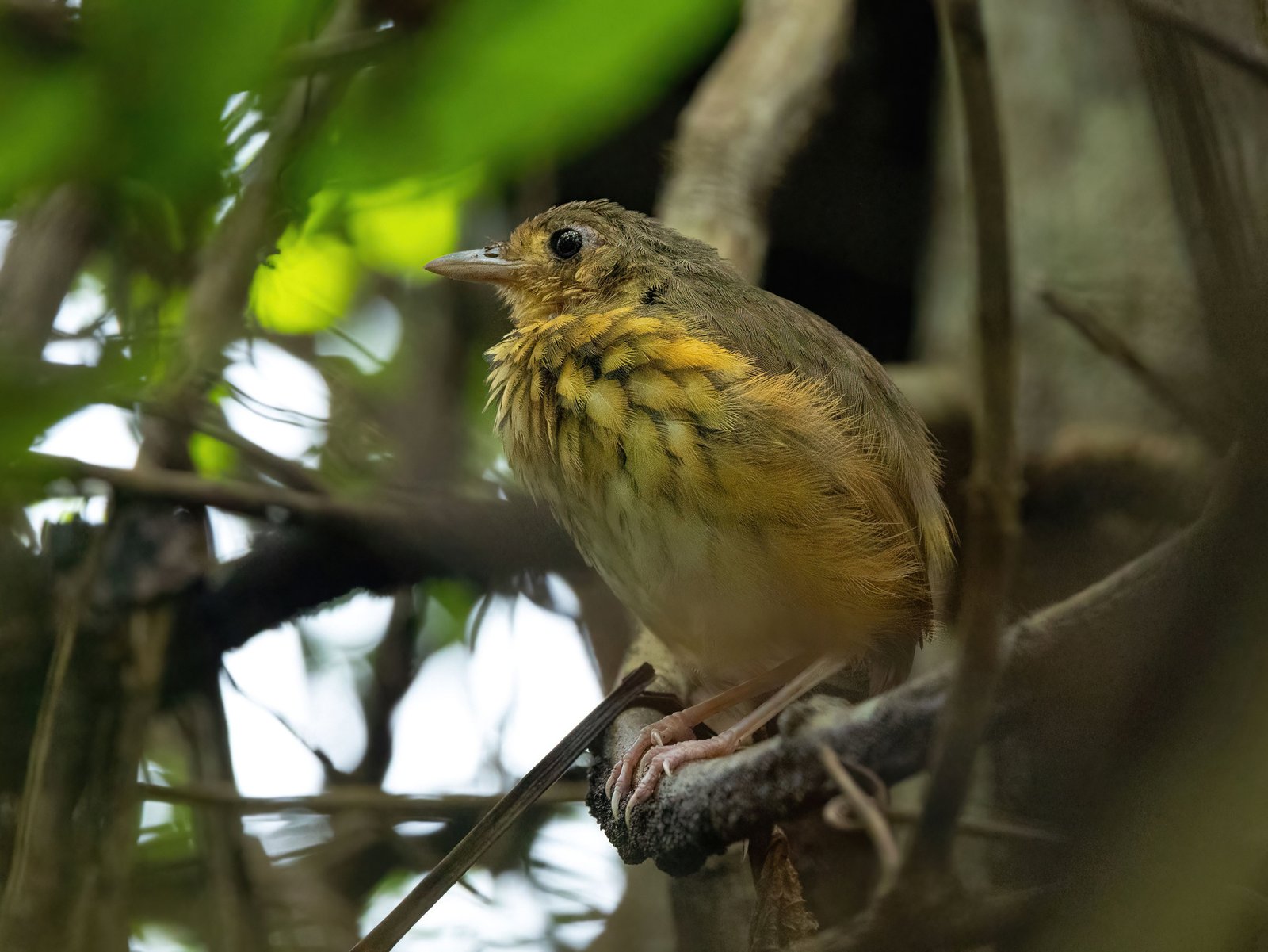
The Amazonian Antpitta is a small antpitta of south-western Amazonia, which in the guide area occurs in eastern Peru and northern Bolivia. It lives in dense growth along rivers and in bamboo. It was formerly placed in the genus Hylopezus; genetic studies moved it to Myrmothera.
Voice
The song is a series of six to ten hollow, even whistled notes that grow slightly louder, hoo-hoo-hoo-hoo-hoo-hoo. It sings mainly in the early morning and towards evening.
No recording with a suitable Creative Commons licence is available for this species yet.
Identification
14 cm, round and almost tailless on long legs. The upperparts are uniform olive-brown, including crown and nape; lores and eye-ring are faintly buff. The throat is white; the breast buff with small black spots that become streaks on the flanks; the belly is white and the flanks ochre-brown. The sexes are alike.
Confusion species
Thrush-like Antpitta Myrmothera campanisona has a breast faintly streaked brown rather than spotted black, and lives in terra firme forest. Masked Antpitta Hylopezus auricularis has a grey crown and a black-and-white head mask. Spotted Antpitta Hylopezus macularius has a grey crown and distinct spectacles, and occurs only north of the Amazon.
Habitat
Dense scrub and forest understorey along rivers, in várzea, transitional forest and bamboo, also in young secondary forest, in the lowlands up to about 500 m. It searches the ground for insects and other invertebrates. Little is known about the nest.
Where the bird is most at home, classified by the vegetation units of the Andes and the west coast.


Range and movements
In Peru in the eastern lowlands, mainly in the south-east in Madre de Dios, Cusco and Puno, and north along the Ucayali. In Bolivia in the north, in Pando, Beni and La Paz. Absent from Colombia, Ecuador and the Galápagos. Outside the guide area in western Brazilian Amazonia, south of the Amazon.
- Resident
- dark = core range, pale = thinly spread
How and when to look
Listen in the early morning for the hollow series in dense riverside growth and bamboo along rivers in Madre de Dios, such as around Manu and Tambopata. The bird sings from the ground and stays in cover.
Conservation status
Least Concern. The range is large and riverside habitat recovers after disturbance.
Scientific name
Myrmothera berlepschi | (Hellmayr, 1903) (GBIF: Hylopezus berlepschi)
Hellmayr described the species in 1903 as Grallaria berlepschi; because it was later moved to another genus, the author and year stand in brackets. The genus Myrmothera was introduced in 1816 by Vieillot. The genus name combines Ancient Greek murmos, 'ant', with thēras, 'hunter'. The species name honours Hans von Berlepsch (1850–1915), a German ornithologist and collector of South American birds. The specimen the first description was based on came from Engenho do Gama, Mato Grosso, Brazil.