All species › Passerines › Antpittas › Thicket Antpitta
Thicket Antpitta | Myrmothera dives
Oranjeflankmierpitta | Tororoí ventricanela colombiano | Torom-do-matagal
The Thicket Antpitta is a Central American antpitta that reaches the guide area only in north-western Colombia. It lives in dense secondary scrub and overgrown clearings, not in tall forest. It was formerly placed in the genus Hylopezus.
Voice
The song is a series of six to nine hollow notes that rise in pitch and volume and stop abruptly, ho-ho-ho-hu-hu-HU-HU. It sings mainly in the morning, from dense cover.
No recording with a suitable Creative Commons licence is available for this species yet.
Identification
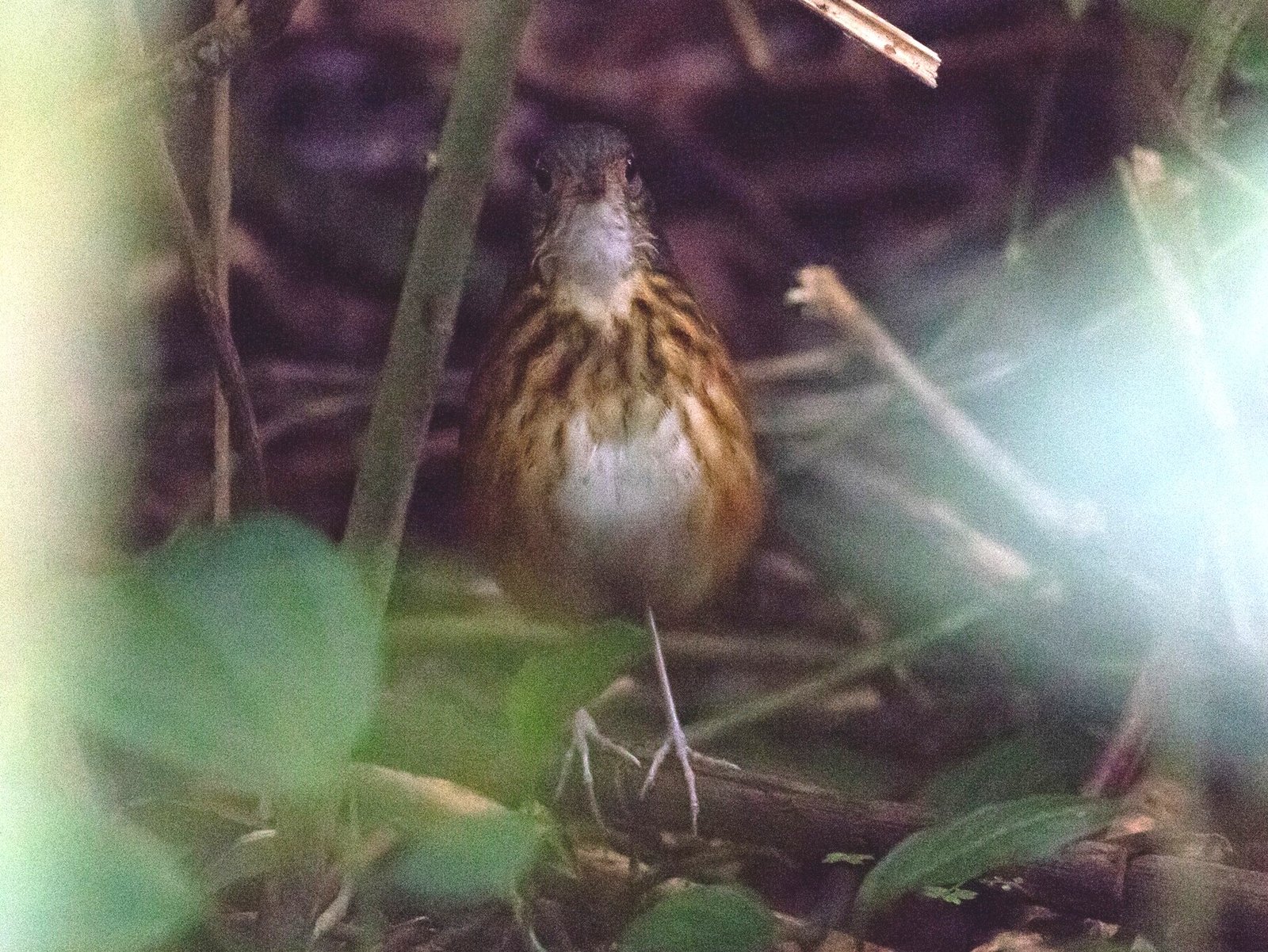
13–14 cm, round and almost tailless on long legs. The crown and upperparts are uniform dark olive-brown, the sides of the head greyish with faint pale lores. The throat is white; breast and flanks are ochre to orange-brown, with faint dark streaks on the breast; the centre of the belly is white. There are no wing spots. The sexes are alike.
Confusion species
Streak-chested Antpitta Hylopezus perspicillatus has buff spectacles, buff spots on the wing coverts and black-streaked white underparts, and lives in tall forest. Rufous-crowned Antpitta Pittasoma rufopileatum is larger, with a rufous crown and black-barred underparts. White-lored Antpitta Myrmothera fulviventris is very similar but occurs only east of the Andes.
Habitat
Dense secondary scrub, overgrown abandoned fields, treefall gaps and forest edges in the lowlands and foothills, up to about 1000 m. It searches the ground for insects and other invertebrates. The nest is a cup of leaves and twigs, low in dense growth.
Where the bird is most at home, classified by the vegetation units of the Andes and the west coast.


Range and movements
In Colombia only in the north-west, in northern Chocó and the Urabá region of Antioquia, near the border with Panama. Absent from Ecuador, Peru, Bolivia and the Galápagos. Outside the guide area from Honduras through Nicaragua and Costa Rica to Panama.
- Resident
- dark = core range, pale = thinly spread
How and when to look
Listen in the early morning for the rising series of hollow notes in overgrown clearings and young secondary forest in the Urabá region. The bird stays low in the densest growth and moves on foot.
Conservation status
Least Concern. The species inhabits secondary growth after clearance; the part of its range within the guide area is small.
Scientific name
Myrmothera dives | (Salvin, 1865) (GBIF: Hylopezus dives)
Salvin described the species in 1865 as Grallaria dives; because it was later moved to another genus, the author and year stand in brackets. The genus Myrmothera was introduced in 1816 by Vieillot. The genus name combines Ancient Greek murmos, 'ant', with thēras, 'hunter'. The species name is Latin dives, 'rich, costly, sumptuous'. The specimen the first description was based on came from Tucurrique, Costa Rica.