All species › Passerines › Antpittas › Thrush-like Antpitta
Thrush-like Antpitta | Myrmothera campanisona
Lijstermierpitta | Tororoí campanero | Tovaca-patinho
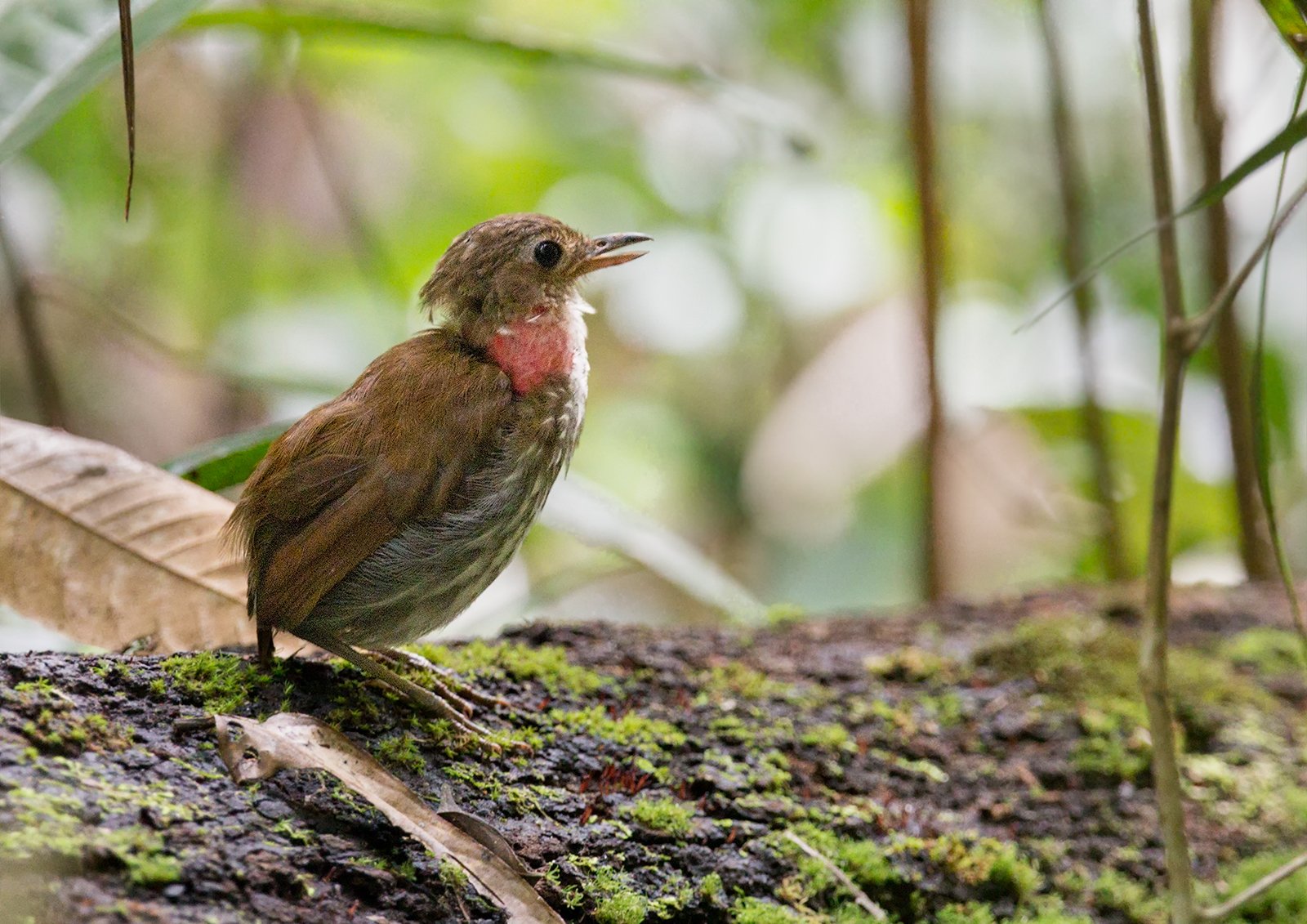
The Thrush-like Antpitta is the most widespread antpitta of the Amazonian lowlands and occurs in all four countries of the guide area, east of the Andes. In plumage and posture it resembles a small thrush on long legs. Its hollow song is one of the regularly heard sounds of the forest floor in tall lowland forest.
Voice
The song is a series of six to nine hollow whistled notes that rise in pitch and volume and stop abruptly, hoo-hoo-hoo-hu-hu-hu. It sings often, also later in the morning.
Recording: Daan van der Hoeven — CC BY-NC-SA 4.0 · xeno-canto
Identification
14–16 cm, round and almost tailless on long, pinkish-grey legs. The upperparts are uniform olive-brown, including crown and nape; lores and a narrow eye-ring are pale buff. The throat is white; the breast whitish with a buff wash and faint, broad brown streaks; the belly white and the flanks olive-brown. The sexes are alike; young birds are spotted rufous-brown.
Confusion species
White-lored Antpitta Myrmothera fulviventris has a grey head with white lores and rufous flanks. Amazonian Antpitta Myrmothera berlepschi and Spotted Antpitta Hylopezus macularius have black spots on a buff breast. Short-tailed Antthrush Chamaeza campanisona has a distinct tail and scaled underparts, walks with its tail cocked and lives mainly in the foothills.
Habitat
The floor and understorey of tall terra firme lowland forest, often around fallen trees, in dense patches and along streams, up to about 1000 m in the foothills. It searches the ground for insects and other invertebrates. The nest is a shallow cup, low in a shrub or on a stump.
Where the bird is most at home, classified by the vegetation units of the Andes and the west coast.


Range and movements
In Colombia in the lowlands east of the Andes, from Meta south to Amazonas. In Ecuador in the eastern lowlands and foothills. In Peru throughout the eastern lowlands. In Bolivia in the north, in Pando, Beni and La Paz. Absent from the Galápagos. Outside the guide area in southern Venezuela, the Guianas and Brazilian Amazonia.
- Resident
- dark = core range, pale = thinly spread
How and when to look
Listen in the early morning for the hollow, rising series in tall terra firme forest in the eastern lowlands of Ecuador and Peru. The bird sings from a fallen log or a low branch and often stays in the same spot for minutes.
Conservation status
Least Concern. The range is very large; deforestation in Amazonia causes local declines.
Scientific name
Myrmothera campanisona | (Hermann, 1783)
Hermann described the species in 1783 as Myrmornim campanisonam; because it was later moved to another genus, the author and year stand in brackets. The genus Myrmothera was introduced in 1816 by Vieillot. The genus name combines Ancient Greek murmos, 'ant', with thēras, 'hunter'. The species name combines Late Latin campana, 'bell', with Latin sonus, 'sounding', after the bell-like song. The specimen the first description was based on came from Cayenne, French Guiana.