All species › Passerines › Antpittas › Undulated Antpitta
Undulated Antpitta | Grallaria squamigera
Geschubde mierpitta | Tororoí ondulado | Tovacuçu-ondulado
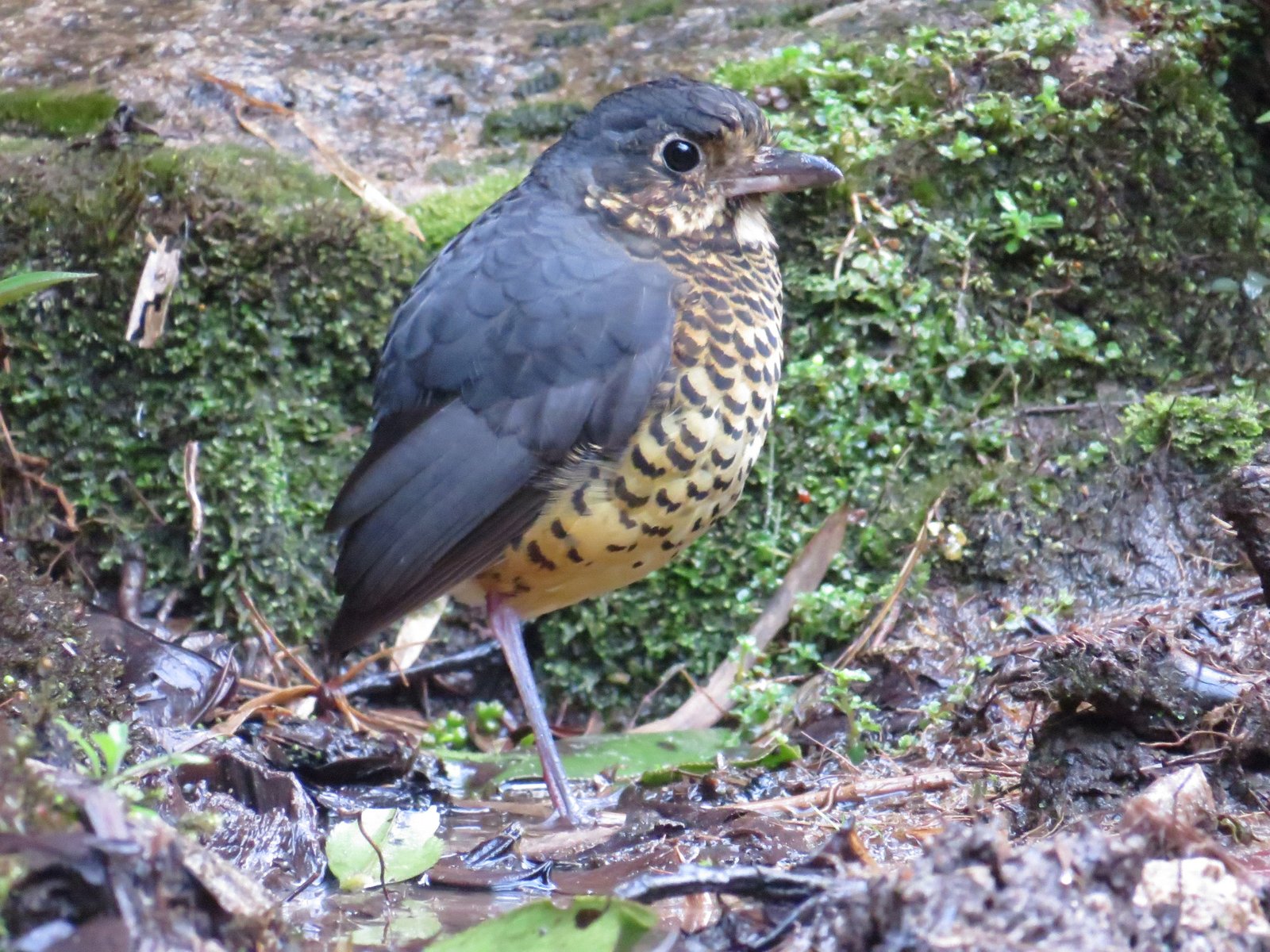
The Undulated Antpitta is one of the largest antpittas of the Andes, a chunky ground bird with ochre underparts finely scalloped with black. It lives hidden in high cloud forest up to the treeline and is heard far more often than seen. Its low, tremulous call is a familiar sound at dusk.
Voice
A long, low, hollow trill lasting a few seconds, swelling slightly and then fading, carrying far through the forest. Heard mainly at dawn and dusk, often also in fog.
Recording: Peter de Rouw — CC BY-NC-SA 4.0 · xeno-canto
Identification
21–24 cm, round and short-tailed, on long grey legs, with a heavy black bill. The crown, nape and back are slate-grey to olive-grey, the wings browner. The throat is white, bordered on each side by a black malar stripe. The breast and belly are warm ochre-yellow to orange-brown, densely covered with wavy black scallops and bars. The sexes are alike.
Confusion species
Giant Antpitta Grallaria gigantea is even larger, with rufous, more finely barred underparts and no white throat or black malar stripe; it has a much smaller, fragmented range. Jocotoco Antpitta Grallaria ridgelyi in southern Ecuador has a black crown with a white cheek patch and greyish-white underparts. Smaller antpittas such as Tawny Antpitta Grallaria quitensis live in more open páramo and are plain brown without scallops.
Habitat
Humid cloud forest, elfin forest and the dense vegetation just below the treeline, also Polylepis groves, at roughly 2300 to 3800 m. It lives on the forest floor and in dense undergrowth, often in wet, mossy places, searching the leaf litter for earthworms and other invertebrates.
Where the bird is most at home, classified by the vegetation units of the Andes and the west coast.


Range and movements
In Colombia in the Andes; in Ecuador on the western and eastern slopes; in Peru mainly on the eastern slope; in Bolivia on the eastern slope of the Andes in the north and centre of the country. Absent from the Galápagos. Outside the guide area in the Andes of Venezuela.
- Resident
- dark = core range, pale = thinly spread
How and when to look
Keeps hidden; the best chance is at a few sites in Ecuador and Colombia where antpittas are lured with earthworms to a fixed spot. Elsewhere, listen at dawn along trails through high cloud forest, where a bird sometimes appears briefly on the path.
Conservation status
Least Concern, but sensitive to clearance and fragmentation of high montane forest.
Scientific name
Grallaria squamigera | de Lafresnaye, 1842
De Lafresnaye described the species in 1842 and placed it straight away in the genus where it still stands. The genus Grallaria was introduced in 1816 by Vieillot. The genus name comes from New Latin grallarius, 'stilt-walker', referring to the long legs. The species name comes from Latin squama, 'scale', and -ger, 'bearing': scaled. The specimen the first description was based on came from Bogotá, Colombia.