All species › Passerines › Antpittas › Giant Antpitta
Giant Antpitta | Grallaria gigantea
Reuzenmierpitta | Tororoí gigante | Tovacuçu-gigante
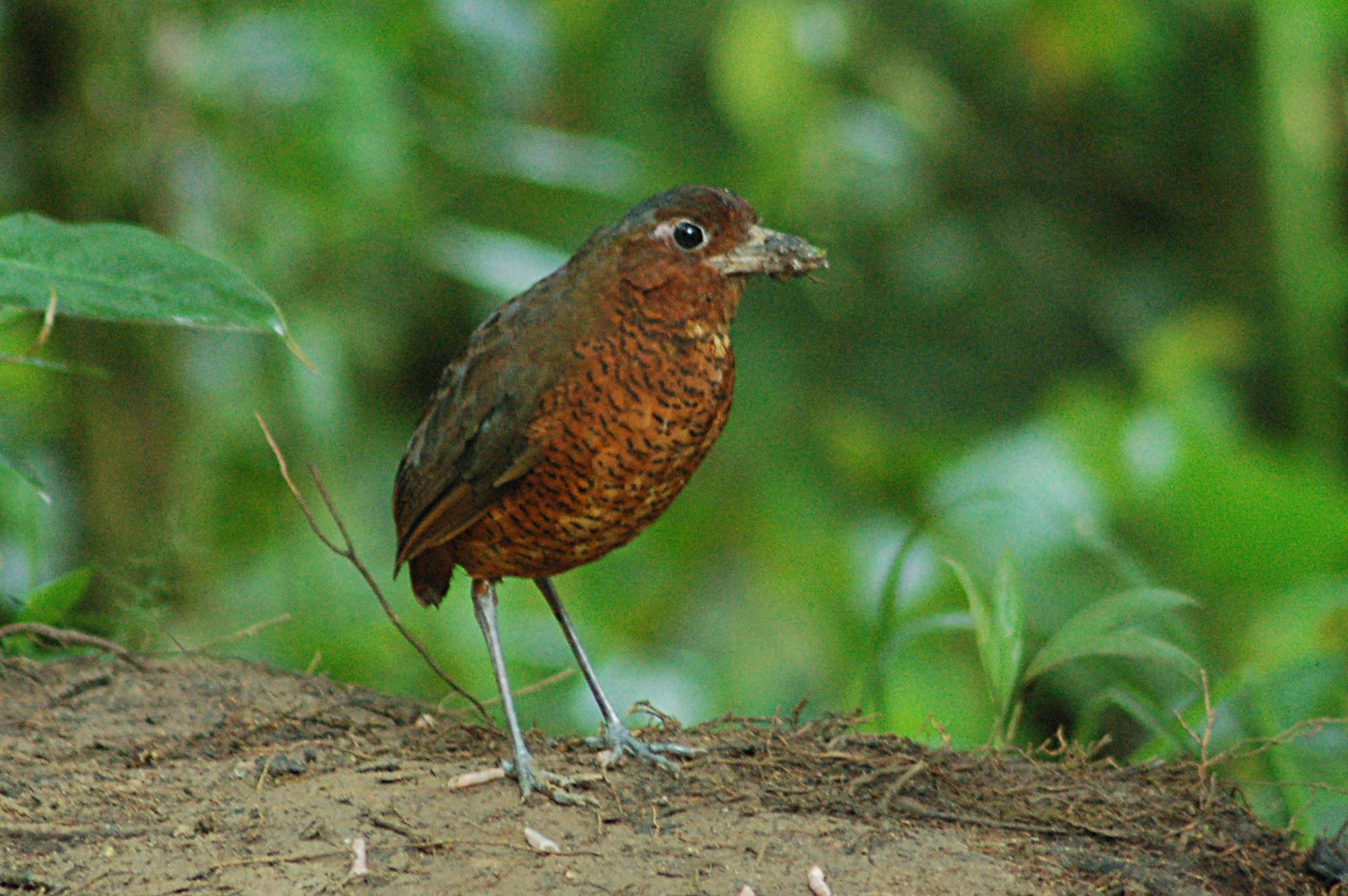
The Giant Antpitta is the largest antpitta and lives in wet montane forest in Colombia and Ecuador. It feeds largely on large earthworms. In a reserve near Mindo in north-western Ecuador, a few birds have come to offered worms since the 2000s.
Voice
The song is a long, even trill of hollow notes, lasting several seconds and growing slightly louder, hu-hu-hu-hu-hu-hu…. It sings mainly in the early morning; the sound carries far through the forest.
Recording: Francisco Sornoza — CC BY-NC-SA 4.0 · xeno-canto
Identification
24–26 cm, large, heavy and almost tailless on long, strong legs, with a heavy bill. The crown and nape are grey, the upperparts olive-brown. The lores and sides of the head are rufous. The underparts are deep rufous with narrow wavy black bars, strongest on breast and flanks. The sexes are alike.
Confusion species
Undulated Antpitta Grallaria squamigera is smaller, with ochre underparts scalloped with black, a white throat and a black malar stripe; it usually lives higher. Moustached Antpitta Grallaria alleni is much smaller, with a white moustachial stripe and unbarred underparts. Scaled Antpitta Grallaria guatimalensis is smaller, with black-scaled upperparts and a white patch on the lower throat.
Habitat
Wet montane and cloud forest, often in ravines and on steep slopes with a dense understorey, also in old secondary forest and along forest edges. In north-western Ecuador mainly between about 1400 and 2300 m, in Colombia and on the eastern slope higher, up to about 3000 m. It eats mainly large earthworms, and also other invertebrates. Little is known about its breeding.
Where the bird is most at home, classified by the vegetation units of the Andes and the west coast.


Range and movements
In Colombia very locally: in the Central Andes in Huila and Cauca, and in the south-west in Nariño. In Ecuador on the western slope in Pichincha and Imbabura, and very locally on the eastern slope in Napo. Absent from Peru, Bolivia and the Galápagos, and not found outside the guide area.
- Resident
- dark = core range, pale = thinly spread
How and when to look
In a reserve near Mindo in Pichincha, a few birds are lured with earthworms to a fixed spot in the early morning, where they can be seen at close range. Elsewhere the species stays in cover and is mainly identified by its trill.
Conservation status
Vulnerable. The population is small and fragmented, and the montane forest it inhabits is being cleared for pasture and farming. Some of its sites lie in protected areas and private reserves.
Scientific name
Grallaria gigantea | Lawrence, 1866
Lawrence described the species in 1866 and placed it straight away in the genus where it still stands. The genus Grallaria was introduced in 1816 by Vieillot. The genus name comes from New Latin grallarius, 'stilt-walker', referring to the long legs. The species name comes from Latin giganteus, 'gigantic'. The specimen the first description was based on came from Ecuador.