All species › Passerines › Antpittas › Moustached Antpitta
Moustached Antpitta | Grallaria alleni
Allens mierpitta | Tororoí bigotudo | Tovacuçu-bigodudo
The Moustached Antpitta is an antpitta of humid montane forest in Colombia and Ecuador, recognised by its broad white moustachial stripe. It lives hidden on the forest floor and was for a long time known from very few sites. The scientific name honours the American zoologist Joel Asaph Allen.
Voice
A series of hollow, whistled notes that rises in pitch and volume and then fades quickly, lasting a few seconds; shorter and faster than the series of Scaled Antpitta. Heard mainly at dawn.
Recording: Brian Cox — CC BY-NC-SA 4.0 · xeno-canto
Identification
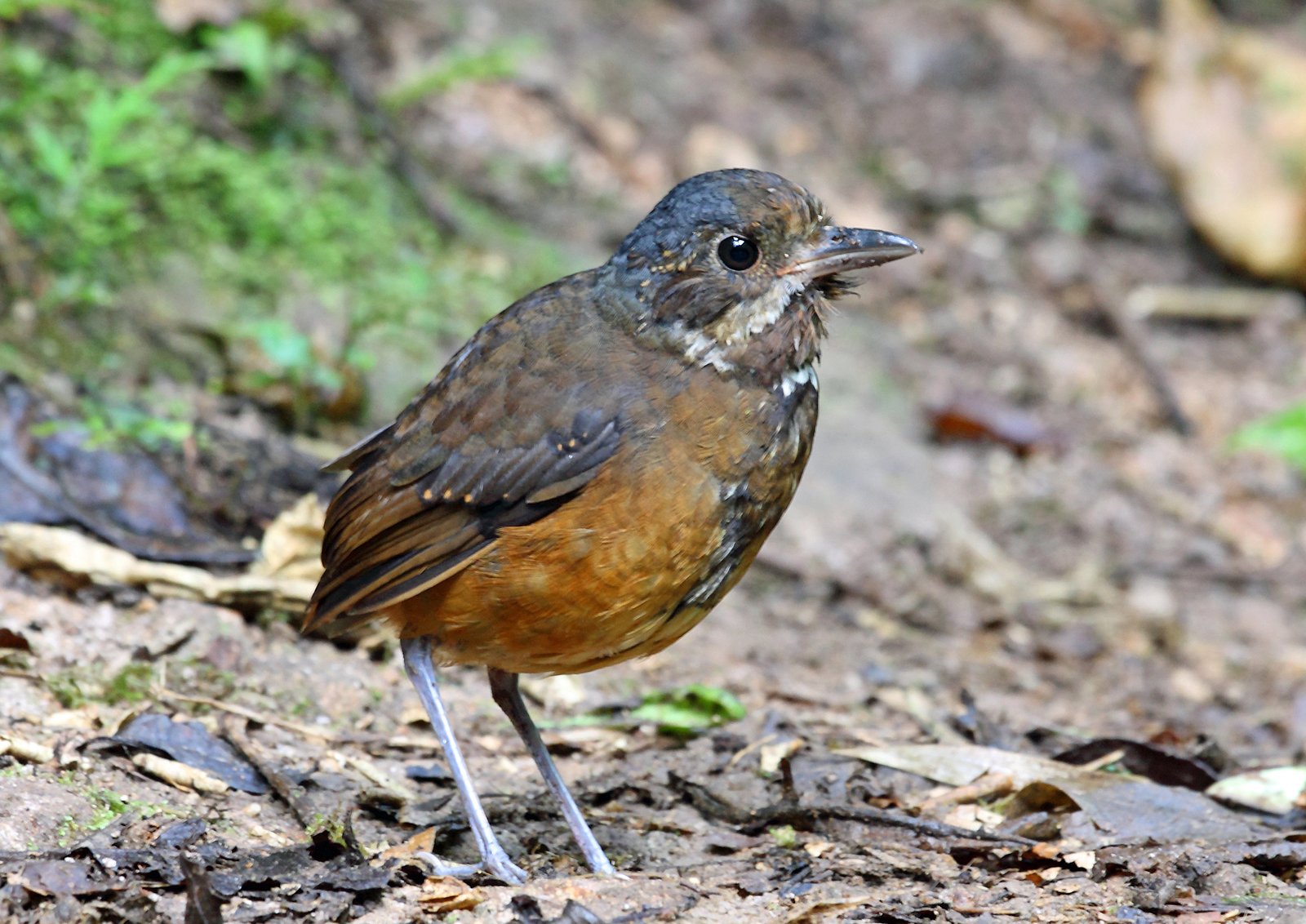
16–18 cm, round and short-tailed, on long grey legs. The crown and nape are slate-grey, the back and wings olive-brown. The broad white moustachial stripe below a dark cheek stripe stands out; the throat is dark brown, with a narrow white crescent below it. The breast and belly are warm brown to ochre-brown, the breast faintly scalloped darker and the centre of the belly paler. The sexes are alike.
Confusion species
Scaled Antpitta Grallaria guatimalensis is slightly larger, with a black-scalloped crown and back and a less contrasting, ochre moustachial stripe. Plain-backed Antpitta Grallaria haplonota lacks the grey crown, has a plain olive-brown head and ochre-yellow underparts, and usually lives lower. Undulated Antpitta Grallaria squamigera is much larger, with ochre-yellow, heavily barred underparts.
Habitat
Humid montane forest and cloud forest with dense undergrowth, often in steep ravines and along streams, also in old secondary forest, at roughly 1800 to 2500 m. It lives on or just above the forest floor and feeds on insects and earthworms. The nest is low in dense vegetation.
Where the bird is most at home, classified by the vegetation units of the Andes and the west coast.


Range and movements
In Colombia locally in the Central Andes and on the eastern slope of the Eastern Andes in the south. In Ecuador on the western slope in the north and at a few sites on the eastern slope. Absent from Peru, Bolivia and the Galápagos. Does not occur outside the guide area.
- Resident
- dark = core range, pale = thinly spread
How and when to look
Listen at dawn in steep, forested ravines at middle elevations. In north-western Ecuador, for example at Paz de las Aves near Mindo, birds come to feeding stations with earthworms.
Conservation status
Vulnerable. The population is small and fragmented; the main threat is clearance of montane forest for agriculture and cattle.
Scientific name
Grallaria alleni | Chapman, 1912
Chapman described the species in 1912 and placed it straight away in the genus where it still stands. The genus Grallaria was introduced in 1816 by Vieillot. The genus name comes from New Latin grallarius, 'stilt-walker', referring to the long legs. The species name honours Arthur A. Allen (1885–1964), American ornithologist who collected the type in 1911 and later founded the Cornell Lab of Ornithology. The specimen the first description was based on came from Salento, Quindío, Colombia.