All species › Passerines › Tyrant flycatchers and allies › Amazonian Black Tyrant
Amazonian Black Tyrant | Knipolegus poecilocercus
Amazonemoortiran | Viudita amazónica | Pretinho-do-igapó
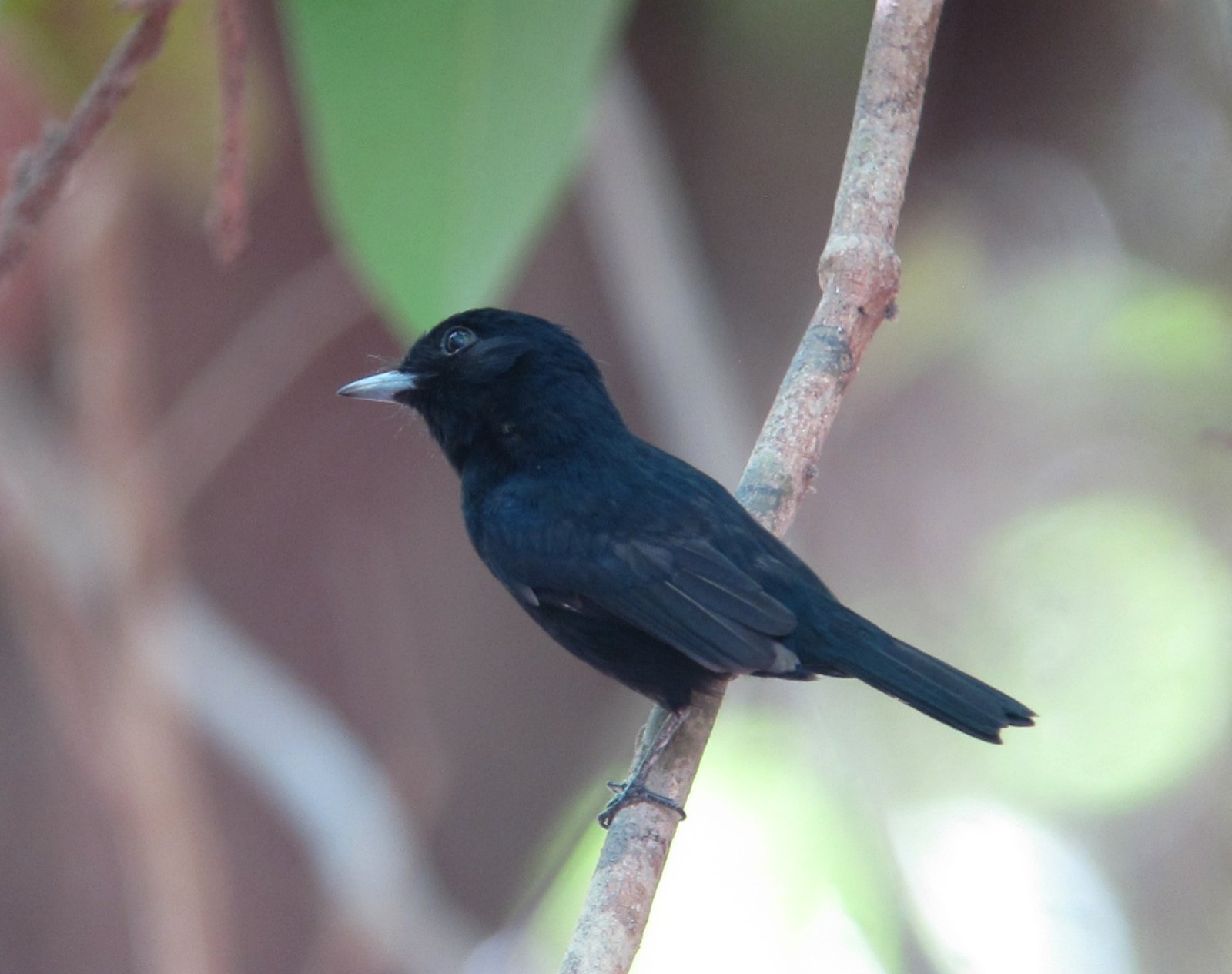
The Amazonian Black Tyrant is a small black tyrant of flooded forest along blackwater rivers and lakes in Amazonia. The male is entirely glossy black, the female brown with rufous accents. It keeps low in the undergrowth over the water and therefore often goes unnoticed.
Voice
Not very vocal. A soft, short tik and a thin, high squeak; the male makes short display flights above the undergrowth, with a clicking sound.
Recording: JAYRSON ARAUJO DE OLIVEIRA — CC BY-NC-SA 4.0 · xeno-canto
Identification
12.5 cm, with a short, thin bill and a fairly long tail. The male is entirely black with a bluish gloss and a blue-grey bill. The female is olive-brown above, with two pale wing bars, a rufous rump and rufous inner webs to the tail feathers; the underparts are pale brown with faint streaking on the breast. Young birds resemble the female.
Confusion species
Riverside Tyrant Knipolegus orenocensis is larger, the male duller greyish black, and lives in young scrub on river islands and sandbars. The female Rufous-tailed Tyrant Knipolegus poecilurus has a greyer head, a red iris and more rufous in the tail, and lives at montane forest edges on the Andean slopes. Long-tailed Tyrant Colonia colonus has a white crown and very long central tail feathers.
Habitat
The undergrowth and edges of seasonally flooded forest (especially blackwater igapó), shrubs along the shores of lakes and streams and the edges of palm swamps, in the lowlands up to about 300 m. It perches low on thin twigs and catches insects with short sallies, often just above the water. The nest is a small cup in a shrub or among roots.
Where the bird is most at home, classified by the vegetation units of the Andes and the west coast.


Range and movements
Colombia: locally in Amazonia in the south-east. Ecuador: very locally in the north-eastern lowlands. Peru: in the north-east, mainly along the rivers of Loreto. Bolivia: at most a few records in the north. Outside the guide area in southern Venezuela, Guyana and Brazilian Amazonia.
- Resident
- dark = core range, pale = thinly spread
How and when to look
Travel slowly by boat along the edges of blackwater lakes and flooded forest, for example in north-eastern Peru, and look for a small black or brown bird perched on a twig low over the water.
Conservation status
Least Concern. Its riverine and lakeside habitat in western Amazonia is still largely intact.
Scientific name
Knipolegus poecilocercus | (Pelzeln, 1868)
Pelzeln described the species in 1868 as Empidochanes poecilocercus; because it was later moved to another genus, the author and year stand in brackets. The genus Knipolegus was introduced in 1826 by Boie. The genus name comes from Greek knips, 'insect', and legō, 'to pick', for its way of foraging. The species name comes from Greek poikilos, 'variegated', and kerkos, 'tail'. The specimen the first description was based on came from Rio Amajaú (Rio Negro), Brazil.