All species › Passerines › Tyrant flycatchers and allies › Rufous-tailed Tyrant
Rufous-tailed Tyrant | Knipolegus poecilurus
Roodstaartmoortiran | Viudita colirrufa | Maria-preta-de-cauda-ruiva
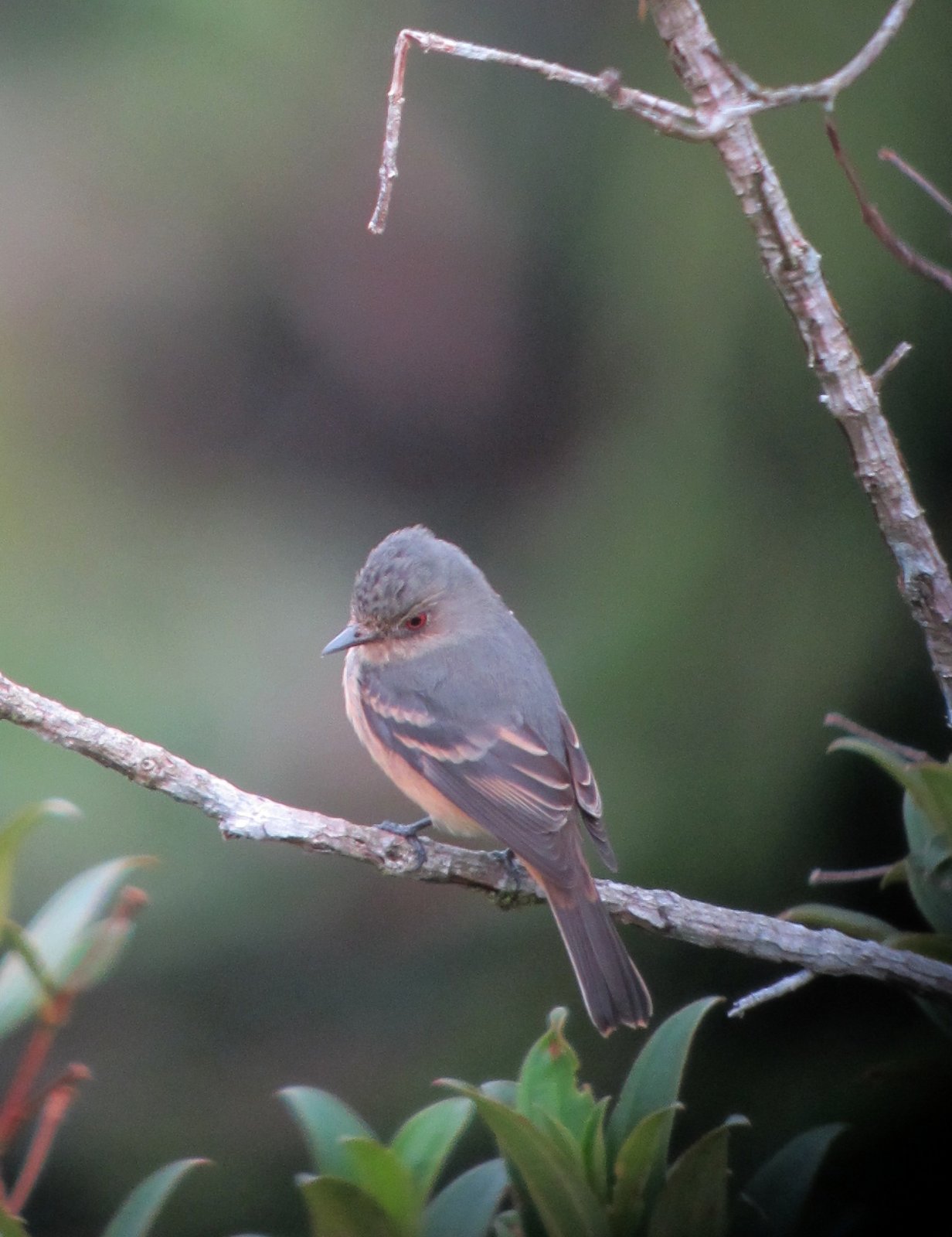
The Rufous-tailed Tyrant is a small, plain tyrant of forest edges and shrubby clearings on the slopes of the Andes. Unlike its black relatives, both sexes are greyish brown. It is marked by its red eyes and the rufous in the tail, which is visible mainly from below and in flight.
Voice
Mostly silent. It gives a thin, high tseep and a soft, repeated ticking.
Recording: Andrew Spencer — CC BY-NC-SA 3.0 · xeno-canto
Identification
13–14 cm. The upperparts are greyish brown, the crown slightly greyer. The wings are dark with two pale wing bars and pale edges to the secondaries. The throat is pale grey, the breast grey, and the belly pale yellow to buff. The tail feathers are dark with rufous inner webs, so that the tail looks largely rufous from below. The eye is red. The sexes are alike.
Confusion species
Cinnamon Flycatcher Pyrrhomyias cinnamomeus is smaller, with cinnamon underparts and rufous wing bars, and often perches in small groups along forest edges. Jelski's Black Tyrant Knipolegus signatus and Plumbeous Tyrant Knipolegus cabanisi have dark males; the females are browner and lack the rufous in the tail. Smoke-colored Pewee Contopus fumigatus is larger, uniformly dark grey and perches high on a bare branch.
Habitat
Edges of cloud forest and montane forest, shrubby clearings, road verges and young regrowth on the slopes of the Andes, roughly between 1200 and 2800 m. It perches low to mid-height in shrubs and sallies after insects, often close to the ground. The nest is a cup of moss and fibres in a shrub or against a bank.
Where the bird is most at home, classified by the vegetation units of the Andes and the west coast.


Range and movements
Colombia: locally in the Andes, mainly in the Eastern Andes and on the east slope. Ecuador: on the east slope of the Andes. Peru: on the east slope of the Andes from north to south. Bolivia: on the east slope of the Andes in La Paz, Cochabamba and Santa Cruz. Absent from the Galápagos. Outside the guide area in the mountains of Venezuela and on the tepuis of Guyana and northern Brazil.
- Resident
- dark = core range, pale = thinly spread
How and when to look
Walk along roads through montane forest on the east slope of the Andes and look in shrubby edges and clearings for a greyish-brown tyrant perching low; watch for the red eyes and the rufous in the tail when it flies up.
Conservation status
Least Concern. The species benefits locally from forest edges and regrowth, but is tied to montane forest as a whole.
Scientific name
Knipolegus poecilurus | (Sclater, 1862)
Sclater described the species in 1862 as Empidochanes poecilurus; because it was later moved to another genus, the author and year stand in brackets. The genus Knipolegus was introduced in 1826 by Boie. The genus name comes from Greek knips, 'insect', and legō, 'to pick', for its way of foraging. The species name comes from Greek poikilos, 'variegated', and oura, 'tail'. The specimen the first description was based on came from Bogotá, Colombia.