All species › Passerines › Tyrant flycatchers and allies › Riverside Tyrant
Riverside Tyrant | Knipolegus orenocensis
Riviermoortiran | Viudita ribereña | Maria-preta-ribeirinha
The Riverside Tyrant is a tyrant of young growth on river islands and sandbars along the large rivers of the Amazon and Orinoco basins. It lives only in the early stages of riverside vegetation, such as young Cecropia, willows and cane. In the guide area the Amazonian subspecies sclateri occurs, in which the female differs strongly from the male.
Voice
A series of musical notes ending in a gravelly, hiccup-like note; the call is a soft, liquid whistle. In display the male makes short flights with audible wing-beats.
Recording: GABRIEL LEITE — CC BY-NC-SA 4.0 · xeno-canto
Identification
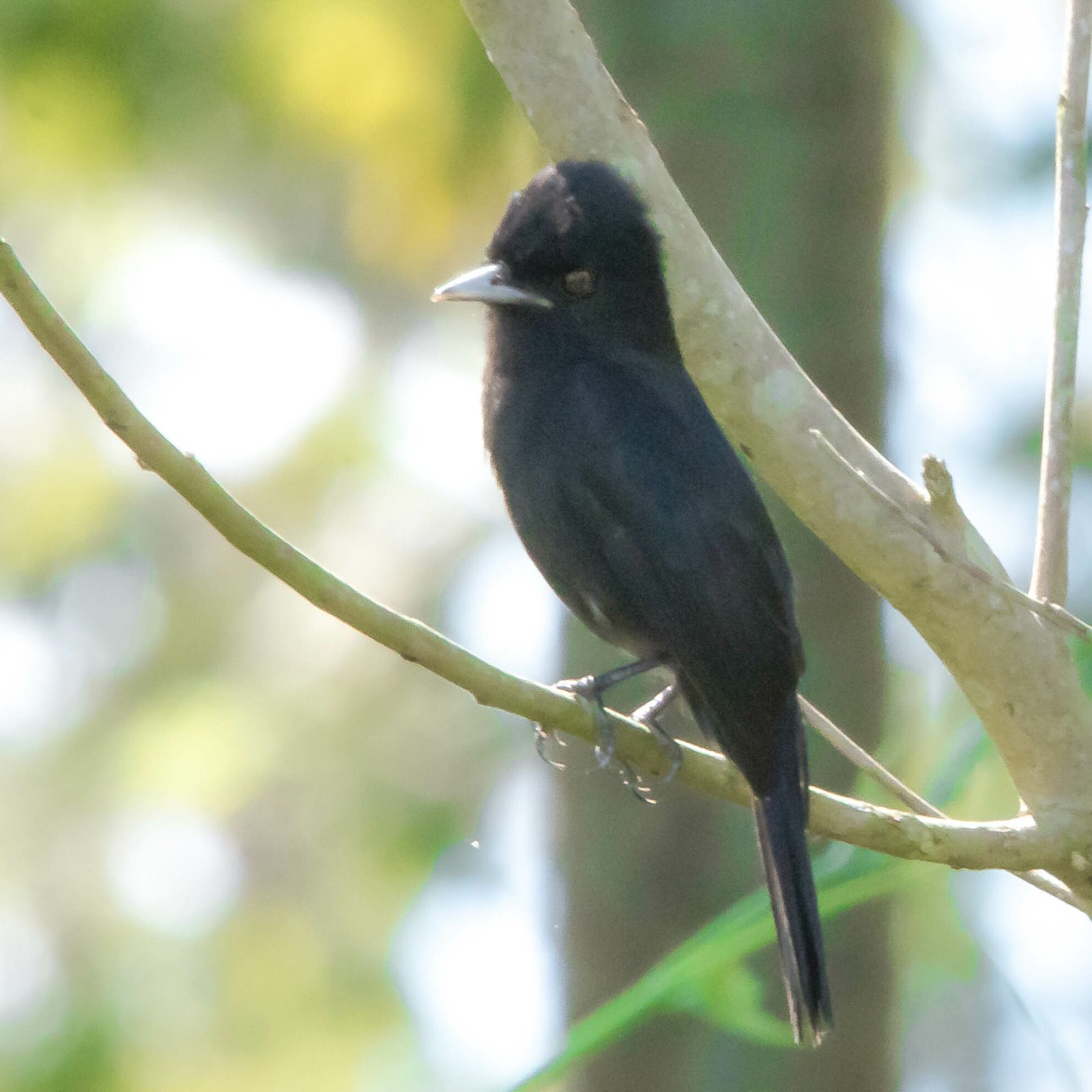
15 cm, slender, with a small crest and a fairly long tail. The male of sclateri is entirely blackish slate to black, darkest on the head; the male of the nominate form in eastern Colombia is slightly paler slate grey. The female of sclateri is sooty grey above and whitish below, with heavy dark streaks on the breast and flanks; the female of the nominate form is slate grey with an olive tinge. The bill is greyish.
Confusion species
Amazonian Black Tyrant Knipolegus poecilocercus is smaller, the male glossy blue-black, the female brown with a rufous rump and tail edges, and it lives in the understorey of várzea and igapó, not on open river islands. Drab Water Tyrant Ochthornis littoralis is sandy brown and perches low on logs and banks at the water's edge. White-winged Black Tyrant Knipolegus aterrimus has white wing patches and lives higher in the Andes.
Habitat
Young scrub and early growth on river islands, sandbars and banks of large, silt-laden rivers, with young Cecropia, willows, cane and tall grass, up to about 300 m. It perches low to mid-height in shrubs and sallies after insects. The nest is a cup of plant material in a shrub.
Where the bird is most at home, classified by the vegetation units of the Andes and the west coast.


Range and movements
Colombia: locally in the north-east (Meta, Orinoco region) and in the far south-east along the Amazon. Ecuador: rare and local in the north-east along the Napo. Peru: in the north-east and east along the Amazon, Marañón, Ucayali and their tributaries. Absent from Bolivia and the Galápagos. Outside the guide area along the Orinoco in Venezuela and along the Amazon and its tributaries in Brazil.
- Resident
- dark = core range, pale = thinly spread
How and when to look
Search river islands with young Cecropia and willow growth, for example near Iquitos, for dark birds perching low in the scrub; the islands are best reached by boat.
Conservation status
Not Evaluated in this treatment. The forms treated elsewhere as separate species are assessed as Least Concern. The species depends on river islands that are constantly reshaped by floods.
Scientific name
Knipolegus orenocensis | Berlepsch, 1884
Berlepsch described the species in 1884 and placed it straight away in the genus where it still stands. The genus Knipolegus was introduced in 1826 by Boie. The genus name comes from Greek knips, 'insect', and legō, 'to pick', for its way of foraging. The species name refers to the Orinoco, not necessarily the type locality. The specimen the first description was based on came from Ciudad Bolívar, Venezuela.