All species › Passerines › Tyrant flycatchers and allies › Amazonian Inezia
Amazonian Inezia | Inezia subflava
Bruinkopinezia | Piojito pantanero | Amarelinho
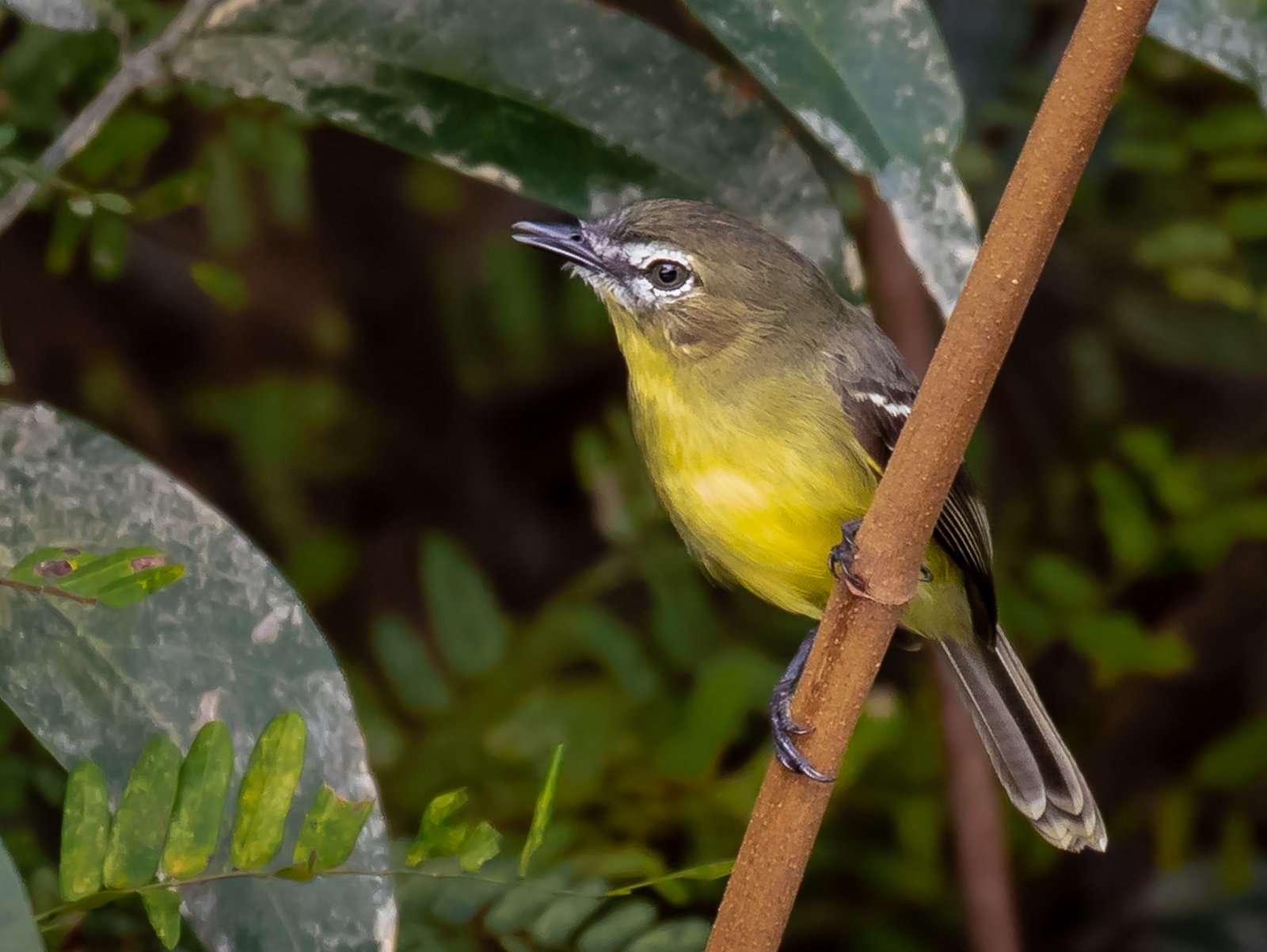
The Amazonian Inezia is a small, yellow tyrant with a white supercilium that almost always lives near water, in shrubby growth along rivers, swamp forest and várzea in Amazonia. Within the guide area it occurs only very locally, in eastern Colombia and the far north of Bolivia. Pairs often sing in duet.
Voice
The male's song is a clear double note, repeated several times; the female answers with a rattled double or triple note, forming a duet. Also a short staccato call and, rarely, a series of nasal, downslurred notes. It sings mainly around dawn.
Recording: JAYRSON ARAUJO DE OLIVEIRA — CC BY-NC-SA 4.0 · xeno-canto
Identification
11–12 cm, with a thin black bill. The crown is olive, browner in the Rio Negro form. There is a broad white supercilium, a dark eyeline and a thin, broken white eye-ring. The wings are dusky, with white edges and two white wing bars. The chin is whitish, the underparts pale to bright yellow, with a dusky wash on the breast sides. The iris is pale greyish olive. The sexes are alike.
Confusion species
Pale-tipped Inezia Inezia caudata is very similar, but has paler tail tips and lives farther north, in the Llanos and along the Orinoco. Plain Inezia Inezia inornata is smaller and greyer, with greyish-white underparts. Lesser Wagtail-Tyrant Stigmatura napensis has a long, white-tipped tail and a white wing patch. Yellow Tyrannulet Capsiempis flaveola has a yellow instead of a white supercilium.
Habitat
Shrubby growth along rivers, streams and lakes, swamp forest and várzea, from sea level to about 200 m. It searches for small insects among leaves and twigs in shrubs and low trees, usually in pairs. Little is known about the nest.
Where the bird is most at home, classified by the vegetation units of the Andes and the west coast.


Range and movements
Colombia: very local in Guainía and Vaupés. Bolivia: only in the far north, on the border with Brazil. Absent from Ecuador, Peru and the Galápagos. Outside the guide area in southern Venezuela and over much of Brazilian Amazonia.
- Resident
- dark = core range, pale = thinly spread
How and when to look
Search shrubby growth along blackwater rivers in Guainía, such as around Inírida, and listen for the duet early in the morning.
Conservation status
Least Concern. The species is widespread in Brazilian Amazonia; in the guide area it is rare and local.
Scientific name
Inezia subflava | (Sclater & Salvin, 1873)
Sclater & Salvin described the species in 1873 as Serphophaga subflava; because it was later moved to another genus, the author and year stand in brackets. The genus Inezia was introduced in 1909 by Cherrie. The genus name honours Enriqueta Inez Cherrie (1898–1943), daughter of the American ornithologist George K. Cherrie, who described the genus in 1909; she was born in the region where he found these birds. The species name comes from Latin subflavus, 'yellowish'. The specimen the first description was based on came from Belém, Pará, Brazil.