All species › Passerines › Tyrant flycatchers and allies › Pale-tipped Inezia
Pale-tipped Inezia | Inezia caudata
Salvins inezia | Piojito coludo | Amarelinho-de-ponta-clara
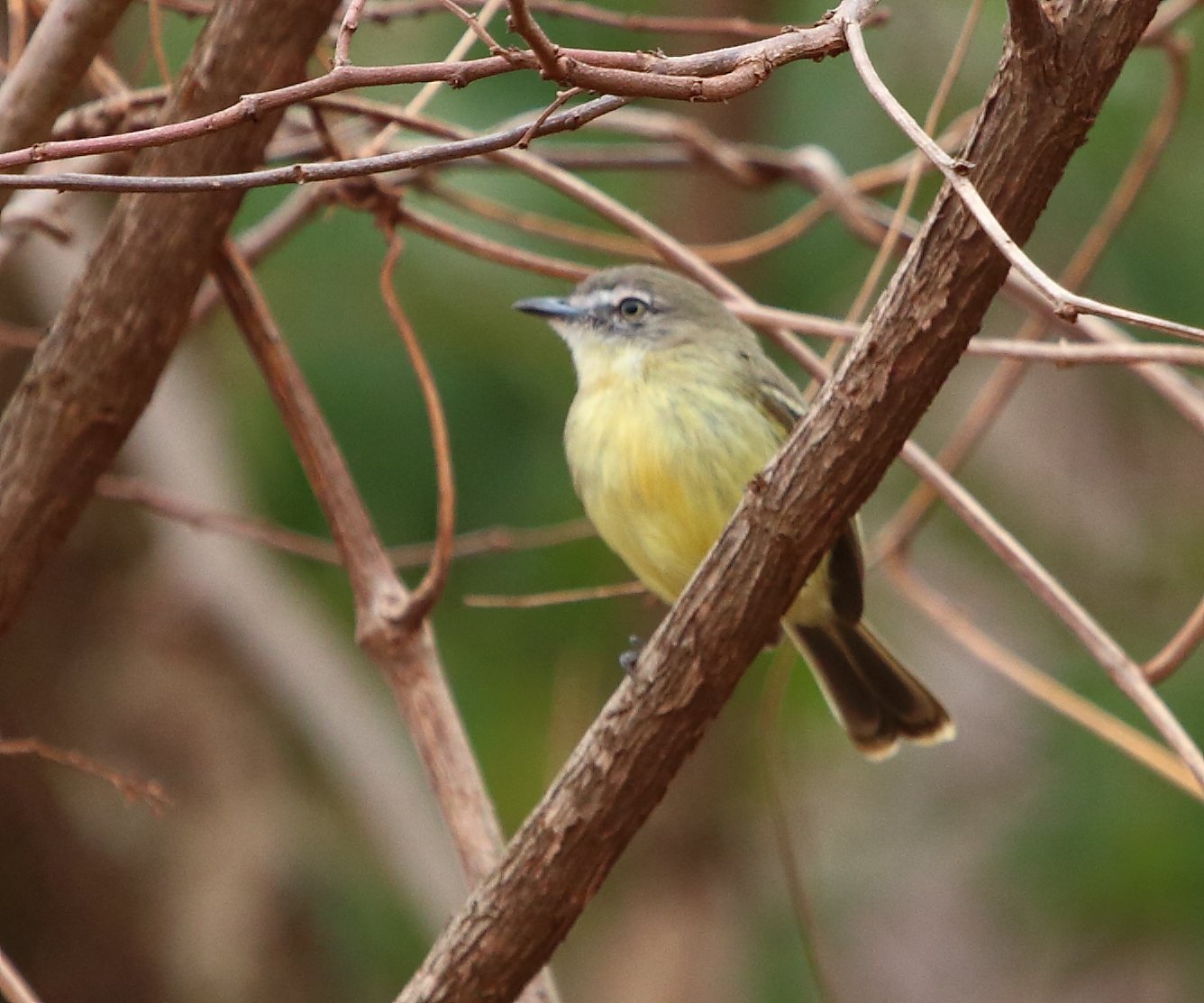
The Pale-tipped Inezia is a small, greyish-olive tyrannulet of forest edges, gallery forest and mangroves in northern South America. Within the guide area it lives only in Colombia. The pale tips to the outer tail feathers and the white lores are the main features.
Voice
A rapid series of clear, slightly descending whistles, often accelerating towards the end, and short, dry calls.
Recording: Paul Lenrumé — CC BY-NC-SA 4.0 · xeno-canto
Identification
11 cm, with a thin, dark bill and a rather long tail. The crown and upperparts are greyish olive-brown, the crown slightly greyer. A white supraloral stripe and a narrow white eye-ring stand out in the grey face. The wings are dark, with two whitish wing bars. The underparts are pale yellow, with a greyish wash on the breast. The outer tail feathers have pale tips, best seen when the bird spreads its tail. The sexes are alike.
Confusion species
Slender-billed Inezia Inezia tenuirostris is smaller, with a thinner bill, and is whiter below; it lives in dry thorn scrub on the Guajira. Amazonian Inezia Inezia subflava is yellower below and lives mainly along rivers and in flooded forest in the Amazon and Orinoco basins. Southern Beardless Tyrannulet Camptostoma obsoletum is smaller, with a ragged crest and a shorter, thicker bill.
Habitat
Dry and semi-humid forest, gallery forest, forest edges, scrub and mangroves in the lowlands, mostly below 500 m. It searches for small insects among leaves in the middle and upper levels of trees and shrubs, alone, in pairs or in mixed flocks. The nest is a small cup in a fork of branches.
Where the bird is most at home, classified by the vegetation units of the Andes and the west coast.


Range and movements
Colombia: in the north, mainly in the Caribbean lowlands and the Magdalena valley, and locally in the llanos of the east. Absent from Ecuador, Peru, Bolivia and the Galápagos. Outside the guide area in Venezuela, the Guianas and the extreme north of Brazil.
- Resident
- dark = core range, pale = thinly spread
How and when to look
Search forest edges and gallery forest in the Caribbean lowlands, for example around Santa Marta and in the Magdalena valley, and listen for the series of descending whistles.
Conservation status
Least Concern. The species also occurs in secondary forest and in scrub along fields.
Scientific name
Inezia caudata | (Salvin, 1897)
Salvin described the species in 1897 as Capsiempis caudata; because it was later moved to another genus, the author and year stand in brackets. The genus Inezia was introduced in 1909 by Cherrie. The genus name honours Enriqueta Inez Cherrie (1898–1943), daughter of the American ornithologist George K. Cherrie, who described the genus in 1909; she was born in the region where he found these birds. The species name comes from Latin caudatus, 'tailed'. The specimen the first description was based on came from Ourumee, Guyana.