All species › Owls › Owls › Amazonian Pygmy Owl
Amazonian Pygmy Owl | Glaucidium hardyi
Hardy's dwerguil | Mochuelo amazónico | Caburé-da-amazônia
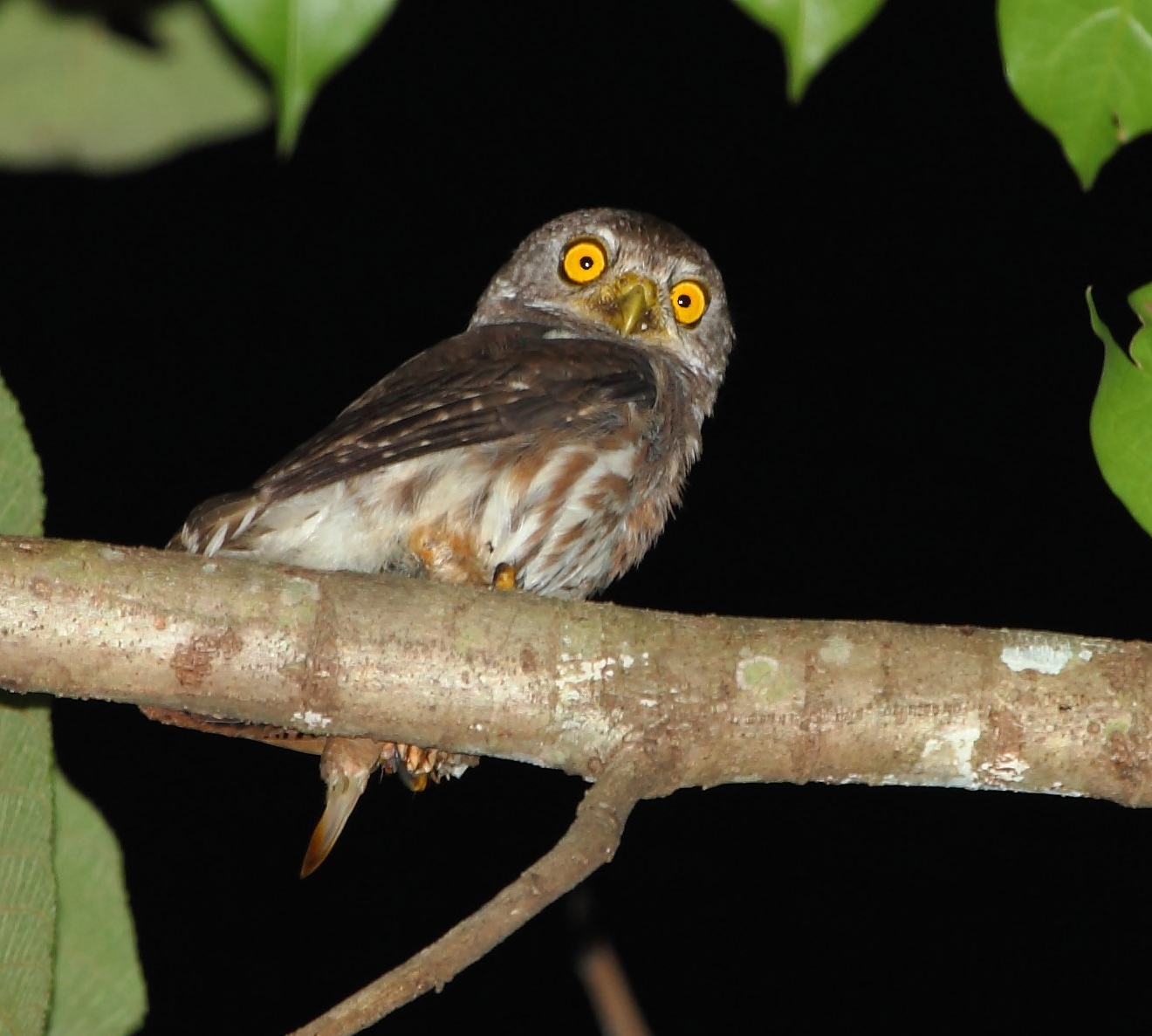
The Amazonian Pygmy Owl is the pygmy owl of the Amazonian forest canopy. The species was described only in 1989, partly on the basis of its song, and is named after the American bioacoustician John William Hardy. It lives high in the crowns and rarely comes low in the forest.
Voice
A rapid, trill-like series of ten to fifty short notes, pupupupupu, much faster than that of Ferruginous Pygmy Owl. It sings mainly at dawn and dusk.
Recording: JAYRSON ARAUJO DE OLIVEIRA — CC BY-NC-SA 4.0 · xeno-canto
Identification
14–15 cm, with a round, greyish-brown head with fine pale dots, yellow eyes and white eyebrows. The back is plain brown to rufous-brown, with few or no spots. On the nape 'false eyes'. The tail is short and dark, with narrow white bars. The underparts are white, with rusty breast sides and rufous streaks on the flanks. The sexes are alike.
Confusion species
Ferruginous Pygmy Owl Glaucidium brasilianum is larger, has a streaked crown and a longer tail, lives in more open country and at forest edges and sings a much slower series of notes. Subtropical Pygmy Owl Glaucidium parkeri lives higher on the eastern slope, has a darker head and distinct white spots on the scapulars and wings, and sings short groups of notes. East Brazilian Pygmy Owl Glaucidium minutissimum from eastern Brazil is similar, but sings short, slower series.
Habitat
Tall terra firme forest and also várzea, mainly in the canopy and upper layers, from the lowlands to about 1000 m in the foothills. It hunts large insects and small birds. It nests in tree cavities.
Where the bird is most at home, classified by the vegetation units of the Andes and the west coast.


Range and movements
In Colombia in the south-east, in the Amazon region. In Ecuador in the eastern lowlands. In Peru throughout the eastern lowlands. In Bolivia in the northern and central lowlands. Absent from the Galápagos. Outside the guide area in the Amazon region of Brazil and Venezuela and in the Guianas.
- Resident
- dark = core range, pale = thinly spread
How and when to look
At dawn, listen from a canopy tower or a clearing for the rapid trill from the canopy. From a tower you look into the crowns, where it usually stays.
Conservation status
Least Concern. Deforestation in the Amazon region affects the species locally.
Scientific name
Glaucidium hardyi | Vielliard, 1989
Vielliard described the species in 1989 and placed it straight away in the genus where it still stands. The genus Glaucidium was introduced in 1826 by Boie. The genus name comes from Greek glaukidion, 'owlet', a diminutive of glaux, 'owl'; Friedrich Boie introduced it in 1826. The species name honours John William Hardy (1930–2012), an American ornithologist and founder of the Bioacoustic Laboratory and Archive at the Florida Museum of Natural History. The specimen the first description was based on came from Brazil.