All species › Passerines › Tyrant flycatchers and allies › Amazonian Scrub Flycatcher
Amazonian Scrub Flycatcher | Sublegatus obscurior
Donkere vliegenpikker | Mosquero matorralero amazónico | Sertanejo-escuro
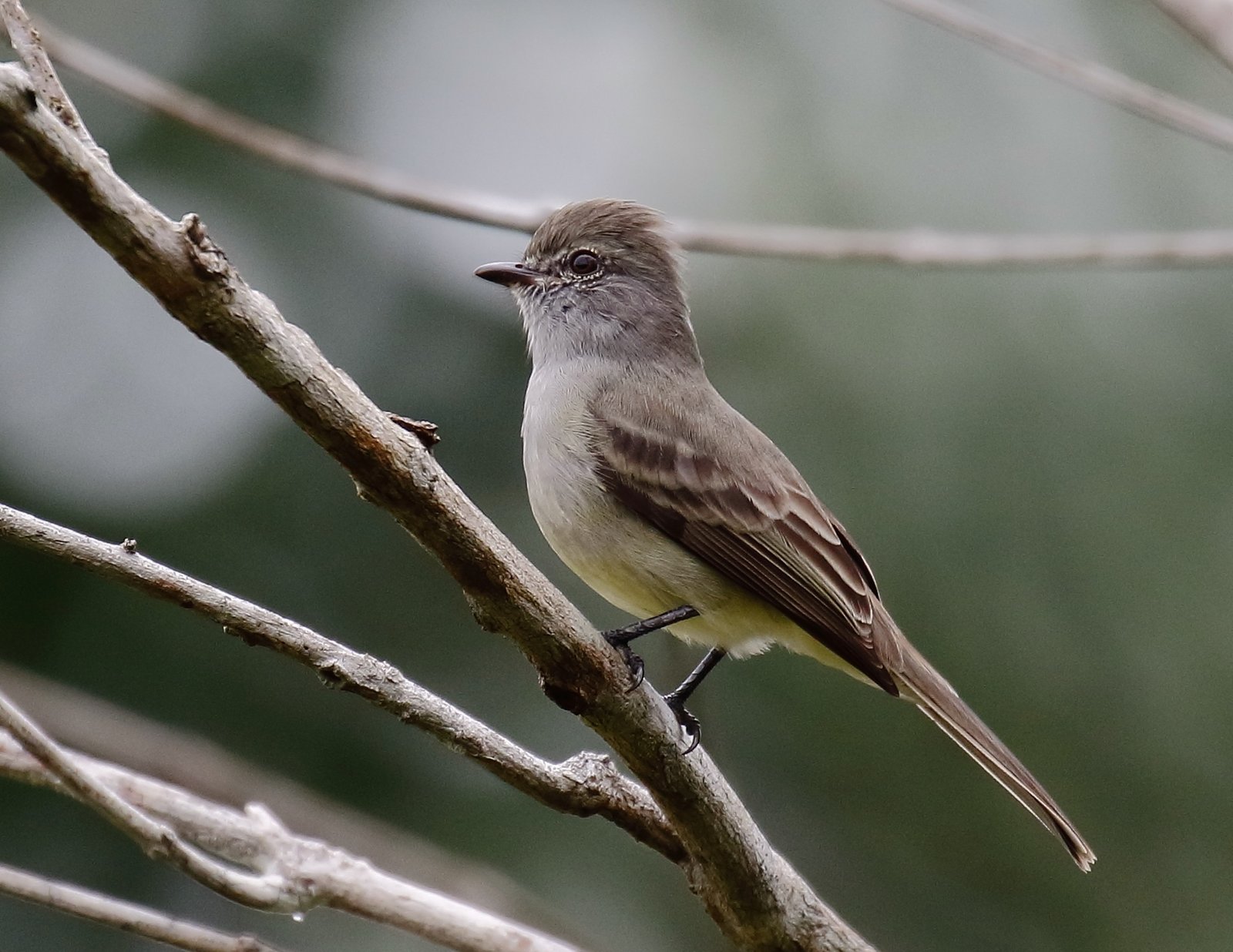
The Amazonian Scrub Flycatcher is a small, greyish-brown tyrant with a strikingly short, black bill, living in scrub and low forest edges in Amazonia. It was formerly treated as one species together with Southern and Northern Scrub Flycatchers. It often perches quietly and upright at middle height in shrubs and low trees.
Voice
A soft, plaintive whistle, wheeu or peeeu, repeated at intervals, and a short series of clear whistles at dawn. It does not call often.
Recording: Guilherme Melo — CC BY-NC-SA 4.0 · xeno-canto
Identification
14 cm. A small tyrant with a short, thick, entirely black bill. The upperparts are dark greyish-brown. A short, pale supraloral stripe runs above the lores, and the eye-ring is narrow and whitish. The wings are dark, with two dull wing-bars. Throat and breast are grey, sharply set off from the pale yellow belly. The tail is fairly long and dark. Sexes alike; juveniles are browner, with cinnamon wing-bars.
Confusion species
Southern Scrub Flycatcher Sublegatus modestus, which migrates to Amazonia in the austral winter, is paler and greyer, with a less sharp border between grey breast and yellow belly. Mouse-colored Tyrannulet Nesotriccus murinus has a longer bill with a pale base, a browner back and a dull, barely yellow belly. Small-billed Elaenia Elaenia parvirostris and other elaenias have a pale base to the lower mandible, often a white crown patch and clearer white wing-bars.
Habitat
Scrub and low forest edges along rivers, shrubby savanna and the open vegetation on white-sand soils, also untidy edges of fields and villages in the lowlands, mostly below 500 m. It hunts insects in the foliage from a sheltered perch and also eats small fruits. The nest is a shallow cup in a tree fork.
Where the bird is most at home, classified by the vegetation units of the Andes and the west coast.


Range and movements
Colombia: in the lowlands east of the Andes, mainly in the south-east. Ecuador: locally in the Amazonian lowlands. Peru: locally in the Amazonian lowlands, in the north-east and the south-east. Bolivia: locally in the northern lowlands. Absent from the Galápagos. Outside the guide area in southern Venezuela, the Guianas and Brazilian Amazonia.
- Resident
- dark = core range, pale = thinly spread
How and when to look
Search in scrub along oxbow lakes and riverbanks and in the open vegetation on sandy soils. It often sits motionless in a shrub for long periods; look for the short black bill and listen for the soft whistle.
Conservation status
Least Concern. Scattered and locally fairly common over a large range.
Scientific name
Sublegatus obscurior | Todd, 1920
Todd described the species in 1920 and placed it straight away in the genus where it still stands. The genus Sublegatus was introduced in 1868 by Sclater & Salvin. The genus name comes from Latin sub, 'somewhat, almost', and the genus Legatus (Piratic Flycatcher): 'resembling Legatus'. The species name is Latin obscurior, 'darker', as this form is darker than its relatives. The specimen the first description was based on came from Cayenne, French Guiana.