All species › Passerines › Tyrant flycatchers and allies › Southern Scrub Flycatcher
Southern Scrub Flycatcher | Sublegatus modestus
Struikvliegenpikker | Mosquero matorralero sureño | Guaracava-modesta
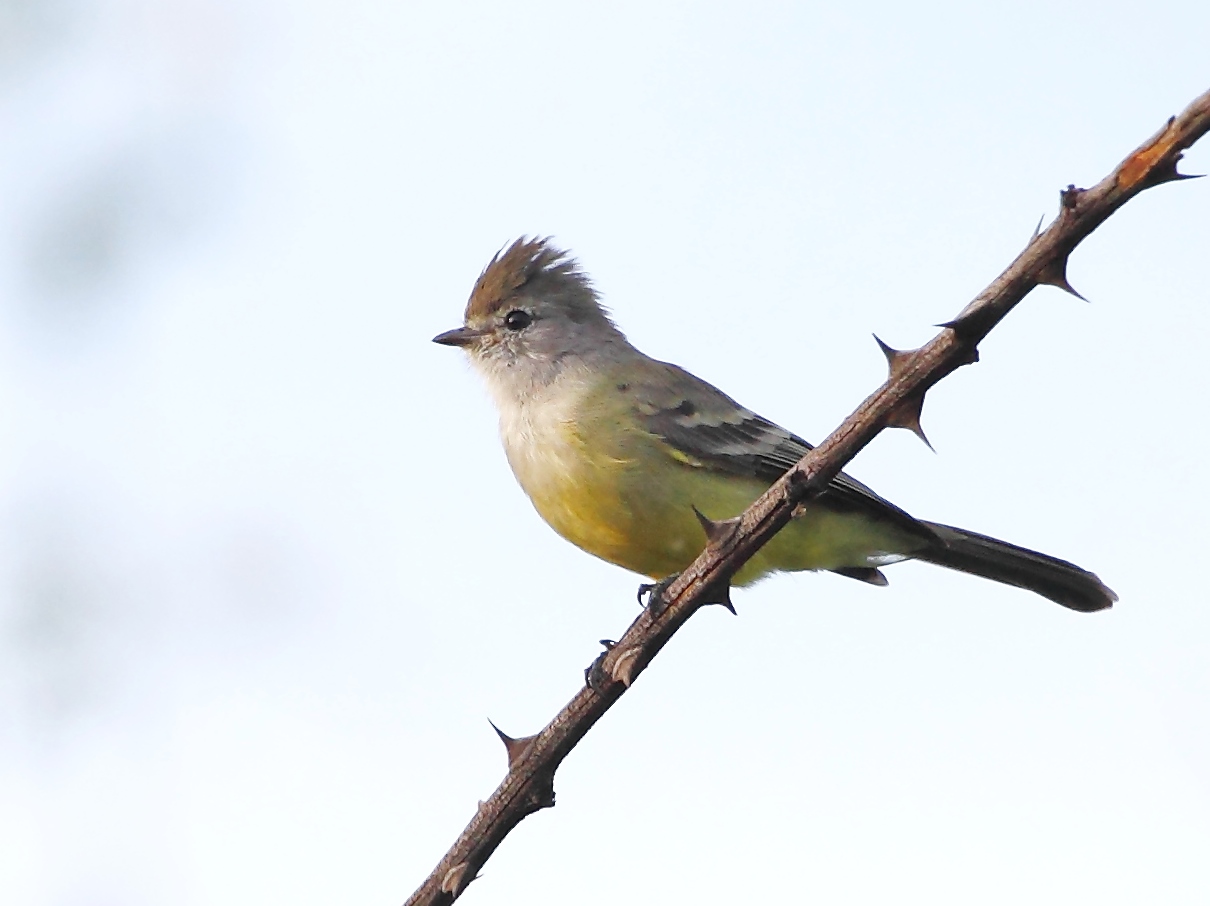
The Southern Scrub Flycatcher is a small, grey tyrant with a short, black bill from the dry woodland and scrub of southern South America. Part of the population migrates north in the austral winter, as far as Amazonia. In the guide area it breeds mainly in Bolivia.
Voice
A soft, falling whistle, peeuw, and in the breeding season a short series of clear notes. Wintering birds are mostly silent.
Recording: JAYRSON ARAUJO DE OLIVEIRA — CC BY-NC-SA 4.0 · xeno-canto
Identification
13.5 cm. A small tyrant with a short, black bill. The upperparts are greyish-brown, the head slightly greyer, with a narrow, pale supraloral stripe and a whitish eye-ring. The wings are dark, with two clear, whitish wing-bars. Throat and breast are pale grey and merge without a sharp border into the pale yellow belly. Sexes alike; juveniles are browner, with cinnamon wing-bars.
Confusion species
Amazonian Scrub Flycatcher Sublegatus obscurior of Amazonia is darker, with a sharper border between grey breast and yellow belly. Mouse-colored Tyrannulet Nesotriccus murinus has a longer bill with a pale base and dull wing-bars. Suiriri Flycatcher Suiriri suiriri is larger, with a white belly and a longer bill. Elaenias such as Small-billed Elaenia Elaenia parvirostris have a pale base to the lower mandible and often a white crown patch.
Habitat
Dry and semi-open woodland, Chaco scrub, savanna with shrubs and cerrado, also forest edges and thickets along rivers; wintering birds in scrub and forest edges of the Amazonian lowlands. Mostly below 1500 m, higher in the dry valleys of Bolivia. It hunts insects in the foliage from a perch and also eats small fruits. The nest is a shallow cup in a tree fork.
Where the bird is most at home, classified by the vegetation units of the Andes and the west coast.


Range and movements
Bolivia: breeds in the lowlands of the east and south, in the Chaco and in the dry valleys on the eastern slope of the Andes; in the austral winter also in the north of the country. Peru: austral winter visitor in the Amazonian lowlands, mainly in the south-east, roughly from April to September. Ecuador and Colombia: at most a rare winter visitor in the Amazonian lowlands; there are few data. Absent from the Galápagos. Outside the guide area it breeds in Paraguay, Uruguay, Argentina and southern and central Brazil, and winters north into Brazilian Amazonia.
- Resident
- dark = core range, pale = thinly spread
How and when to look
In the breeding season (October to March) search dry scrub and the Chaco of south-eastern Bolivia. In the austral winter wintering birds can be found in scrub along rivers in south-eastern Peru.
Conservation status
Least Concern. Widespread and fairly common.
Scientific name
Sublegatus modestus | (Wied-Neuwied, 1831)
Wied-Neuwied described the species in 1831 as M[uscipeta] modesta; because it was later moved to another genus, the author and year stand in brackets. The genus Sublegatus was introduced in 1868 by Sclater & Salvin. The genus name comes from Latin sub, 'somewhat, almost', and the genus Legatus (Piratic Flycatcher): 'resembling Legatus'. The species name is Latin modestus, 'modest, plain', after the unremarkable plumage. The specimen the first description was based on came from Camamu, Bahia, Brazil.