All species › Passerines › Tyrant flycatchers and allies › Large-headed Flatbill
Large-headed Flatbill | Ramphotrigon megacephalum
Wenkbrauwbreedbektiran | Picoplano cabezón | Maria-cabeçuda
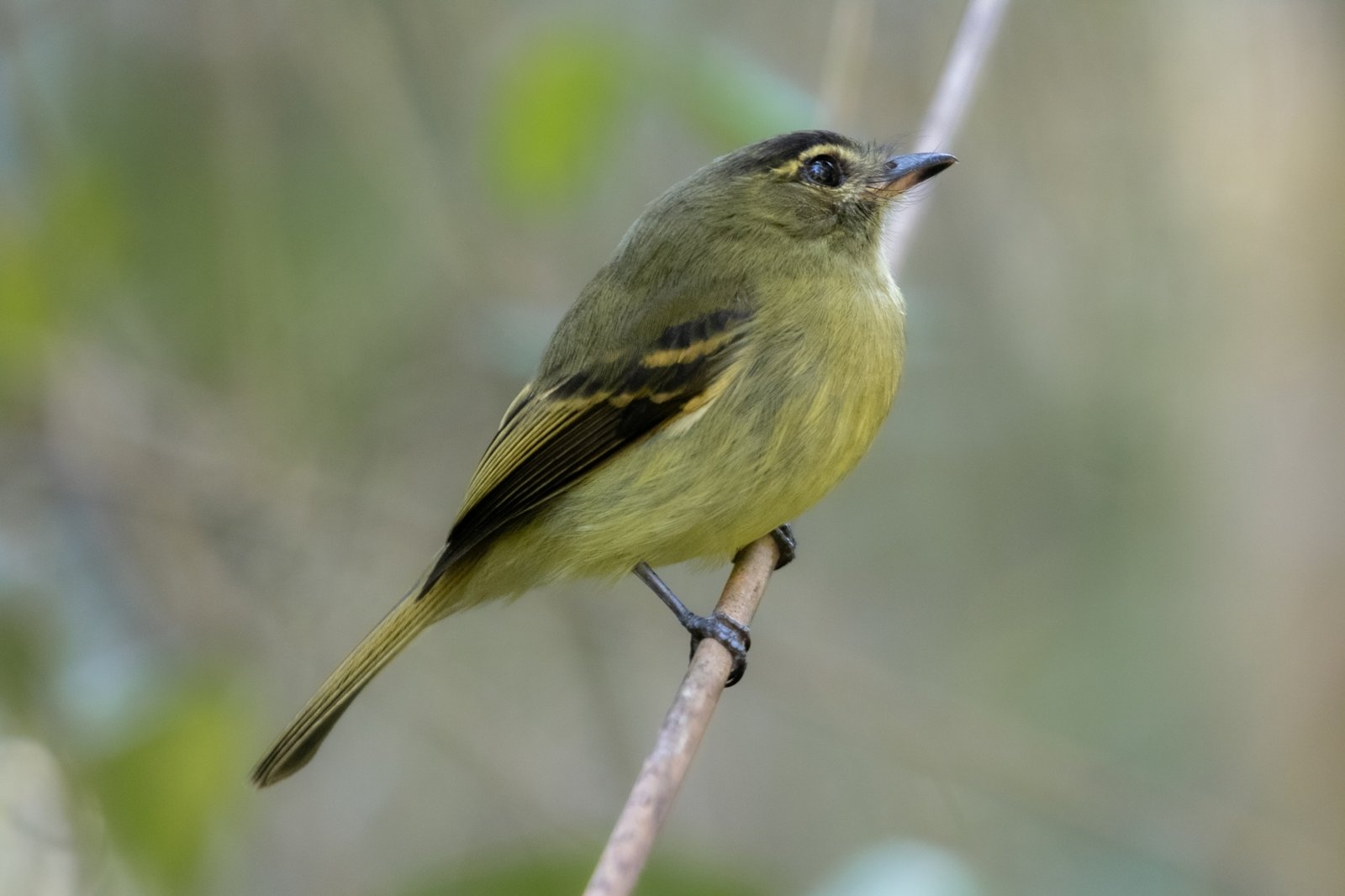
The Large-headed Flatbill is an olive tyrant with a large head, a broad, flat bill and a pale streak above the lores. It is almost always found in or near bamboo. In the guide area it lives locally in the lowlands and foothills east of the Andes; it often sits still for long periods and is mostly noticed by its call.
Voice
The dawn song is a rapid, continuous series of whistles such as tee-tu-twit or whu hu-hoowhip; the call is a soft, mournful whistled wheé-whoo, often rendered as bam-boo.
Recording: Juan Freile — CC BY-NC-SA 4.0 · xeno-canto
Identification
13 cm, with a relatively large head and a flat black bill with a dull pinkish base to the lower mandible. Crown and upperparts dark olive; lores dusky, with a whitish to yellowish streak above them and a whitish to yellowish eye-ring. Wings dark with yellow-olive edges to the flight feathers and two ochraceous wing bars; tail dark with yellow-olive edges. Throat whitish to yellowish, breast greyish-olive with faint yellow streaks, belly yellow. Iris brown. Sexes alike. The Bolivian-Peruvian subspecies bolivianum has a browner breast and a duller yellow belly.
Confusion species
Rufous-tailed Flatbill Ramphotrigon ruficauda is larger, with rufous wing edgings and tail. Dusky-tailed Flatbill Ramphotrigon fuscicauda is larger and darker, with cinnamon wing bars and a less distinct streak above the lores; it too often lives in bamboo. Yellow-margined Flatbill Tolmomyias assimilis has a greyer head, a yellow patch at the base of the primaries and a different voice.
Habitat
Bamboo (mainly Guadua) in lowland forest, including seasonally flooded várzea and igapó forest, and in the foothills; in Ecuador from 300 to 1300 m, in Peru up to about 1200 m. It perches for long periods in the understorey and middle storey and takes insects from leaves and branches after a short sally, often hovering briefly; usually alone, sometimes in mixed flocks. The nest is a bulky structure of plant material in a cavity in a tree or bamboo stem; the clutch is usually two eggs.
Where the bird is most at home, classified by the vegetation units of the Andes and the west coast.


Range and movements
Colombia: rare and local, east of the Andes. Ecuador: local east of the Andes. Peru: east of the Andes, mainly in the south-east (Ucayali to Puno). Bolivia: in the north, to Cochabamba and Santa Cruz. Absent from the Galápagos. Outside the guide area in Venezuela, the Guianas, Amazonian and south-eastern Brazil, Paraguay and Misiones in Argentina.
- Resident
- dark = core range, pale = thinly spread
How and when to look
Search bamboo forest in south-eastern Peru, for example in the Madre de Dios region, and listen for the soft, two-note call.
Conservation status
Least Concern. The range is very large, but the population is thought to be decreasing. Fairly common in Peru, uncommon and local in Ecuador, rare in Colombia; it occurs in many protected areas.
Scientific name
Ramphotrigon megacephalum | (Swainson, 1835)
Swainson described the species in 1835 as Tyrannula megacephala; because it was later moved to another genus, the author and year stand in brackets. The genus Ramphotrigon was introduced in 1855 by Gray. The genus name combines Greek rhamphos, 'bill', and trigōnon, 'triangle'. The species name comes from Greek megas, 'large', and kephalē, 'head': 'large-headed'. The specimen the first description was based on came from São Paulo, Brazil.