All species › Passerines › Tyrant flycatchers and allies › Rufous-tailed Flatbill
Rufous-tailed Flatbill | Ramphotrigon ruficauda
Roodstaartbreedbektiran | Picoplano colirrufo | Bico-chato-de-rabo-vermelho
The Rufous-tailed Flatbill is a small, olive-green flycatcher of the Amazonian lowlands with a broad, flat bill and a bright rufous tail. It sits still for long periods in the lower and middle storeys of tall forest and is mainly noticed by its plaintive, mewing whistle. It belongs to the genus Ramphotrigon, whose species nest in cavities.
Voice
By day a low, mewing whistle that rises and falls, meeooo, sometimes stressed at the end. The dawn song is a low mewing whistle with a higher, hiccuping ending, roughly meeoooOOoo-weepur.
Recording: Jacob Wijpkema — CC BY-NC-SA 4.0 · xeno-canto
Identification
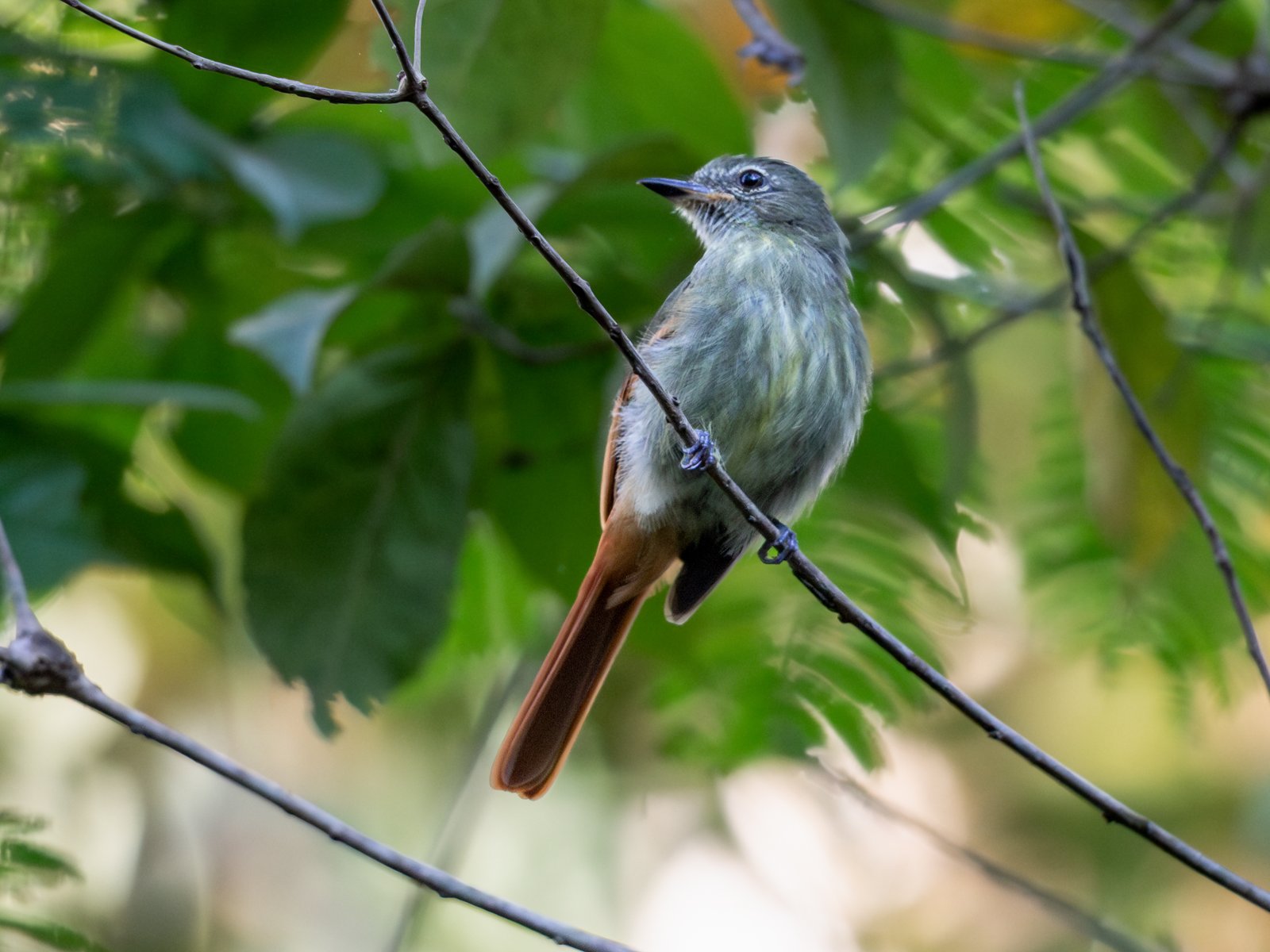
15–16 cm, with a fairly large head and a broad, flat, dark bill. The crown and upperparts are dark olive-green, with a faint pale line behind the lores. The uppertail coverts and the whole tail are bright rufous. The wings are blackish with broad rufous edges. The underparts are olive-green with faint yellow streaks, the belly pale yellow. The sexes are alike.
Confusion species
Dusky-tailed Flatbill Ramphotrigon fuscicauda has a dark, not rufous, tail and two cinnamon wing bars; it lives mainly in bamboo. Large-headed Flatbill Ramphotrigon megacephalum has a distinct pale supercilium, ochre wing bars and a brown tail. The flatbills of the genus Tolmomyias have yellowish-green wing bars and an olive tail, and sit higher in the foliage.
Habitat
Humid lowland forest, both terra firme and várzea, up to about 700 m; in Ecuador mainly below 250 m. It sits still in the lower and middle storeys and catches insects with a short sally to the foliage. The only described nest was in a cavity in a partly rotten stump.
Where the bird is most at home, classified by the vegetation units of the Andes and the west coast.


Range and movements
Colombia: in the southeast, in the Amazonian lowlands. Ecuador: in the eastern lowlands. Peru: throughout the Amazonian lowlands east of the Andes. Bolivia: in the northwest. Absent from the Galápagos. Outside the guide area in southern Venezuela, the Guianas and Amazonian Brazil.
- Resident
- dark = core range, pale = thinly spread
How and when to look
Listen in tall lowland forest for the low, mewing whistle; the bird often sits for minutes on the same branch in the lower storey. The rufous tail is often the first thing you see.
Conservation status
Least Concern. Widespread in the Amazonian lowlands, but dependent on large, unbroken forest.
Scientific name
Ramphotrigon ruficauda | (Spix, 1825)
Spix described the species in 1825 as Platyrhynchus ruficauda; because it was later moved to another genus, the author and year stand in brackets. The genus Ramphotrigon was introduced in 1855 by Gray. The genus name combines Greek rhamphos, 'bill', and trigōnon, 'triangle'. The species name comes from Latin rufus, 'rufous', and cauda, 'tail'. The specimen the first description was based on came from Mouth of the Rio Madeira, Amazonas, Brazil.