All species › Passerines › Tyrant flycatchers and allies › Dusky-tailed Flatbill
Dusky-tailed Flatbill | Ramphotrigon fuscicauda
Chapmans breedbektiran | Picoplano colioscuro | Maria-de-cauda-escura
The Dusky-tailed Flatbill is a small, dark olive-green flycatcher with a broad, flat bill, almost restricted to bamboo in the lowland forest of southwestern Amazonia. It sits still in dense bamboo and vine tangles and is usually detected by its soft, falling whistles.
Voice
The dawn song is a soft, falling whistle followed by a musical hiccup, peeww-wichwee. The call is a soft whistle with a slowing, falling chatter, peeewww trrr-peer-peer-pur, and a falling-rising peeer-wee?.
Recording: Jacob Wijpkema — CC BY-NC-SA 4.0 · xeno-canto
Identification
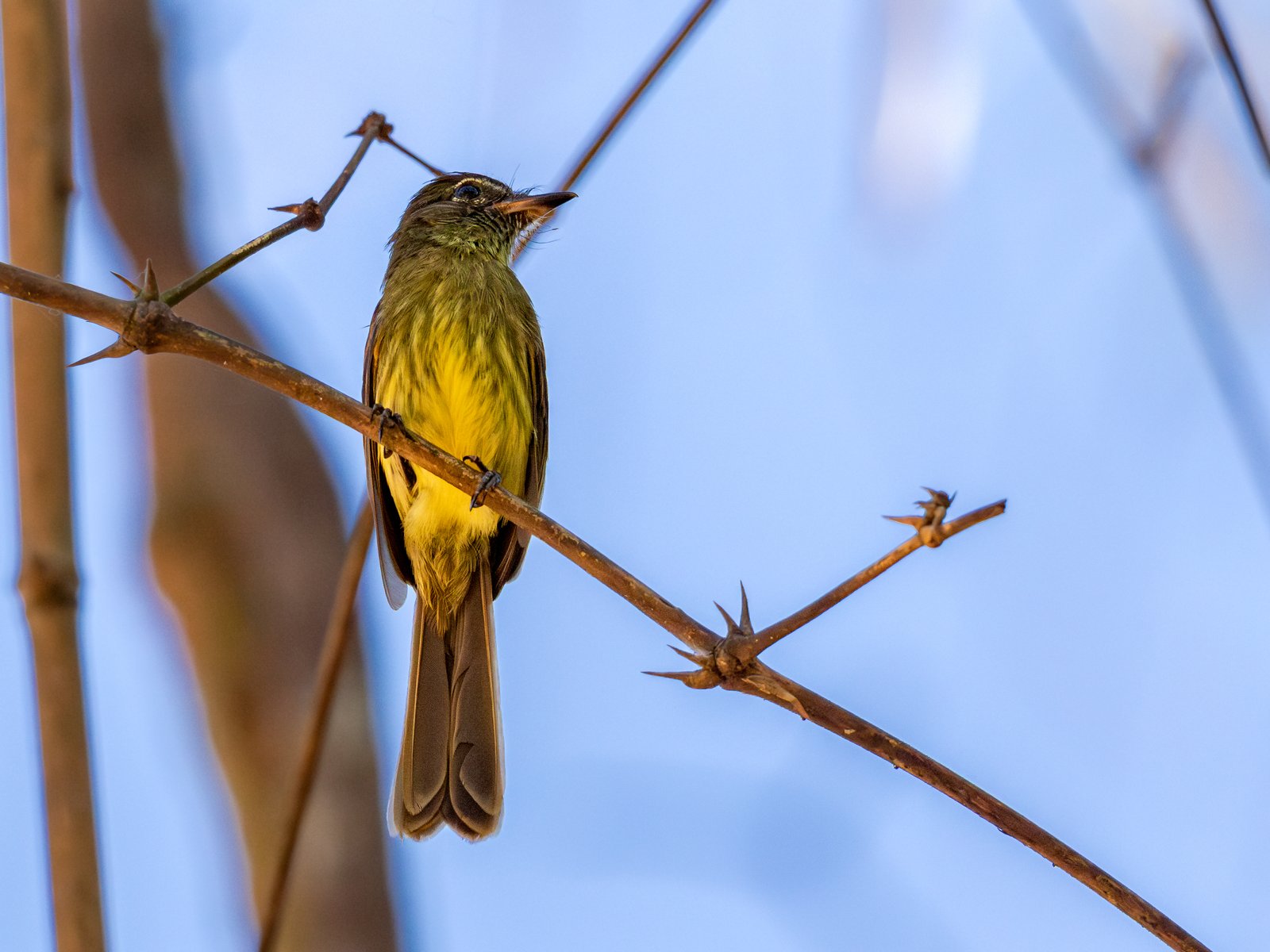
15.5–16.5 cm, with a broad, flat black bill with a pink base. The crown and upperparts are dark olive-green, the lores greyish, with a thin yellowish-green line behind the lores and below the eye. The wings are blackish with two rufous-brown to cinnamon wing bars. The tail is dark. The throat and upper breast are olive-green streaked yellow, the lower breast and flanks yellow streaked olive-green, the undertail coverts citron-yellow. The sexes are alike.
Confusion species
Rufous-tailed Flatbill Ramphotrigon ruficauda has a bright rufous tail and rufous wing edges without distinct bars. Large-headed Flatbill Ramphotrigon megacephalum, which also lives in bamboo, has a distinct pale supercilium and ochre wing bars and is paler below. The flatbills of the genus Tolmomyias have yellowish-green wing bars and sit higher in the canopy.
Habitat
Humid evergreen forest with bamboo, especially Guadua, and locally dense vine tangles away from bamboo. In Ecuador between 250 and 750 m, in Peru up to about 1050 m. It sits still in the lower and middle parts of the growth and catches insects with a short sally to the foliage. Little is known about the nest.
Where the bird is most at home, classified by the vegetation units of the Andes and the west coast.


Range and movements
Colombia: locally in the extreme southwest of the lowlands east of the Andes. Ecuador: very rare and local in the east, south to Napo. Peru: in the southeast, in the bamboo forest of Ucayali, Madre de Dios and Puno. Bolivia: in the northwest. Absent from the Galápagos. Outside the guide area in western Amazonian Brazil.
- Resident
- dark = core range, pale = thinly spread
How and when to look
Search dense Guadua bamboo in Madre de Dios and listen at dawn for the falling whistles; the bird often stays long in one place in the tangle.
Conservation status
Least Concern. Fairly common in bamboo forest in southeastern Peru and Bolivia; scarce and local elsewhere.
Scientific name
Ramphotrigon fuscicauda | Chapman, 1925
Chapman described the species in 1925 and placed it straight away in the genus where it still stands. The genus Ramphotrigon was introduced in 1855 by Gray. The genus name combines Greek rhamphos, 'bill', and trigōnon, 'triangle'. The species name comes from Latin fuscus, 'dusky', and cauda, 'tail'. The specimen the first description was based on came from Río Suno, Ecuador.