All species › Passerines › Tyrant flycatchers and allies › Short-tailed Field Tyrant
Short-tailed Field Tyrant | Muscigralla brevicauda
Kortstaartveldtiran | Tiranito colicorto | Suiriri-de-cauda-curta
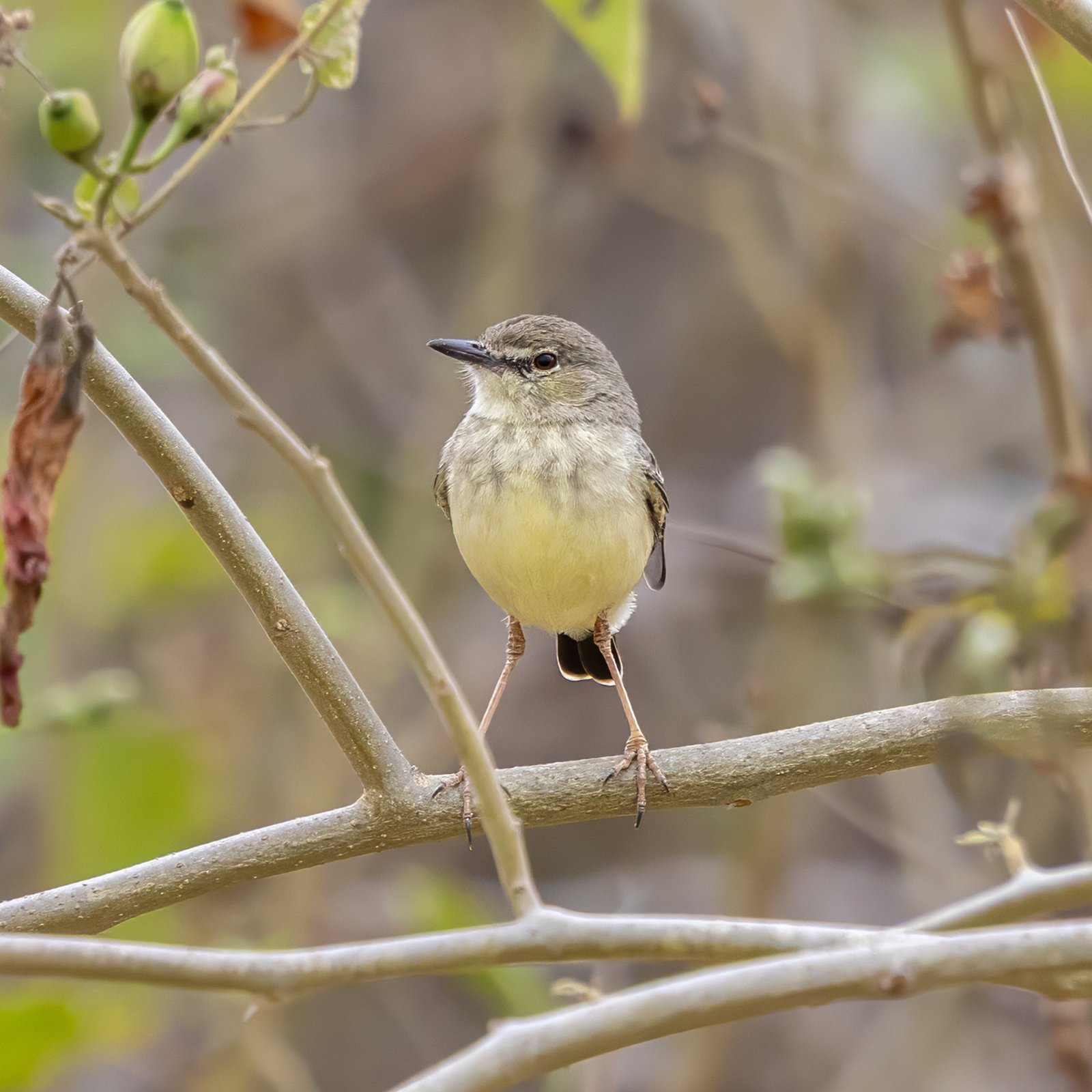
The Short-tailed Field Tyrant is a small, ground-dwelling tyrant of the dry Pacific coastal plain and the dry Andean valleys. With its long legs, upright stance and very short tail it differs in shape from almost all other tyrants. It is the only species in its genus.
Voice
A thin, buzzy song such as tsit-tsrrrr, given from a low perch or in a short display flight; also short, high tsit calls.
Recording: Scott Olmstead — CC BY-NC-SA 4.0 · xeno-canto
Identification
11 cm, with long, pale, pinkish to greyish legs, a thin bill and a very short tail. The upperparts are greyish brown, the underparts dull white with a pale buff wash on the breast and flanks. The wings have two pale wing bars. The uppertail coverts are cinnamon-rufous, the tail blackish with a pale tip. A yellowish crown patch is usually concealed. The sexes are alike.
Confusion species
Coastal Miner Geositta peruviana also walks on bare ground, but is longer, sandier, with a longer bill and a pale tail with a dark terminal band. Spot-billed Ground Tyrant Muscisaxicola maculirostris is larger, with a longer tail with white outer edges, and lives higher in the Andes. Pipits Anthus are streaked and have a longer tail.
Habitat
Dry, open scrub, desert with scattered shrubs, the edges of irrigated fields, fallow land and gardens, from sea level to about 2800 m in the dry Andean valleys. It walks and runs on the ground, picking up insects or catching them in a short jump. The nest is a cup on or just above the ground, under a shrub or grass tussock.
Where the bird is most at home, classified by the vegetation units of the Andes and the west coast.


Range and movements
Ecuador: in the dry west, from Manabí and Santa Elena to El Oro and Loja. Peru: along the whole coast and in dry Andean valleys on the western slope and in the Marañón. Colombia: locally in the dry Patía valley in the south-west (Cauca, Nariño). Absent from Bolivia and the Galápagos. Outside the guide area only in the far north of Chile.
- Resident
- dark = core range, pale = thinly spread
How and when to look
Search bare or sparsely vegetated ground along fields and in desert scrub on the Peruvian coast; in the breeding season the birds sing from stones, posts or low shrubs.
Conservation status
Least Concern. The species also lives in farmland and along irrigation channels.
Scientific name
Muscigralla brevicauda | d'Orbigny, ACVMD & de Lafresnaye, 1837
D'Orbigny, ACVMD & de Lafresnaye described the species in 1837 and placed it straight away in the genus where it still stands. He introduced the genus Muscigralla in that same work. The genus name combines the genus Muscicapa, 'flycatcher', with Latin grallae, 'stilts' (from gradus, 'step'), for a long-legged flycatcher. The species name comes from Latin brevis, 'short', and cauda, 'tail'. The specimen the first description was based on came from Tacna, Peru.