All species › Passerines › Tyrant flycatchers and allies › White-bearded Flycatcher
White-bearded Flycatcher | Phelpsia inornata
Witbaardtiran | Bienteveo barbiblanco | Bem-te-vi-de-barba-branca
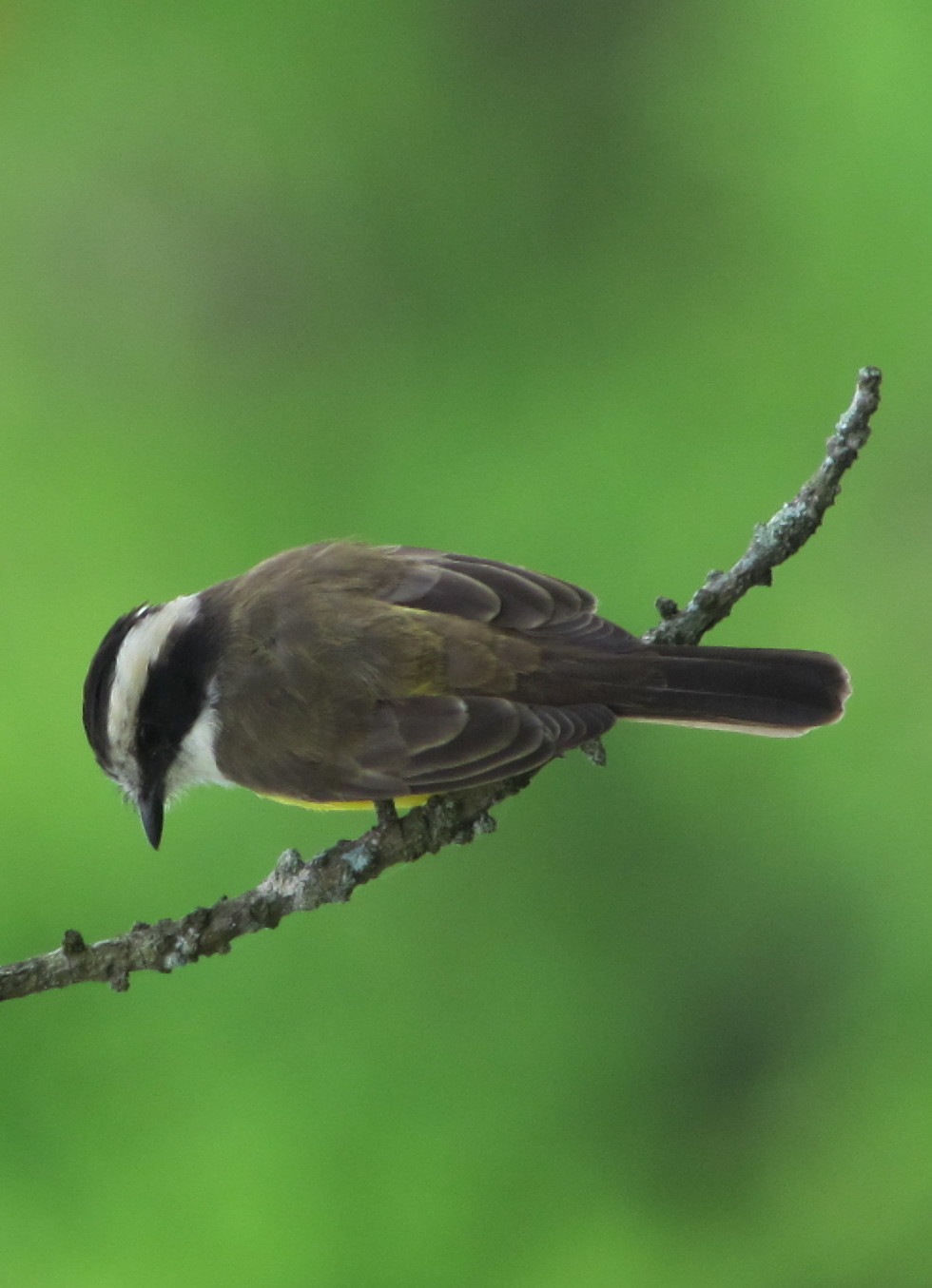
The White-bearded Flycatcher is a tyrant flycatcher of the llanos that occurs in the guide area only in the far north-east of Colombia. It resembles a small kiskadee, but lacks a coloured crown patch and has a white, somewhat puffy throat. It is the only species in the genus Phelpsia.
Voice
A sharp, rising call, roughly churup, repeated in series when alarmed; pairs sing a duet of rapid, staccato hammering notes.
Recording: Joe Klaiber — CC BY-NC-SA 4.0 · xeno-canto
Identification
16.5–18 cm, with a short black bill. The crown is brownish black, with a broad white supercilium extending well behind the eye. The upperparts and tail are olive-brown. The throat is white and often somewhat puffed out, and the rest of the underparts are bright yellow. There is no crown patch. The sexes are alike.
Confusion species
Social Flycatcher Myiozetetes similis has an olive-green back, a greyer head and an orange-red crown patch. Rusty-margined Flycatcher Myiozetetes cayanensis has rufous edges to the flight feathers and a yellow to orange crown patch. Great Kiskadee Pitangus sulphuratus is much larger, with a heavy bill, a yellow crown patch and rufous in the wings. Lesser Kiskadee Philohydor lictor has a long, thin bill and lives by water.
Habitat
Open llanos with scattered trees, small woods, gallery forest and cattle ranches, in the lowlands up to about 250 m. It lives in pairs or small family groups and often stays around ranch buildings. It perches in a concealed spot and takes most insects by dropping to the ground or low vegetation; it also eats a few small fruits. The nest is an open cup of twigs and fibres, bound with spider web and covered with lichen, high in a branch fork; non-breeding birds sometimes help the breeding pair.
Where the bird is most at home, classified by the vegetation units of the Andes and the west coast.


Range and movements
Colombia: only in the llanos of the north-east, in Arauca and Vichada along the border with Venezuela. Absent from Ecuador, Peru, Bolivia and the Galápagos. Most of the range lies outside the guide area, in the llanos of Venezuela.
- Resident
- dark = core range, pale = thinly spread
How and when to look
Search the llanos of Arauca around cattle ranches, small woods and gallery forest; pairs give themselves away by their duet and sharp calls.
Conservation status
Least Concern. The species tolerates ranchland with scattered trees and often lives close to farms.
Scientific name
Phelpsia inornata | (Lawrence, 1869)
Lawrence described the species in 1869 as Myiozetetes inornatus; because it was later moved to another genus, the author and year stand in brackets. The genus Phelpsia was introduced in 1984 by Lanyon. The genus name honours William H. Phelps (1875–1965), American-Venezuelan businessman and ornithologist, and his family. Latin inornatus means 'unadorned', referring to the plain plumage; the ending was changed to match the gender of Phelpsia. The specimen the first description was based on came from Valencia, Carabobo, Venezuela.