All species › Passerines › Antbirds › Amazonian Streaked Antwren
Amazonian Streaked Antwren | Myrmotherula multostriata
Amazonemiersluiper | Hormiguerito rayado amazónico | Choquinha-estriada-da-amazônia
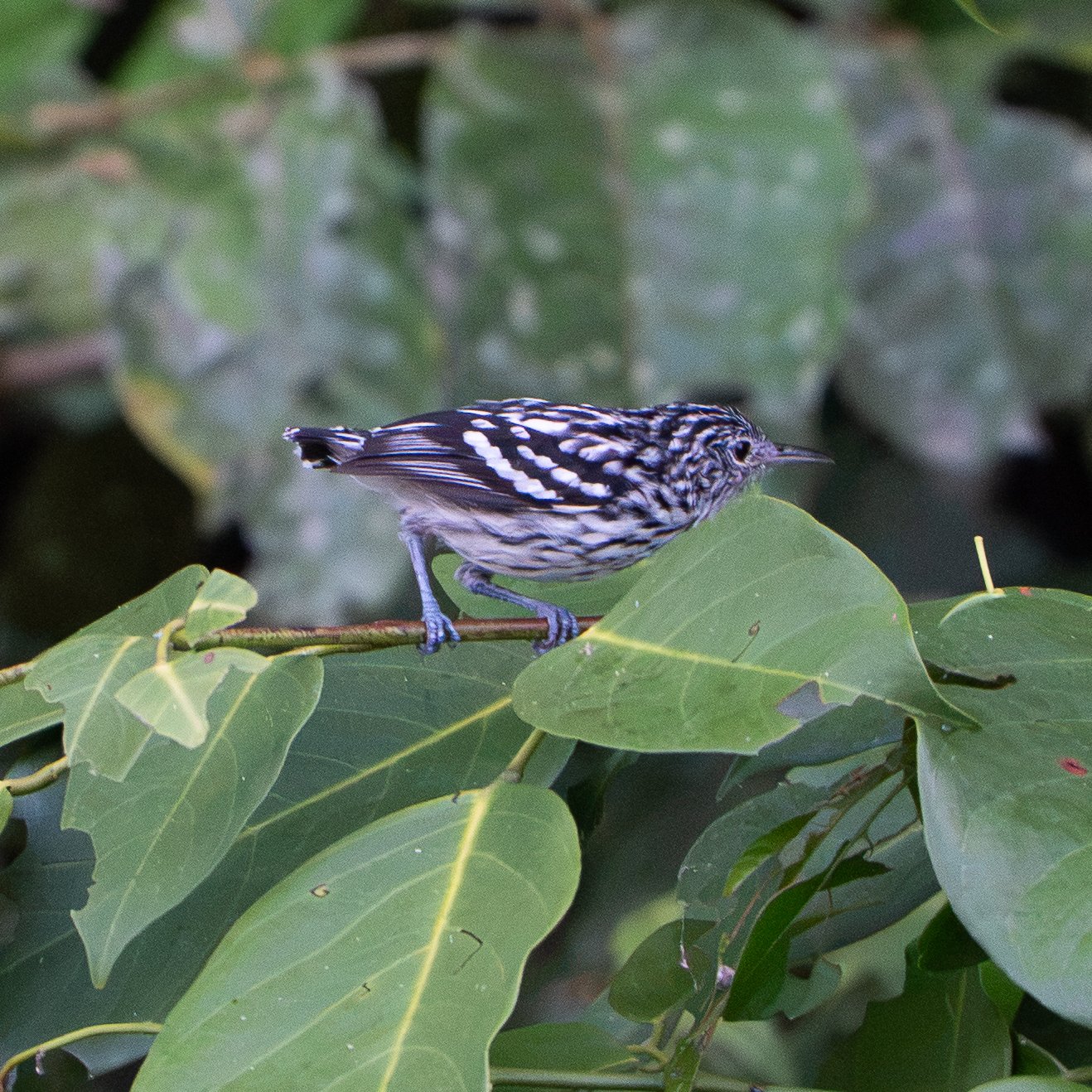
The Amazonian Streaked Antwren is a small, black-and-white streaked antwren of vegetation along rivers, oxbow lakes and marshes in western Amazonia. It keeps low to mid-level, often in vines and shrubs overhanging the water. Along lowland rivers in the guide area it is the most widespread streaked antwren.
Voice
The song is a series of clear, evenly spaced notes, slower than a trill. Calls are short cheep and chee-pu notes.
Recording: Juan Freile — CC BY-NC-SA 4.0 · xeno-canto
Identification
9–10 cm, with a short tail and a thin bill. The male is streaked black and white on the head, crown and back, with black wings with two white wing bars and white underparts streaked black from the throat to the flanks. The female has an orange-brown head and nape streaked black, upperparts streaked like the male and pale ochre, barely streaked underparts.
Confusion species
Guianan Streaked Antwren Myrmotherula surinamensis is almost identical, but lives in north-eastern South America, outside the countries of the guide area. Cherrie's Antwren Myrmotherula cherriei has more heavily streaked underparts, also in the female, and lives mainly in white-sand forest and along blackwater rivers. Stripe-chested Antwren Myrmotherula longicauda has a longer tail and finer streaking below and lives higher, in the foothills of the eastern slope. Black-and-white Antbird Myrmochanes hemileucus is larger, unstreaked white below and lives in scrub on river islands.
Habitat
Scrub, vines and low trees along rivers, oxbow lakes and marshes, in várzea, on river islands and along forest edges, mostly below 600 m, locally higher. It searches in pairs for small arthropods in low and middle vegetation, often over the water. The nest is a suspended cup of plant fibres.
Where the bird is most at home, classified by the vegetation units of the Andes and the west coast.


Range and movements
Colombia: in the Amazonian lowlands of the south-east, from the base of the Andes eastward. Ecuador: in the Amazonian lowlands. Peru: throughout the Amazonian lowlands. Bolivia: in the north, in Pando, Beni and the lowlands of La Paz. Absent from the Galápagos. Outside the guide area in southern Venezuela and western and central Amazonian Brazil.
- Resident
- dark = core range, pale = thinly spread
How and when to look
Travel by boat or on foot along oxbow lakes and river meanders in the lowlands, for example along the Río Napo or in Madre de Dios, and search vines and shrubs over the water. Pairs keep in contact with short calls.
Conservation status
Least Concern. Fairly common in waterside vegetation; this vegetation recovers quickly after disturbance.
Scientific name
Myrmotherula multostriata | Sclater, 1858
Sclater described the species in 1858 and placed it straight away in the genus where it still stands. He introduced the genus Myrmotherula in that same work. The genus name is a diminutive of Myrmothera (Greek murmos, 'ant', and thēras, 'hunter'): little ant-hunter. The species name comes from Latin multus, 'many', and striatus, 'striped': heavily streaked. The specimen the first description was based on came from Ucayali River, Peru.