All species › Passerines › Antbirds › Pacific Antwren
Pacific Antwren | Myrmotherula pacifica
Pacifische miersluiper | Hormiguerito del Pacífico | Choquinha-do-pacífico
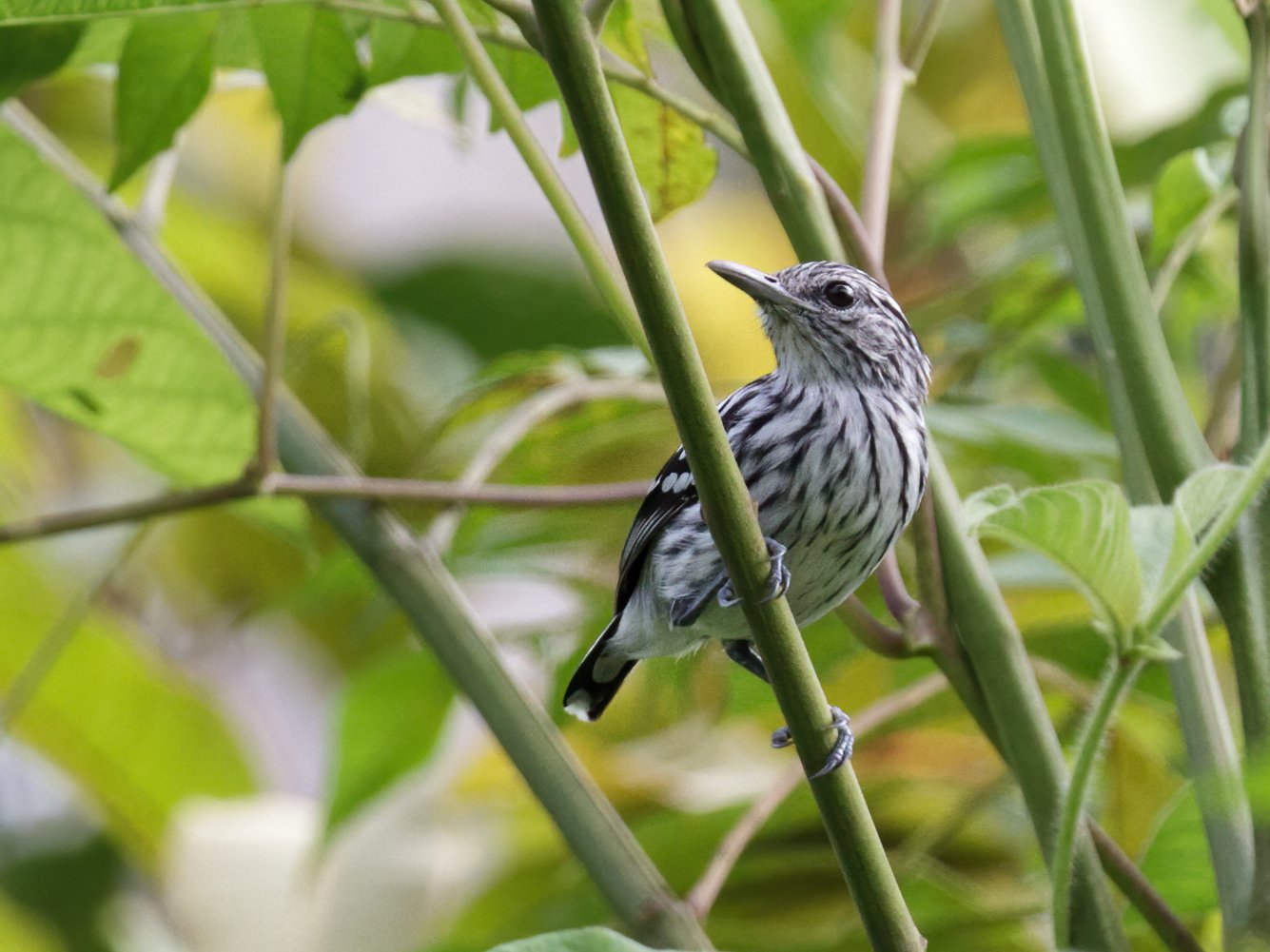
The Pacific Antwren is the only antwren west of the Andes with black-and-white streaked upperparts and underparts. It lives in forest edges, secondary forest and scrub and also occurs in gardens and plantations. It was formerly lumped with Guianan Streaked and Amazonian Streaked Antwrens as a single species.
Voice
The song is a quick, lively series of chip notes that rises slightly in pitch. Calls are a short chee-pu, a chee-cher and a harsh, level trill.
Recording: rudy gelis — CC BY-NC-SA 4.0 · xeno-canto
Identification
9–10 cm, with a short tail and a thin bill. The male is streaked black and white on the head, crown and back, with a narrow white patch between the shoulders, black wings with white tips to the coverts and a black tail with white edges. The underparts are white with black streaks from the throat to the belly, the flanks greyer. The female has a buff to cinnamon-rufous head, nape and shoulders, with black streaks only on the crown and nape, and unstreaked orange-ochre underparts with a paler throat and belly.
Confusion species
Moustached Antwren Myrmotherula ignota in the Chocó has yellow underparts, a white throat with a black moustachial stripe and lives higher in the forest. Black-and-white Warbler Mniotilta varia, a winter visitor from North America, is larger, has a white supercilium and creeps along trunks and branches. Dot-winged Antwren Microrhopias quixensis is unstreaked black or rufous, with white spots on the wings and a long tail.
Habitat
Lower and middle levels of forest edges, secondary forest and scrub in humid lowlands and foothills, often near streams, also in gardens and plantations, mostly up to 800 m and in Colombia locally up to 1200 m. It rarely enters the interior of closed forest. It searches in pairs for small arthropods among vines and leaves. The nest is a suspended cup.
Where the bird is most at home, classified by the vegetation units of the Andes and the west coast.


Range and movements
Colombia: in the Pacific lowlands and in the north and centre of the country, east to the Magdalena Valley and Cundinamarca. Ecuador: in the western lowlands and foothills, south to Azuay. Absent from Peru, Bolivia and the Galápagos. Outside the guide area in eastern Panama.
- Resident
- dark = core range, pale = thinly spread
How and when to look
Walk along forest edges, streams and overgrown plots in the lowlands of western Ecuador or Colombia and look for pairs in vines two to five metres up. They answer each other's songs with chip notes.
Conservation status
Least Concern. The species tolerates forest edges and secondary growth and locally benefits from partial clearance.
Scientific name
Myrmotherula pacifica | Hellmayr, 1911
Hellmayr described the species in 1911 and placed it straight away in the genus where it still stands. The genus Myrmotherula was introduced in 1858 by Sclater. The genus name is a diminutive of Myrmothera (Greek murmos, 'ant', and thēras, 'hunter'): little ant-hunter. The species name refers to the Pacific Ocean (Latin pacificus), for its range along the Pacific coast. The specimen the first description was based on came from Buenaventura, Valle del Cauca, Colombia.