All species › Passerines › Antbirds › Cherrie's Antwren
Cherrie's Antwren | Myrmotherula cherriei
Cherrie's miersluiper | Hormiguerito de Cherrie | Choquinha-de-peito-riscado
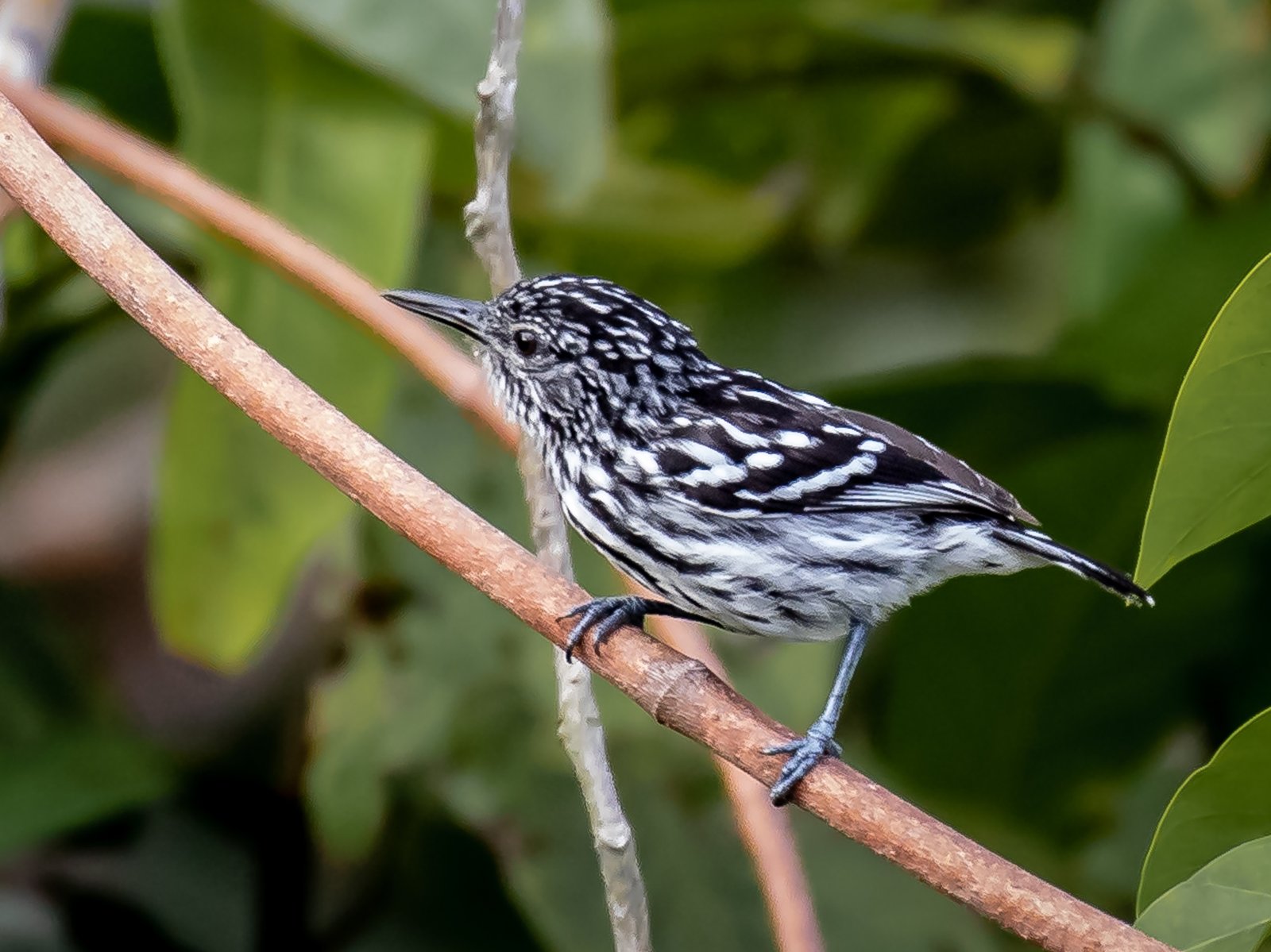
Cherrie's Antwren is a small, heavily black-and-white streaked antwren of stunted white-sand forest, gallery forest and blackwater rivers in northern Amazonia and the Orinoco basin. In the guide area it lives in eastern Colombia and, as an isolated population, in north-eastern Peru. The species is named after the American naturalist George Cherrie.
Voice
The song is a short, very high, sharp rattling trill, rising slightly at the start. The call is a high, nasal tjeew or tee-tjuw.
Recording: Iván Lau — CC BY-NC-SA 4.0 · xeno-canto
Identification
9–10 cm, with a very short tail and a thin bill. The male is streaked black and white on the head, crown and back, with a narrow white patch between the shoulders, black wings with white tips to the coverts and white underparts with broad black streaks from the throat to the flanks. The female has buff instead of white streaks on the head, no white shoulder patch and pale buff underparts with narrower black streaks.
Confusion species
Amazonian Streaked Antwren Myrmotherula multostriata has narrower streaks below; the female has an orange-brown head and barely streaked underparts. It lives mainly along whitewater rivers and in várzea. Yellow-throated Antwren Myrmotherula ambigua has a yellow throat and underparts and lives in the canopy. Pygmy Antwren Myrmotherula brachyura has yellow, unstreaked underparts.
Habitat
Lower and middle levels of stunted, shrubby white-sand forest, gallery forest in savanna, várzea and igapó forest and thickets on islands, sandbars and lagoon edges along blackwater rivers, in the lowlands. It searches in pairs for small arthropods among leaves and vines. The nest is a suspended cup.
Where the bird is most at home, classified by the vegetation units of the Andes and the west coast.


Range and movements
Colombia: in the east, mainly in gallery forest and white-sand forest in Vichada, Guainía and Vaupés. Peru: an isolated population in north-eastern Loreto, along the edges of streams and lagoons, among others in the Río Nanay drainage. Absent from Ecuador, Bolivia and the Galápagos. Outside the guide area in southern Venezuela and north-western Brazil, in the Rio Negro and Rio Branco drainages.
- Resident
- dark = core range, pale = thinly spread
How and when to look
Search along the banks of blackwater rivers and in stunted white-sand forest, in Colombia around Inírida and in Peru in the white-sand forests near Iquitos. Look for the broad black streaks below.
Conservation status
Least Concern. Its habitat is largely intact; the isolated population in Peru is small and local.
Scientific name
Myrmotherula cherriei | Berlepsch & Hartert, 1902
Berlepsch & Hartert described the species in 1902 and placed it straight away in the genus where it still stands. The genus Myrmotherula was introduced in 1858 by Sclater. The genus name is a diminutive of Myrmothera (Greek murmos, 'ant', and thēras, 'hunter'): little ant-hunter. The species name honours George Kruck Cherrie (1865–1948), American naturalist and collector in South America. The specimen the first description was based on came from Perico, upper Orinoco, Venezuela.