All species › Passerines › Antbirds › Stripe-chested Antwren
Stripe-chested Antwren | Myrmotherula longicauda
Langstaartmiersluiper | Hormiguerito pechilistado | Choquinha-de-peito-estriado
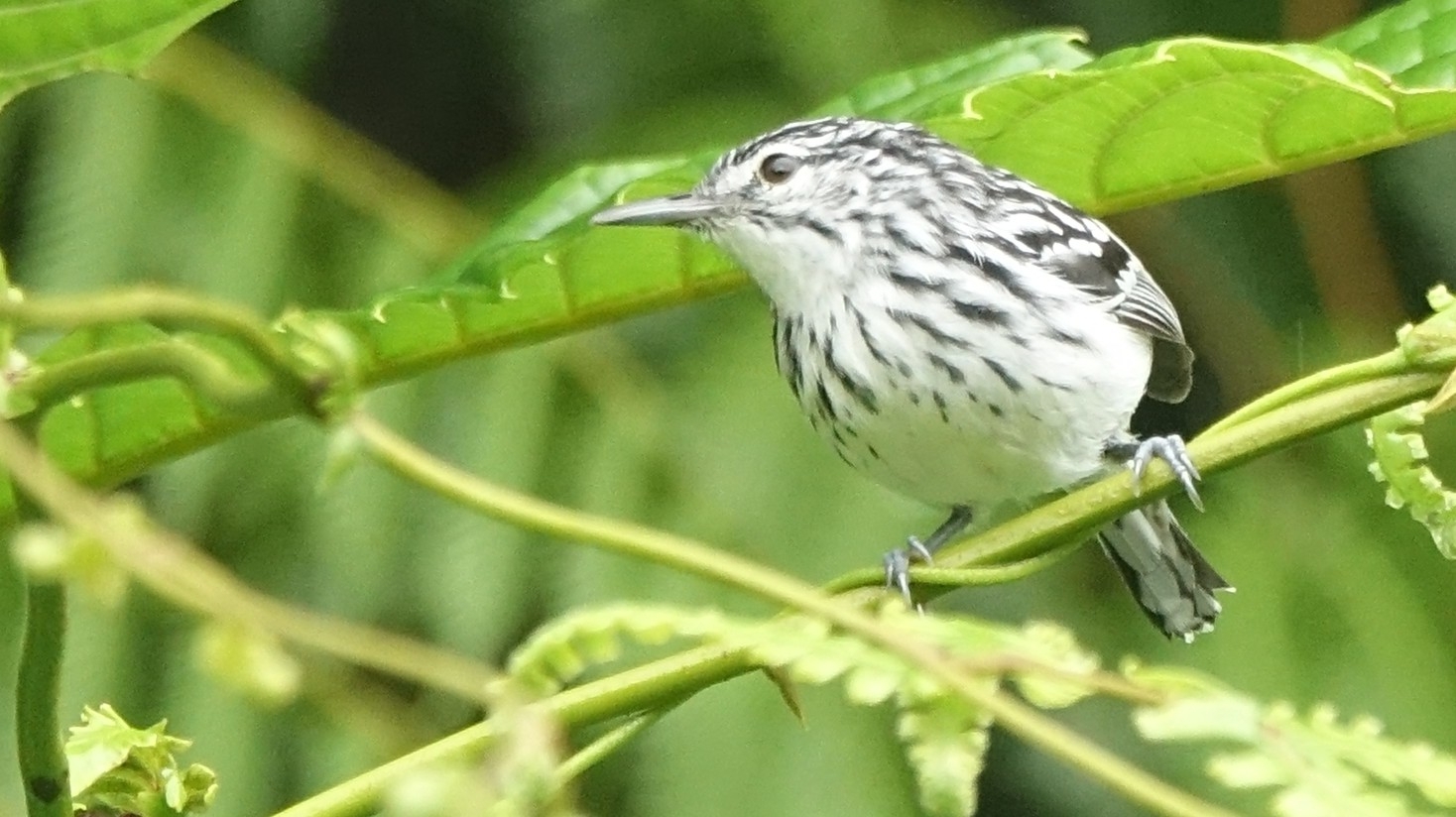
The Stripe-chested Antwren is a black-and-white streaked antwren of the foothills of the eastern slope of the Andes, with a slightly longer tail than its relatives. It lives in forest edges, secondary forest and bamboo and occurs patchily from southern Colombia to Bolivia. The English and Spanish names refer to the streaked breast, the Dutch name to the tail.
Voice
The song is a rapid repetition of a short, musical phrase, also described as an unhurried, monotonous series of paired notes. The call is a doubled note followed by a short, descending trill, besides soft notes and a harsh rattle.
Recording: Jacob Wijpkema — CC BY-NC-SA 4.0 · xeno-canto
Identification
10–11 cm, slender, with a fairly long tail for a Myrmotherula. The male is streaked black and white on the head, crown and back, with black wings with broad white edges to the coverts and a black tail with white edges and tips. The underparts are white, with fine black streaks on the breast and flanks. The female has buff streaks on the head and upperparts and buff underparts, darker on the breast than on the throat and belly, with a little pale grey streaking on the sides of the breast.
Confusion species
Amazonian Streaked Antwren Myrmotherula multostriata has a shorter tail and more heavily streaked underparts, the female an orange-brown head; it lives in the lowlands along water. Sclater's Antwren Myrmotherula sclateri has yellow underparts and lives in the canopy of lowland forest. Slaty Antwren Myrmotherula schisticolor in the same elevation range is unstreaked grey, the male with a black throat.
Habitat
Edges of humid evergreen forest, secondary forest and bamboo stands on the lower eastern slope, mostly between 400 and 1550 m, in Colombia up to about 1100 m and in Ecuador mostly below 1000 m. An isolated population in Loreto lives at about 150 m in permanently flooded forest around blackwater lakes. It searches in pairs for small arthropods in low and middle vegetation, often with mixed flocks. The nest is a suspended cup.
Where the bird is most at home, classified by the vegetation units of the Andes and the west coast.


Range and movements
Colombia: only in the south, in Putumayo. Ecuador: on the eastern slope, in the north in Napo and further south from Morona-Santiago. Peru: on the eastern slope of the Andes from the north to Cusco and Puno, with an isolated population in the lowlands of Loreto. Bolivia: on the eastern slope in La Paz and Cochabamba. Absent from the Galápagos. Does not occur outside the guide area.
- Resident
- dark = core range, pale = thinly spread
How and when to look
Search along roads through foothill forest on the eastern slope, where forest edges, bamboo and secondary forest alternate, for example in Manu or along the road to Coroico. Pairs often sing from dense vegetation along the edge.
Conservation status
Least Concern. The species tolerates forest edges and secondary forest; foothill forest is cleared locally for agriculture.
Scientific name
Myrmotherula longicauda | Berlepsch & Sztolcman, 1894
Berlepsch & Sztolcman described the species in 1894 and placed it straight away in the genus where it still stands. The genus Myrmotherula was introduced in 1858 by Sclater. The genus name is a diminutive of Myrmothera (Greek murmos, 'ant', and thēras, 'hunter'): little ant-hunter. The species name comes from Latin longus, 'long', and cauda, 'tail'. The specimen the first description was based on came from Chontabamba and La Merced, central Peru.