All species › Passerines › Antbirds › White-flanked Antwren
White-flanked Antwren | Myrmotherula axillaris
Witflankmiersluiper | Hormiguerito flanquiblanco | Choquinha-de-flanco-branco
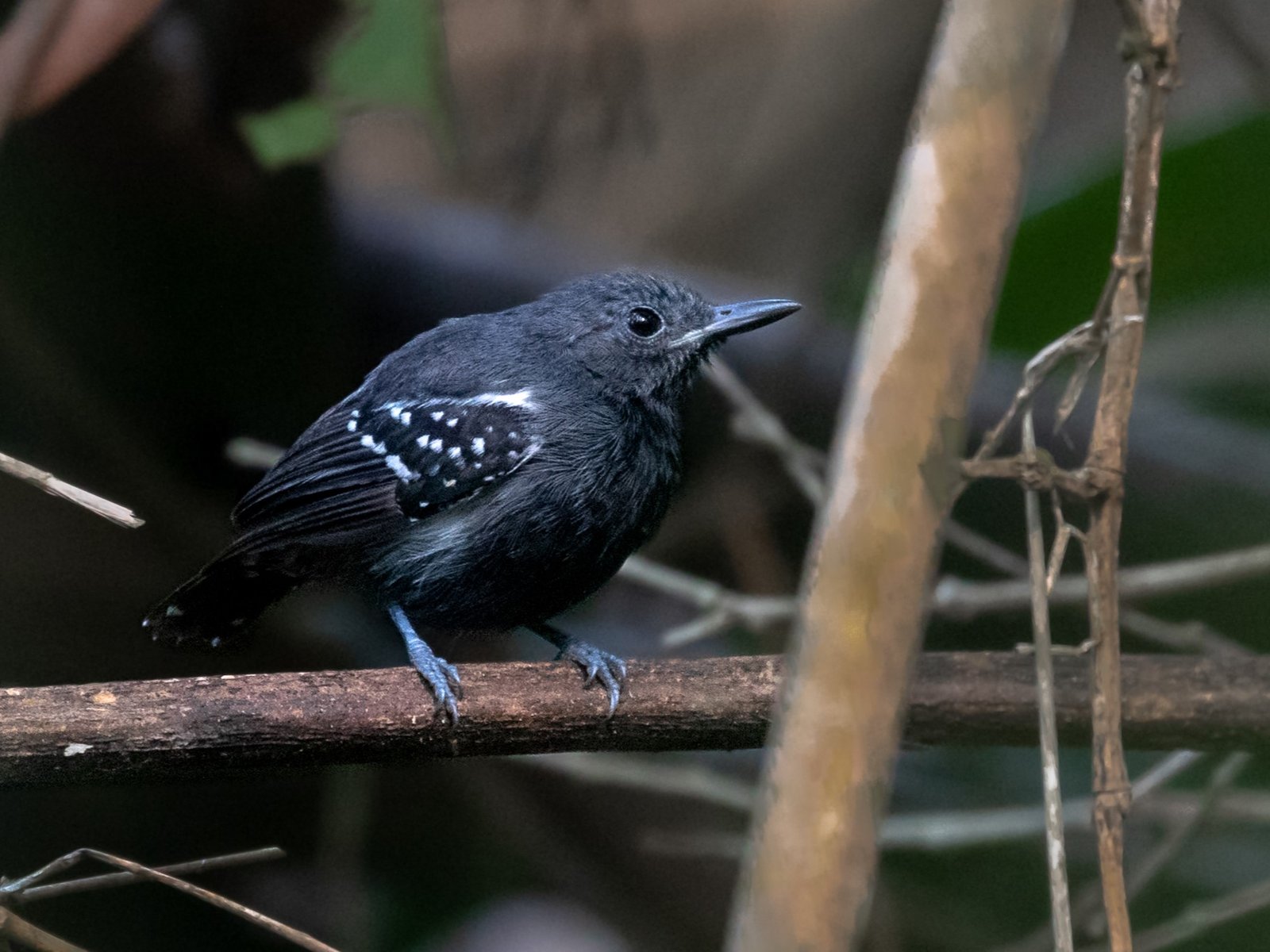
The White-flanked Antwren is one of the most widespread antwrens of tropical lowland forest. The male is black and grey with white, silky flank feathers that show as it constantly flicks its wings. It is a regular member of understorey mixed flocks, on both sides of the Andes.
Voice
The song is a descending series of whistles, pee-pee-pee-pew. The call is a two-syllabled, falling chee-doo, often repeated.
Recording: Juan Freile — CC BY-NC-SA 4.0 · xeno-canto
Identification
10 cm, with a short tail and a thin bill. The male is slaty grey to blackish above, with a black throat and breast, black wings with white spots on the coverts and long white flank feathers that often protrude from under the wing. The female is greyish brown above, with paler wing spots, a whitish throat, buff underparts and the same white flanks.
Confusion species
Long-winged Antwren Myrmotherula longipennis lacks the white flanks; the male is greyer with a black throat patch, the female has a grey head. Grey Antwren Myrmotherula menetriesii is plain grey, the male with a black throat, and lives mainly higher in the forest. Slaty Antwren Myrmotherula schisticolor lives on the Andean slopes above the lowlands and lacks white flanks.
Habitat
Lower and middle levels of humid evergreen lowland forest in terra firme and várzea, also older secondary growth and forest edges, up to about 1000 m, locally to 1200 m. It searches in pairs for small arthropods among leaves and vines, flicking its wings, almost always with understorey mixed flocks. The nest is a suspended cup of plant fibres.
Where the bird is most at home, classified by the vegetation units of the Andes and the west coast.


Range and movements
Colombia: throughout the eastern lowlands and west of the Andes in the Pacific lowlands and the Magdalena Valley. Ecuador: in the Amazonian lowlands and in the north-west. Peru: throughout the Amazonian lowlands and the lower eastern slope. Bolivia: in the lowlands and foothills of the north and centre. Absent from the Galápagos. Outside the guide area from Honduras through Central America to Venezuela, the Guianas and Amazonian Brazil.
- Resident
- dark = core range, pale = thinly spread
How and when to look
Follow an understorey mixed flock in lowland forest; White-flanked Antwrens are usually right with it. Watch for the white flanks that flash when the bird flicks its wings.
Conservation status
Not Evaluated in its current species limits. Common over a very large range and tolerates older secondary growth.
Scientific name
Myrmotherula axillaris | (Vieillot, 1817)
Vieillot described the species in 1817 as Myrmothera axillaris; because it was later moved to another genus, the author and year stand in brackets. The genus Myrmotherula was introduced in 1858 by Sclater. The genus name is a diminutive of Myrmothera (Greek murmos, 'ant', and thēras, 'hunter'): little ant-hunter. The species name comes from Latin axilla, 'armpit', for the white underwing and flank feathers. The specimen the first description was based on came from Cayenne, French Guiana.