All species › Passerines › Antbirds › Slaty Antwren
Slaty Antwren | Myrmotherula schisticolor
Leigrijze miersluiper | Hormiguerito pizarroso | Choquinha-ardósia
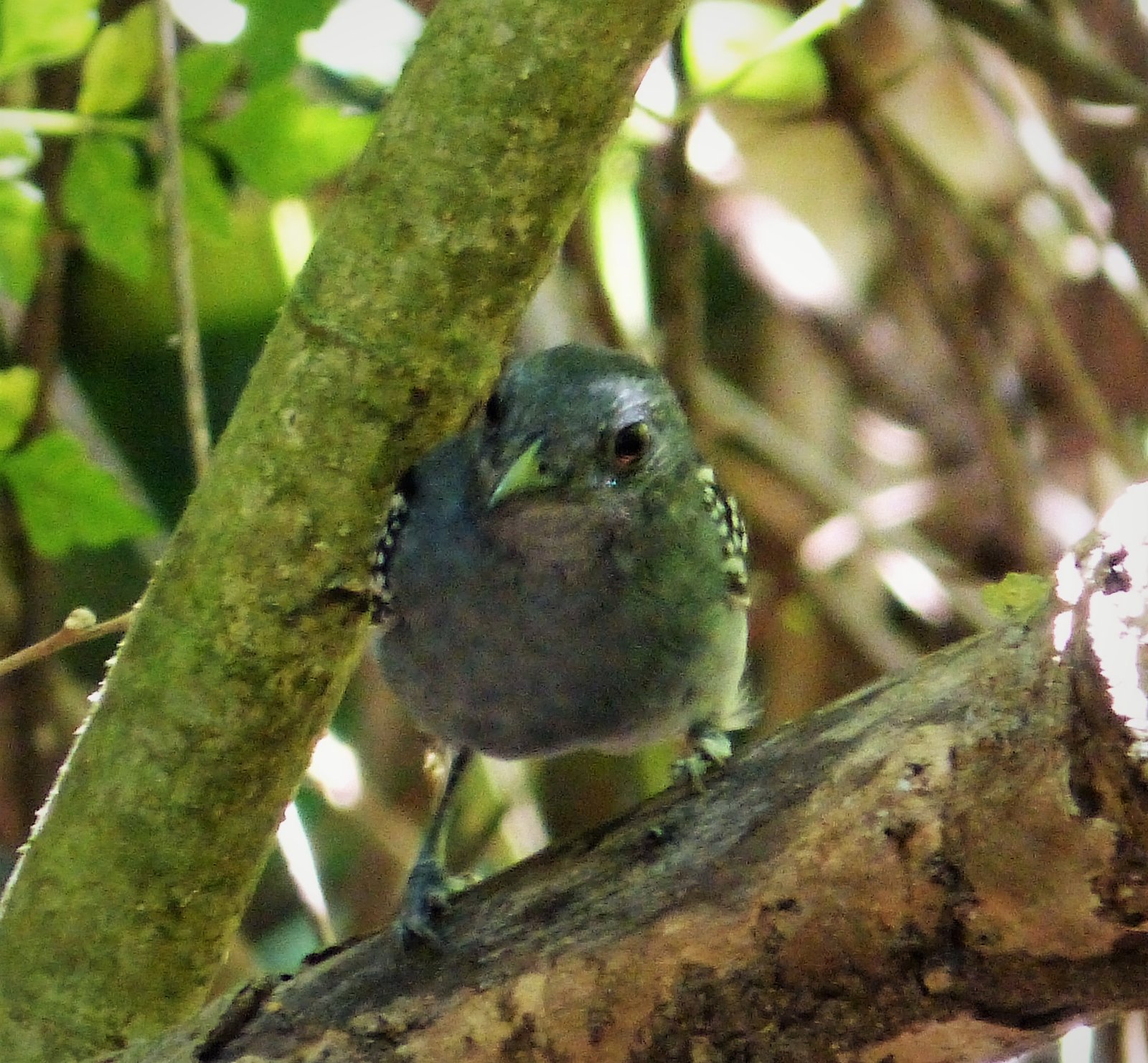
The Slaty Antwren is a small antwren of the understorey of humid foothill and montane forest. The male is slate-grey with a black throat and breast, the female olive-brown with ochre underparts. In the guide area it is the grey antwren of the Andean slopes, above the lowlands where related species live.
Voice
The song is a short series of slightly nasal, plaintive whistles. The call is a nasal, descending chee-oo.
Recording: José María Loaiza B. — CC BY-NC-SA 4.0 · xeno-canto
Identification
10 cm, compact, with a thin bill and a fairly short tail. The male is uniform slate-grey, with a black throat and upper breast; the wing coverts are blackish with narrow white tips. A concealed white patch lies between the shoulders. The female is olive-brown above, with a greyish tinge to the head, and warm ochre below; the wings are almost unmarked. Young males at first resemble the female.
Confusion species
Plain Antvireo Dysithamnus mentalis is larger and bulkier, with a thicker bill; the female has a rufous crown. Rio Suno Antwren Myrmotherula sunensis is smaller and shorter-tailed and lives lower, in the eastern lowlands and foothills. Grey Antwren Myrmotherula menetriesii and Long-winged Antwren Myrmotherula longipennis live in the Amazonian lowlands; the female Grey Antwren is grey above. White-flanked Antwren Myrmotherula axillaris has long white flank plumes, and the male is blackish below.
Habitat
Understorey and middle storey of humid foothill and montane forest, often on slopes with many vines, mostly between 500 and 2000 m, locally lower on the Pacific side. Pairs glean insects and spiders from leaves, often among hanging dead leaves, and join understorey mixed flocks. The nest is a small cup hung low in the fork of a twig.
Where the bird is most at home, classified by the vegetation units of the Andes and the west coast.


Range and movements
Colombia: on the Pacific slope and on the slopes of all three Andean ranges, also in the Serranía del Perijá. Ecuador: on the western and eastern slopes of the Andes. Peru: on the eastern slope of the Andes, south to Puno. Absent from Bolivia and the Galápagos. Outside the guide area from southern Mexico to Panama and in Venezuela.
- Resident
- dark = core range, pale = thinly spread
How and when to look
Search understorey mixed flocks in cloud forest and foothill forest, for example along trails through slope forest. Pairs often forage among dead leaves caught in vines.
Conservation status
Least Concern. Fairly common in suitable forest; locally declining through clearance of montane and foothill forest.
Scientific name
Myrmotherula schisticolor | (Lawrence, 1865)
Lawrence described the species in 1865 as Formicivora schisticolor; because it was later moved to another genus, the author and year stand in brackets. The genus Myrmotherula was introduced in 1858 by Sclater. The genus name is a diminutive of Myrmothera (Greek murmos, 'ant', and thēras, 'hunter'): little ant-hunter. The species name comes from Latin schistus, 'slate', and color, 'colour': slate-coloured. The specimen the first description was based on came from Turrialba, Costa Rica.