All species › Owls › Bay owls and barn owls › American Barn Owl
American Barn Owl | Tyto furcata
Amerikaanse kerkuil | Lechuza de campanario | Suindara
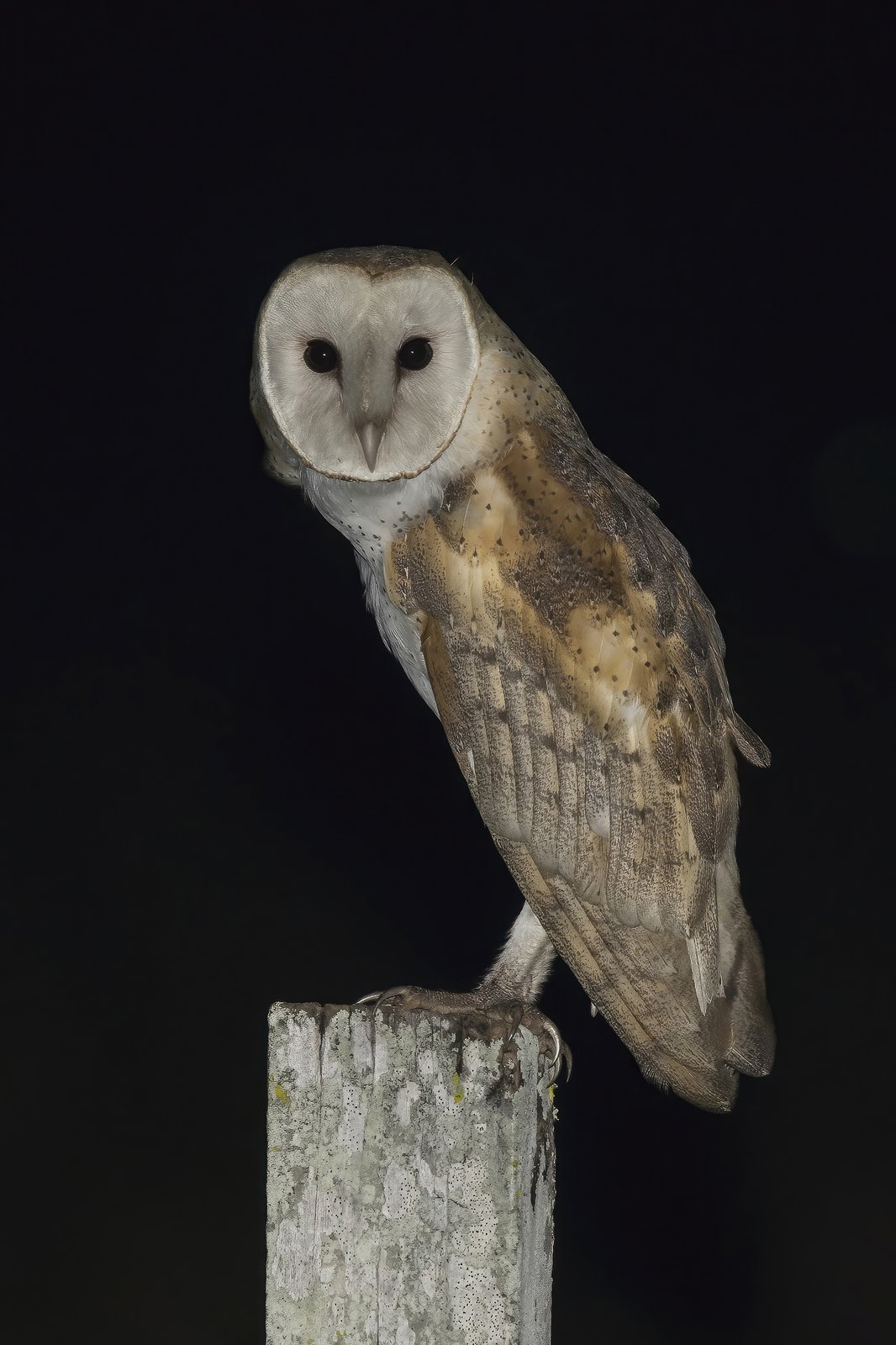
The American Barn Owl is the barn owl of the New World, a pale, long-legged owl with a heart-shaped facial disc. It is larger and heavier than the barn owl of Europe and Africa, from which it is now often split as a separate species. In the guide area it occurs from the coastal desert to the valleys of the Andes, and on the Galápagos in a distinct, dark subspecies.
Voice
A long, hoarse, screeching scream, often in flight. At the nest the birds hiss and snore, and young beg with a sustained snoring hiss.
Recording: JAYRSON ARAUJO DE OLIVEIRA — CC BY-NC-SA 4.0 · xeno-canto
Identification
33–39 cm, with long wings, a short tail and long, thinly feathered legs. The facial disc is white and heart-shaped, bordered by a narrow brown rim, with small black eyes. The upperparts are marbled golden-buff and grey with fine white and black spots. The underparts vary from white to warm ochre, with fine dark spots. Females are on average darker and more heavily spotted than males. Birds on the Galápagos are smaller and darker, with more densely spotted underparts.
Confusion species
Short-eared Owl Asio flammeus also lives in open country and on the Galápagos, but has yellow eyes in a dark-ringed face, short ear tufts and a heavily streaked breast; it often hunts by day. Striped Owl Asio clamator has long ear tufts and heavily streaked underparts.
Habitat
Open and semi-open country: pasture, fields, dry forest and scrub, coastal desert with oases and valleys, forest edges, and villages and towns, from sea level to high in the Andean valleys. It nests in buildings, church towers, barns, tree cavities, rock crevices and cliffs. It hunts at night in a low quartering flight, mainly for rodents.
Where the bird is most at home, classified by the vegetation units of the Andes and the west coast.


Range and movements
In Colombia, Ecuador, Peru and Bolivia widespread in open country, on both sides of the Andes and in the valleys; scarce in the dense rainforest of the Amazon basin, mainly near clearings and settlements. On the Galápagos a distinct subspecies occurs on several islands. Outside the guide area from southern Canada and the United States through Central America and the Caribbean to Tierra del Fuego.
- Resident
- dark = core range, pale = thinly spread
How and when to look
In villages and towns, where birds nest in old buildings and churches, and at dusk over pasture and fields. On the Galápagos sometimes by day in the shade of a lava crevice.
Conservation status
Not Evaluated. The IUCN still assesses it as part of the barn owl in the broad sense, which is Least Concern worldwide. Locally, rodent poisons and loss of nest sites have an effect.
Scientific name
Tyto furcata | (Temminck, 1827)
Temminck described the species in 1827 as Strix furcata; because it was later moved to another genus, the author and year stand in brackets. The genus Tyto was introduced in 1828 by Billberg. The genus name comes from Greek tutō, 'owl'. The species name comes from Latin furcatus, 'forked'. The specimen the first description was based on came from Cuba.