All species › Owls › Owls › Long-whiskered Owlet
Long-whiskered Owlet | Xenoglaux loweryi
Snorrebaarduil | Mochuelo peludo | Corujinha-bigoduda
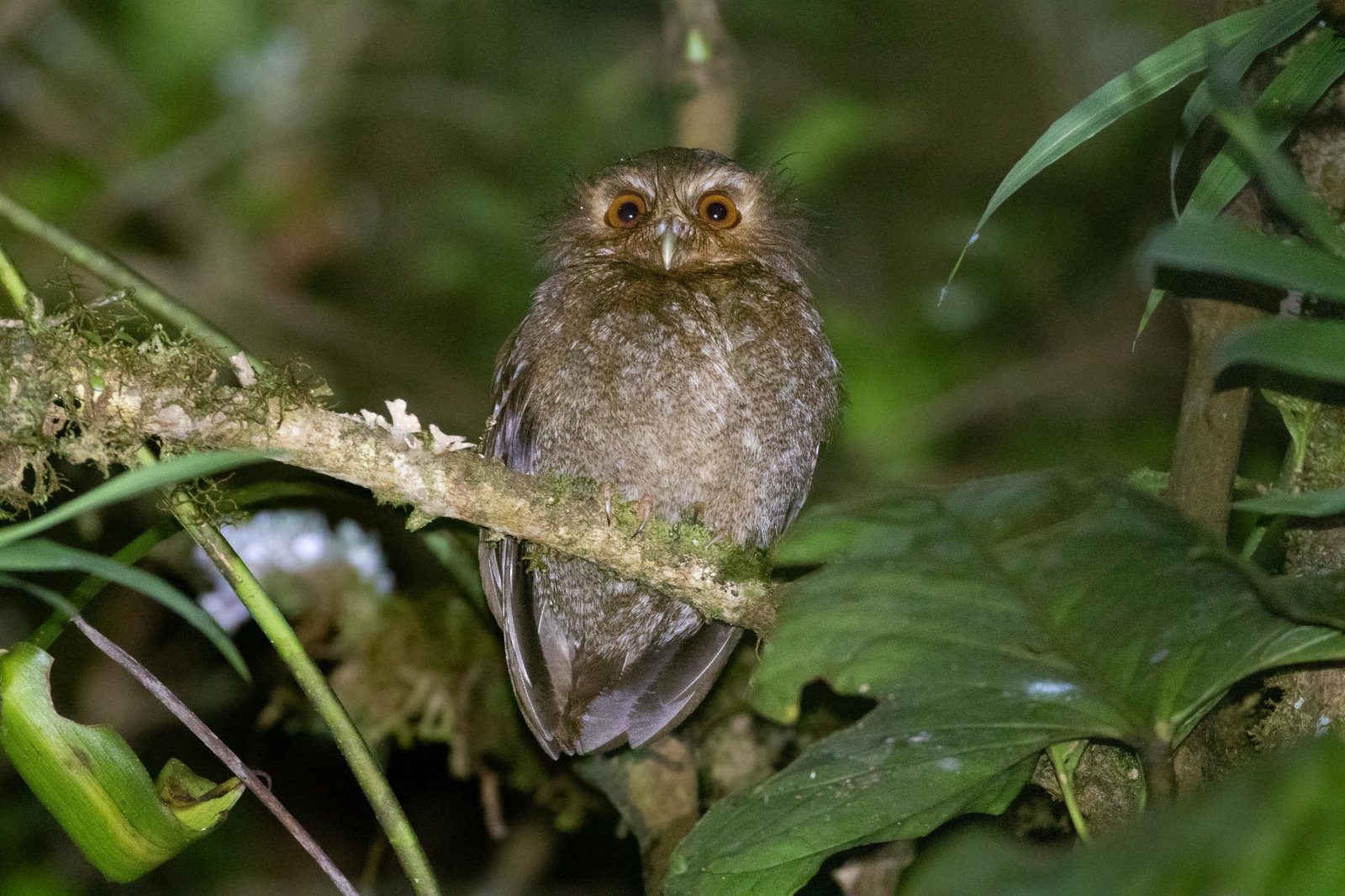
The Long-whiskered Owlet is one of the smallest owls in the world and the only species of the genus Xenoglaux. It is known only from a small area of cloud forest in northern Peru and was not discovered until 1976 and described in 1977. The genus name literally means 'strange owl'; the species' English name refers to the long, fan-shaped whiskers around the bill.
Voice
A short, low, single whistle, hoo, repeated about every three seconds, mainly at dusk and at night.
Recording: Andrew Spencer — CC BY-NC-SA 3.0 · xeno-canto
Identification
13–14 cm, round in shape, with a very short tail that barely projects beyond the wings. Long, fan-shaped bristly feathers surround the base of the bill and extend from the sides of the face. The facial disc is brown and indistinct, with pale eyebrows. The eyes are orange-brown to amber. The upperparts are warm brown with fine dark barring, with a collar of large whitish spots on the nape and white spots on the scapulars. The underparts are brown with fine barring, whiter towards the belly. The legs are bare and pink. The sexes are alike.
Confusion species
Yungas Pygmy Owl Glaucidium bolivianum lives in the same forest, but has yellow eyes, a longer barred tail, 'false eyes' on the nape and no long whiskers. Cinnamon Screech Owl Megascops petersoni is larger, warmer cinnamon-brown and has ear tufts. Cloud-forest Screech Owl Megascops marshalli is also larger, with ear tufts and a clearly outlined facial disc.
Habitat
Humid cloud forest with a very dense understorey, rich in mosses, ferns, orchids and other epiphytes, roughly between 1900 and 2350 m. It lives low in dense vegetation and is mainly active at dusk and at night. As far as known it feeds mainly on insects. The nest and breeding biology are unknown.
Where the bird is most at home, classified by the vegetation units of the Andes and the west coast.


Range and movements
Endemic to Peru: known only from the eastern Andes in the north of the country, in the departments of Amazonas and San Martín, including the area around Abra Patricia. Absent from Colombia, Ecuador, Bolivia and the Galápagos.
- Resident
- dark = core range, pale = thinly spread
How and when to look
Around Abra Patricia in northern Peru, at night on a calm evening with little wind, when birds give their low whistle. They perch low in dense vegetation, often close to a forest trail.
Conservation status
Vulnerable. The range is very small, and clearing of forest for farming, cattle ranching and road building along the eastern slope is the main threat. Part of the habitat lies within protected areas.
Scientific name
Xenoglaux loweryi | O'Neill & Graves, 1977
O'Neill & Graves described the species in 1977 and placed it straight away in the genus where it still stands. He introduced the genus Xenoglaux in that same work. The genus name comes from Greek xenos, 'strange', and glaux, 'owl'. The species name honours George H. Lowery Jr. (1913–1978), American ornithologist at Louisiana State University. The specimen the first description was based on came from Abra Patricia, Peru.