All species › Owls › Owls › Buff-fronted Owl
Buff-fronted Owl | Aegolius harrisii
Harris' zaaguil | Lechucita canela | Caburé-acanelado
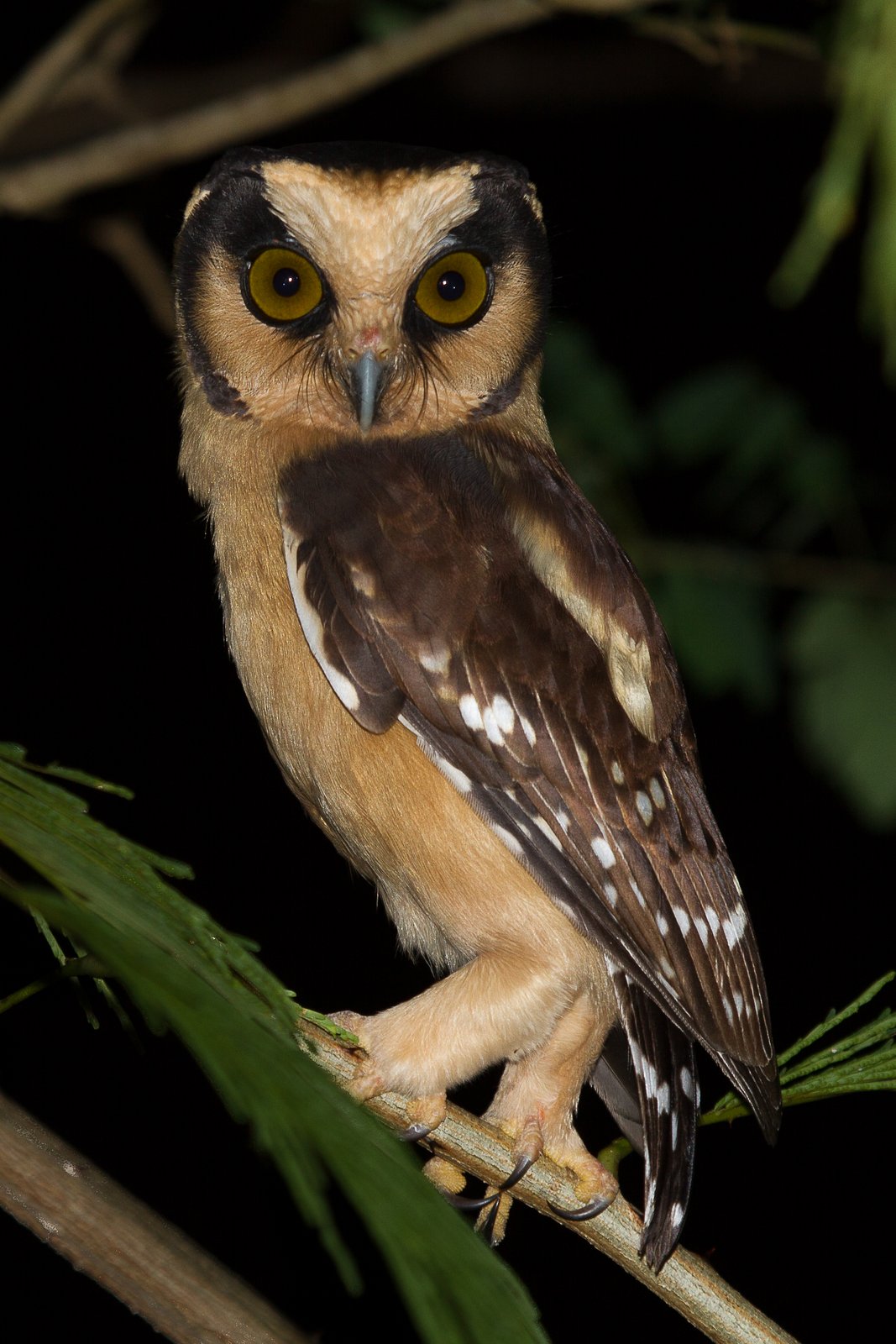
The Buff-fronted Owl is a small, compact owl without ear tufts, with a clear contrast between the chocolate-brown upperparts and the plain buff underparts and facial disc. It is related to Boreal Owl of the northern hemisphere. In the Andes it is scattered and local in montane forest, and outside them it occurs in separate populations in eastern South America.
Voice
The male's song is a rapid, quavering trill lasting several seconds, which rises and falls slightly. Fledged young beg with a hissing, rasping call.
Recording: Thyago Almeida — CC BY-NC-SA 4.0 · xeno-canto
Identification
19–21 cm, with a large, square head without ear tufts and a short tail. The facial disc is buff with a black rim and a black patch above each greenish-yellow eye. The forehead and hindneck are yellowish buff, and the rest of the head and upperparts chocolate brown, with white spots on the wings. The tail is blackish with two narrow white bars and a white tip. The underparts are plain buff, with a small brown spot on the chin. The sexes are alike.
Confusion species
No other owl in the guide area combines plain buff underparts with a pale, black-rimmed facial disc. Andean Pygmy Owl Glaucidium jardinii and related pygmy owls are smaller, with a longer tail, streaked underparts and 'false eyes' on the nape. Rufous-banded Owl Strix albitarsis is larger and densely barred, with dark eyes. Young Spectacled Owls Pulsatrix perspicillata also have a whitish to buff body, but are much larger and have a dark face.
Habitat
Humid and semi-humid montane forest, cloud forest, forest edges, Polylepis woodland and semi-open country with scattered trees, also drier forest, in the Andes roughly between 1500 and 3800 m. It hunts at night from a perch, taking insects, rodents and small birds. It nests in tree cavities, such as old woodpecker holes.
Where the bird is most at home, classified by the vegetation units of the Andes and the west coast.


Range and movements
In Colombia, Ecuador and Peru scattered and local in the Andes, on both slopes and in the inter-Andean valleys. In Bolivia local in the Andes and the eastern valleys. Absent from the Galápagos. Outside the guide area in Venezuela, on the tepuis of Venezuela and Guyana, and as a distinct subspecies in eastern and southern Brazil, Paraguay and north-eastern Argentina; also in north-western Argentina.
- Resident
- dark = core range, pale = thinly spread
How and when to look
On calm nights, listen for the long trill along forest edges in montane forest. The species is local everywhere and keeps to fixed territories; recent reports from a site give the best chance.
Conservation status
Least Concern. The population is considered stable, although deforestation in the Andes causes local habitat loss.
Scientific name
Aegolius harrisii | (Cassin, 1849)
Cassin described the species in 1849 as Nyctale Harrisii; because it was later moved to another genus, the author and year stand in brackets. The genus Aegolius was introduced in 1829 by Kaup. The genus name is Latin aegolius, a kind of screech owl, from Greek aigōlios, 'bird of ill omen'. The species name honours Edward Harris (1799–1863), an American farmer, amateur ornithologist and travelling companion and patron of Audubon. The specimen the first description was based on came from South America (per the description).