All species › Owls › Owls › Burrowing Owl
Burrowing Owl | Athene cunicularia
Holenuil | Mochuelo de madriguera | Coruja-buraqueira
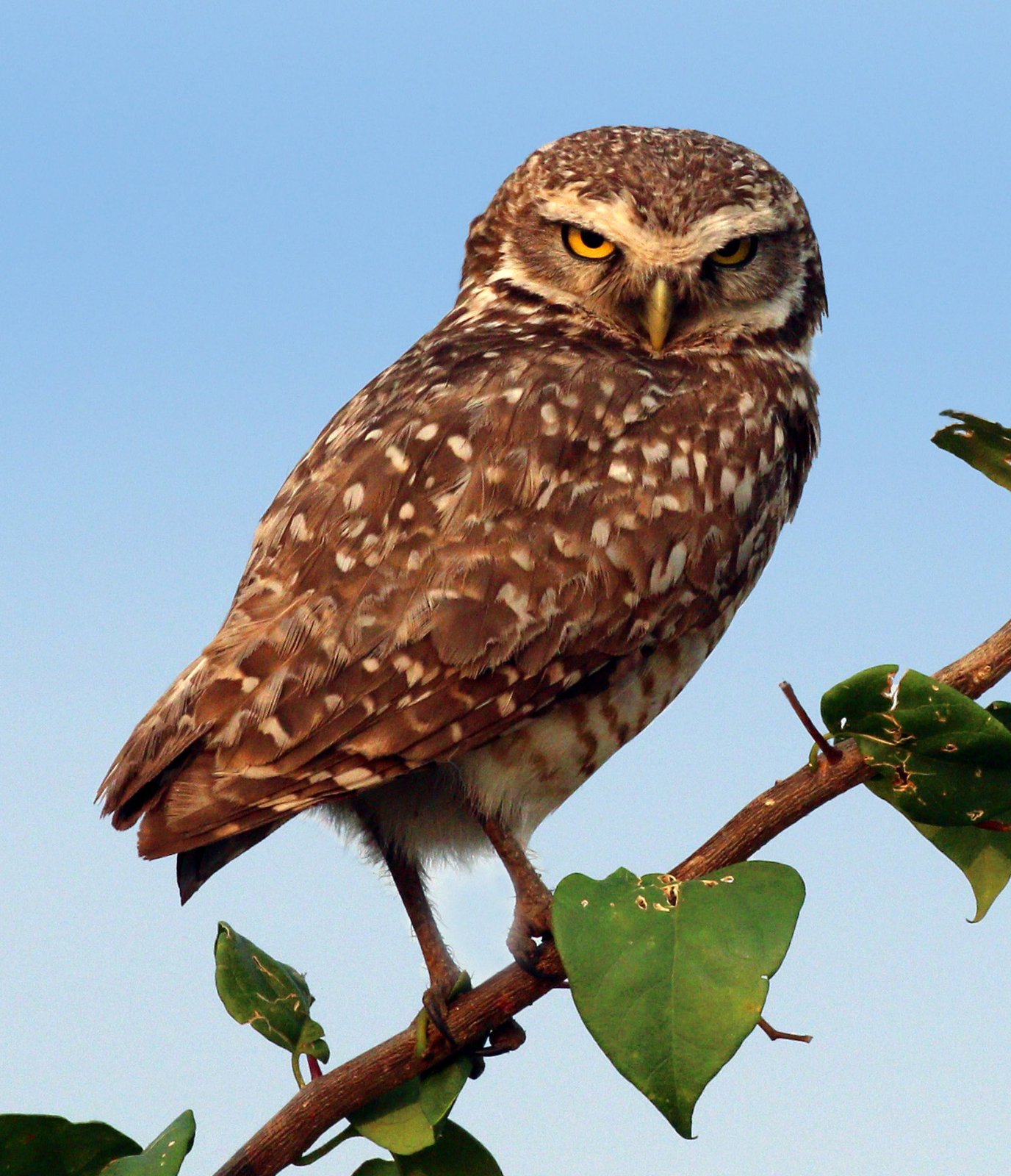
The Burrowing Owl is a small, long-legged owl of open country that lives on the ground and nests in burrows. It is also active by day and often stands upright at the entrance of its burrow or on a post. In the guide area it occurs from the coastal desert to the puna of the high Andes, with different subspecies on the coast and in the Andes.
Voice
The male gives a soft, two-part cooing call, coo-hoo, mainly at dusk and at night. When disturbed it gives rapid, cackling kwik-kwik series and hoarse screeches; young in the burrow hiss when threatened with a sound resembling a rattlesnake.
Recording: Manuel Grosselet — CC BY-NC-SA 4.0 · xeno-canto
Identification
20–26 cm; Andean birds are on average larger than coastal ones. Round head without ear tufts, yellow eyes, prominent white eyebrows and a white throat, long, thinly feathered legs and a short tail. The upperparts are sandy brown to dark brown with white spots. The breast is brown with white spots, and the belly paler with brown bars. The sexes are similar; females are often slightly darker. Juveniles have a plain brown breast and an unmarked buff belly.
Confusion species
Short-eared Owl Asio flammeus also lives in open country, but is larger, with short ear tufts, a dark-ringed facial disc and a streaked breast; it rarely stands upright on long legs. Pacific Pygmy Owl Glaucidium peruanum is smaller, with a long barred tail and 'false eyes' on the nape, and perches in trees and shrubs rather than on the ground.
Habitat
Open country with short or sparse vegetation: coastal desert, sandy plains and dry coastal scrub, puna and altiplano, dry inter-Andean valleys, pasture, fields, savanna, and also road verges, airfields and the edges of villages, from sea level to above 4000 m. It feeds on insects, mainly beetles and grasshoppers, and on rodents, lizards and small birds. It nests in a burrow in the ground, dug itself or taken over from mammals such as viscachas or armadillos.
Where the bird is most at home, classified by the vegetation units of the Andes and the west coast.


Range and movements
In Colombia local in open country, including dry valleys and the lowland savannas. In Ecuador in the inter-Andean valleys and highlands and in the dry south-west, including the Santa Elena peninsula. In Peru widespread along the entire coast and in the Andes up to the puna. In Bolivia on the altiplano, in the dry valleys and in the savannas of the eastern lowlands. Absent from the Galápagos and from closed rainforest in the Amazon basin. Outside the guide area from south-western Canada and the western United States through Central America, Florida and the Caribbean to Patagonia.
- Resident
- dark = core range, pale = thinly spread
How and when to look
By day, check posts, earth mounds and burrows for a small owl along roads through the coastal desert, over pasture and on the puna. Pairs use the same burrows for years and can often be found at the same spot.
Conservation status
Least Concern. Locally the species suffers from loss of open grassland, disturbance of burrows, traffic and pesticides, but it also uses open land created by people.
Scientific name
Athene cunicularia | (Molina, 1782)
Molina described the species in 1782 as Strix Cunicularia; because it was later moved to another genus, the author and year stand in brackets. The genus Athene was introduced in 1822 by Boie. The genus name refers to Athena, the Greek goddess of wisdom, whose sacred bird was the little owl. The species name is Latin cunicularius, 'miner, burrower', from cuniculus, 'rabbit, burrow', for its life in burrows. The specimen the first description was based on came from Chile.