All species › Owls › Owls › Cloud-forest Pygmy Owl
Cloud-forest Pygmy Owl | Glaucidium nubicola
Nevelwouddwerguil | Mochuelo nuboselvático | Caburé-das-nuvens
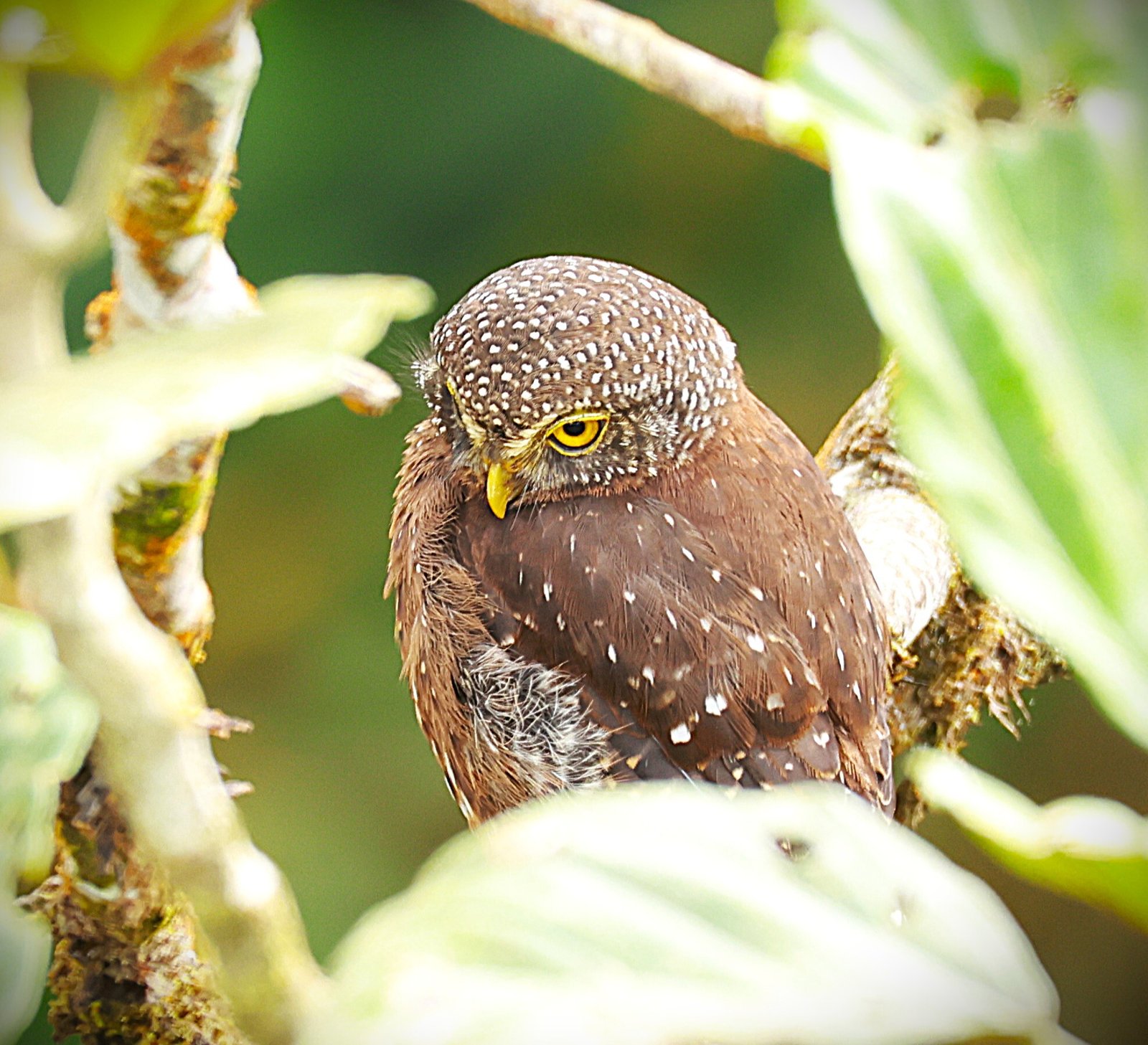
The Cloud-forest Pygmy Owl is a dark, compact pygmy owl of the cloud forests on the western slope of the Andes in Colombia and Ecuador. It was described as a separate species only in 1999; before that, the birds were included in Andean Pygmy Owl. It lives in a narrow elevation band between Central American Pygmy Owl in the lowlands and Andean Pygmy Owl higher up.
Voice
A series of hollow whistles, usually in pairs and sometimes in threes, with clear pauses between them. Most vocal in the morning, but also during the rest of the day; the song often attracts small birds that mob the owl.
Recording: Olaf Jahn — CC BY-NC-SA 4.0 · xeno-canto
Identification
14–16 cm, compact, with a round head without ear tufts, yellow eyes and a short tail. Mostly dark brown, sometimes with a rufous wash. Crown with fine pale dots; back, breast sides and flanks almost without pale spots or bars. On the nape two dark, white-edged 'false eyes'. The tail is blackish with narrow, incomplete white bars. Chin, sides of the throat and upper breast white, the rest of the underparts white with dark streaks. Females are slightly larger than males.
Confusion species
Andean Pygmy Owl Glaucidium jardinii lives higher, has a clearly pale-spotted back and a longer tail, and sings a long, rapid series of notes. Central American Pygmy Owl Glaucidium griseiceps lives lower, in the lowlands and foothills, and has a grey head. Ferruginous Pygmy Owl Glaucidium brasilianum lives in lower and more open country, with a streaked crown and a rufous, barred tail.
Habitat
Humid cloud forest on steep slopes, roughly between 900 and 2000 m, mainly in the canopy and middle layers, sometimes lower when hunting. It tolerates lightly disturbed forest and forest edges, but not heavily degraded forest. It also hunts by day, taking insects, small birds and lizards. It nests in tree cavities.
Where the bird is most at home, classified by the vegetation units of the Andes and the west coast.


Range and movements
In Colombia on the western slope of the Western Andes, from Risaralda southwards. In Ecuador on the western slope of the Andes in the north-west, south to about Cotopaxi, with an isolated population in El Oro. Absent from Peru, Bolivia and the Galápagos. Endemic to the guide area.
- Resident
- dark = core range, pale = thinly spread
How and when to look
Along roads and trails through cloud forest on the western slope in north-western Ecuador, for example around Mindo, or in the Western Andes of Colombia. By day, watch for flocks of small birds giving alarm calls and listen for the paired notes.
Conservation status
Vulnerable. Its habitat has shrunk greatly through deforestation, mainly logging, and further through road building, farming, gold mining, coca growing and cattle ranching. Only a small part of the range lies within protected areas.
Scientific name
Glaucidium nubicola | Robbins & Stiles, 1999
Robbins & Stiles described the species in 1999 and placed it straight away in the genus where it still stands. The genus Glaucidium was introduced in 1826 by Boie. The genus name comes from Greek glaukidion, 'owlet', a diminutive of glaux, 'owl'; Friedrich Boie introduced it in 1826. The species name is Latin for 'cloud-dweller', from nubes, 'cloud', and -cola, 'inhabitant', for the very wet cloud forests where it lives. The specimen the first description was based on came from Chical, Carchi, Ecuador.