All species › Owls › Owls › Andean Pygmy Owl
Andean Pygmy Owl | Glaucidium jardinii
Andesdwerguil | Mochuelo andino | Caburé-andino
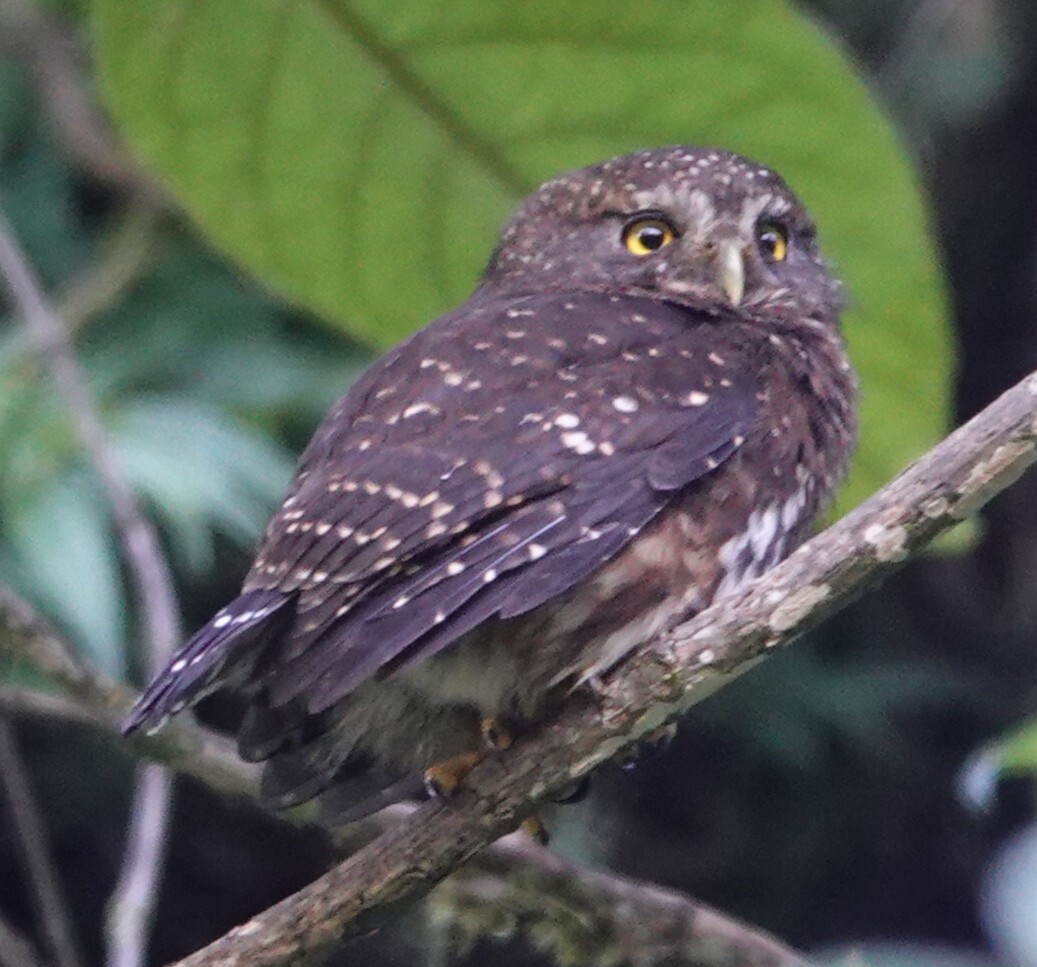
The Andean Pygmy Owl is the pygmy owl of the higher montane forests of the northern Andes, up to the treeline. It is also active by day and is often found because small birds mob it loudly. Cloud-forest, Yungas and Costa Rican Pygmy Owls were formerly included in this species.
Voice
A long series of rapid, evenly spaced hollow notes, poop-poop-poop, sometimes preceded by two whistles. It sings by day and at night.
Recording: Peter de Rouw — CC BY-NC-SA 4.0 · xeno-canto
Identification
15–16 cm, with a round head without ear tufts, yellow eyes, white eyebrows, a white 'moustache' and a broad white throat. There is a dark brown morph with white markings and a chestnut morph with buff markings. The crown has small white dots, the back pale spots. On the nape a black-and-white pattern of 'false eyes'. The tail has pale bars, white in the brown and buff in the rufous morph. The breast sides are dark with pale markings, the rest of the underparts white with heavy brown streaks. The sexes are alike.
Confusion species
Cloud-forest Pygmy Owl Glaucidium nubicola lives lower on the western slope, has an almost unspotted back and a shorter tail, and sings notes in pairs. Yungas Pygmy Owl Glaucidium bolivianum replaces it further south on the eastern slope in Peru and sings a slower series. Ferruginous Pygmy Owl Glaucidium brasilianum and Pacific Pygmy Owl Glaucidium peruanum live lower and in more open or drier country and have a streaked crown.
Habitat
Cloud forest, elfin forest at the treeline, Polylepis woodland and sometimes forest edges and pasture with scattered trees, from the middle layers into the canopy, in Colombia roughly between 1500 and 3500 m, in Ecuador and Peru somewhat higher. It hunts by day and night, taking invertebrates, small birds and small mammals. It nests in tree cavities, such as old woodpecker holes.
Where the bird is most at home, classified by the vegetation units of the Andes and the west coast.


Range and movements
In Colombia in all three Andean ranges. In Ecuador on both slopes and in the higher parts of the Andes. In Peru only in the north; the boundary with Yungas Pygmy Owl is not precisely known. Absent from Bolivia and the Galápagos. Outside the guide area in western Venezuela.
- Resident
- dark = core range, pale = thinly spread
How and when to look
By day, listen in cloud forest and along the treeline for the series of notes and watch for alarmed groups of hummingbirds, tanagers and other small birds. It often perches on an open branch at the forest edge.
Conservation status
Least Concern. The species is locally fairly common, but deforestation in the Andes may affect the population in the long term.
Scientific name
Glaucidium jardinii | (Bonaparte, 1855)
Bonaparte described the species in 1855 as Phalaenopsis jardinii; because it was later moved to another genus, the author and year stand in brackets. The genus Glaucidium was introduced in 1826 by Boie. The genus name comes from Greek glaukidion, 'owlet', a diminutive of glaux, 'owl'; Friedrich Boie introduced it in 1826. The species name honours Sir William Jardine (1800–1874), a Scottish naturalist and editor of The Naturalist's Library. The specimen the first description was based on came from Andes near Quito, Ecuador.