All species › Owls › Owls › Yungas Pygmy Owl
Yungas Pygmy Owl | Glaucidium bolivianum
Boliviaanse dwerguil | Caburé yungueño | Caburé-das-yungas
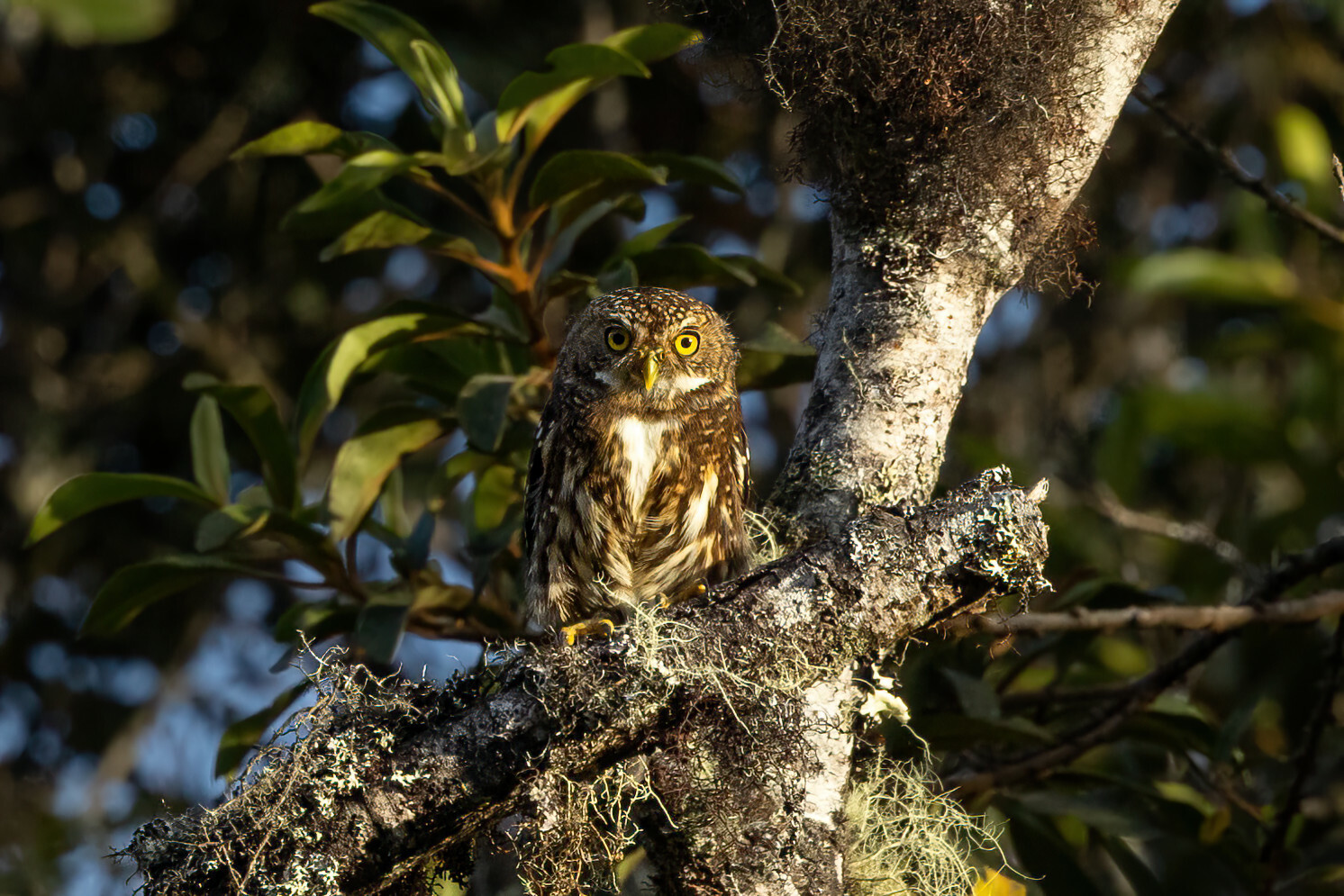
The Yungas Pygmy Owl is the pygmy owl of the Yungas, the humid montane forests on the eastern slope of the Andes from Peru to north-western Argentina. It was formerly regarded as a subspecies of Andean Pygmy Owl, but differs in song. Like its relatives it is also active by day.
Voice
A rather slow series of evenly spaced hollow notes, sometimes preceded by two or three whistles. It sings by day and at night.
Recording: Jacob Wijpkema — CC BY-NC-SA 4.0 · xeno-canto
Identification
16 cm, with a round head without ear tufts, yellow eyes, white eyebrows and a white throat. There are brown and rufous morphs and, rarely, a grey one. Crown, back and upperwing with pale spots, and the tail with pale bars. On the nape two black, white-edged 'false eyes'. The underparts are pale, with brown streaks on the flanks and belly. Females are on average slightly heavier than males.
Confusion species
Andean Pygmy Owl Glaucidium jardinii lives further north and sings a faster, long series of notes; in the field the song is the best feature. Long-whiskered Owlet Xenoglaux loweryi is smaller, with almost no tail, orange-brown eyes and long whiskers. Subtropical Pygmy Owl Glaucidium parkeri lives lower, in the foothills, and sings short series of a few notes. Amazonian Pygmy Owl Glaucidium hardyi lives in lowland forest in the Amazon basin and has a greyer head.
Habitat
Humid montane forest, cloud forest with heavy moss and epiphytes, and Podocarpus forest, from the middle layers into the canopy, mostly between 1400 and 3000 m, locally from 900 m and in Bolivia up to 3900 m. It hunts insects, small birds and small mammals. It nests in tree cavities.
Where the bird is most at home, classified by the vegetation units of the Andes and the west coast.


Range and movements
In Peru on the eastern slope of the Andes, from Amazonas and San Martín southwards. In Bolivia in the Yungas and the montane forests of the eastern slope. Absent from Colombia, Ecuador and the Galápagos. Outside the guide area in north-western Argentina.
- Resident
- dark = core range, pale = thinly spread
How and when to look
Along roads through the Yungas, for example the Manu road in Peru or the Yungas road in Bolivia. Listen for the slow series of notes and watch for small birds giving alarm calls.
Conservation status
Least Concern. The species is locally fairly common; deforestation on the eastern slope is a local threat.
Scientific name
Glaucidium bolivianum | König, 1991
König described the species in 1991 and placed it straight away in the genus where it still stands. The genus Glaucidium was introduced in 1826 by Boie. The genus name comes from Greek glaukidion, 'owlet', a diminutive of glaux, 'owl'; Friedrich Boie introduced it in 1826. The species name refers to Bolivia, the country named after Simón Bolívar (1783–1830). The specimen the first description was based on came from Bolivia.