All species › Owls › Owls › Subtropical Pygmy Owl
Subtropical Pygmy Owl | Glaucidium parkeri
Parkers dwerguil | Mochuelo subtropical | Caburé-subtropical
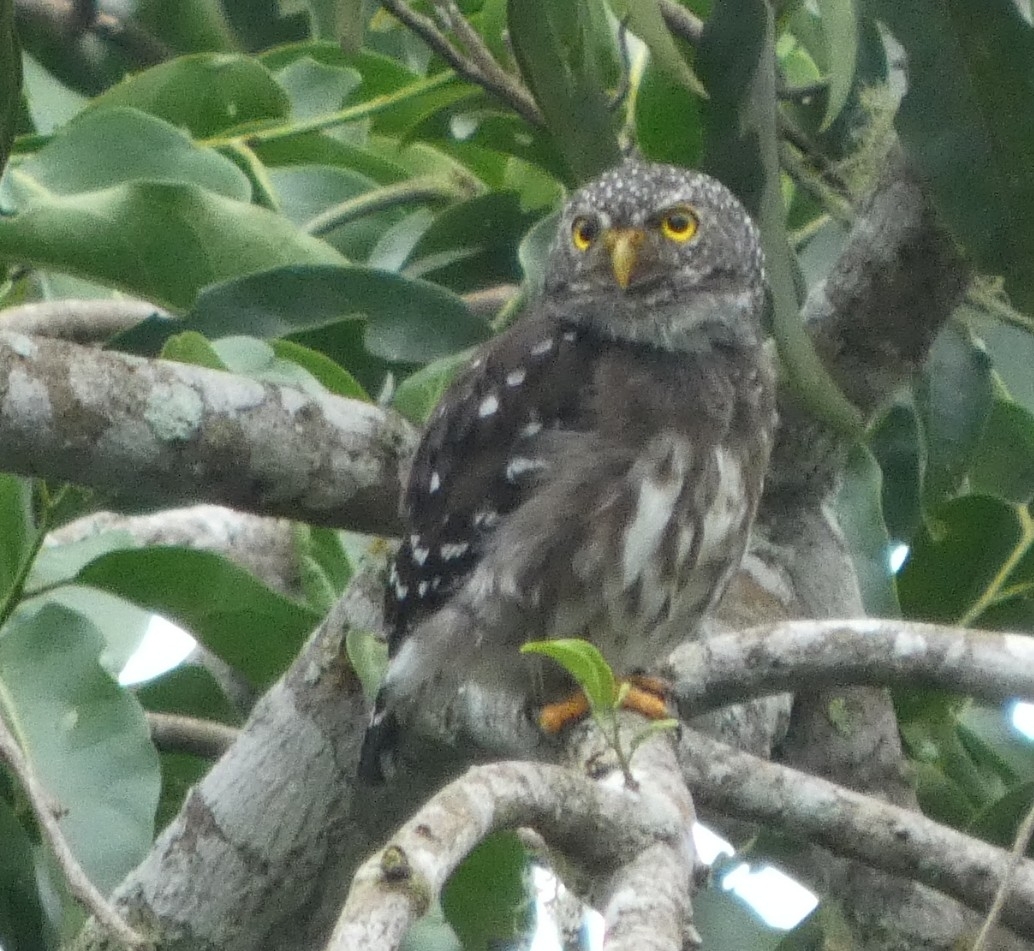
The Subtropical Pygmy Owl is a small pygmy owl of the lower montane rainforest on the eastern slope of the Andes. The species was described only in 1995 and is named after the American ornithologist Ted Parker. It lives high in the canopy and is mostly detected by its song.
Voice
Short groups of two or three soft, hollow whistles, hoo-hoo or hoo-hoo-hoo, repeated with regular pauses. It sings mainly at dusk and at night, sometimes by day.
Recording: Jorge L. Peña — CC BY-NC-SA 4.0 · xeno-canto
Identification
14 cm, a small, compact pygmy owl with a round head without ear tufts, yellow eyes and white eyebrows. The upperparts are warm dark brown; crown and forehead are densely covered with white dots, and the scapulars and wing coverts also bear distinct white spots. On the nape a black-and-white pattern of 'false eyes'. The tail is short and dark, with narrow white bars. The underparts are white, with rufous-brown spots and streaks on the breast sides and flanks. The sexes are alike.
Confusion species
Andean Pygmy Owl Glaucidium jardinii lives higher, has fewer white spots on the back and sings a long, rapid series of notes. Yungas Pygmy Owl Glaucidium bolivianum is larger and longer-tailed, also lives higher and sings a long, slow series. Amazonian Pygmy Owl Glaucidium hardyi lives in the lowlands, has a greyer head and an almost unspotted back and sings a rapid trill.
Habitat
Humid montane rainforest on the eastern slope, mainly in the canopy and at forest edges, roughly between 1400 and 2000 m. It feeds on large insects and small vertebrates. Little is known about breeding; it presumably nests in tree cavities, like other pygmy owls.
Where the bird is most at home, classified by the vegetation units of the Andes and the west coast.


Range and movements
In Colombia only locally on the eastern slope, mainly in the south. In Ecuador locally on the eastern slope. In Peru scattered along the eastern slope from north to south. In Bolivia locally in the Yungas. Absent from the Galápagos. Does not occur outside the guide area.
- Resident
- dark = core range, pale = thinly spread
How and when to look
At dusk, listen along roads through mid-elevation forest on the eastern slope for the short groups of whistles. By day, the alarm calls of small birds may reveal its position.
Conservation status
Least Concern. The species is poorly known and probably more widespread than the number of records suggests; deforestation on the eastern slope is a threat.
Scientific name
Glaucidium parkeri | Robbins & Howell, 1995
Robbins & Howell described the species in 1995 and placed it straight away in the genus where it still stands. The genus Glaucidium was introduced in 1826 by Boie. The genus name comes from Greek glaukidion, 'owlet', a diminutive of glaux, 'owl'; Friedrich Boie introduced it in 1826. The species name honours Theodore A. (Ted) Parker III (1953–1993), an American ornithologist with unrivalled knowledge of Neotropical birds and their voices. The specimen the first description was based on came from Panguri, Zamora-Chinchipe, Ecuador.