All species › Waders, gulls and terns › Stilts and avocets › Andean Avocet
Andean Avocet | Recurvirostra andina
Andeskluut | Avoceta andina | Alfaiate-andino
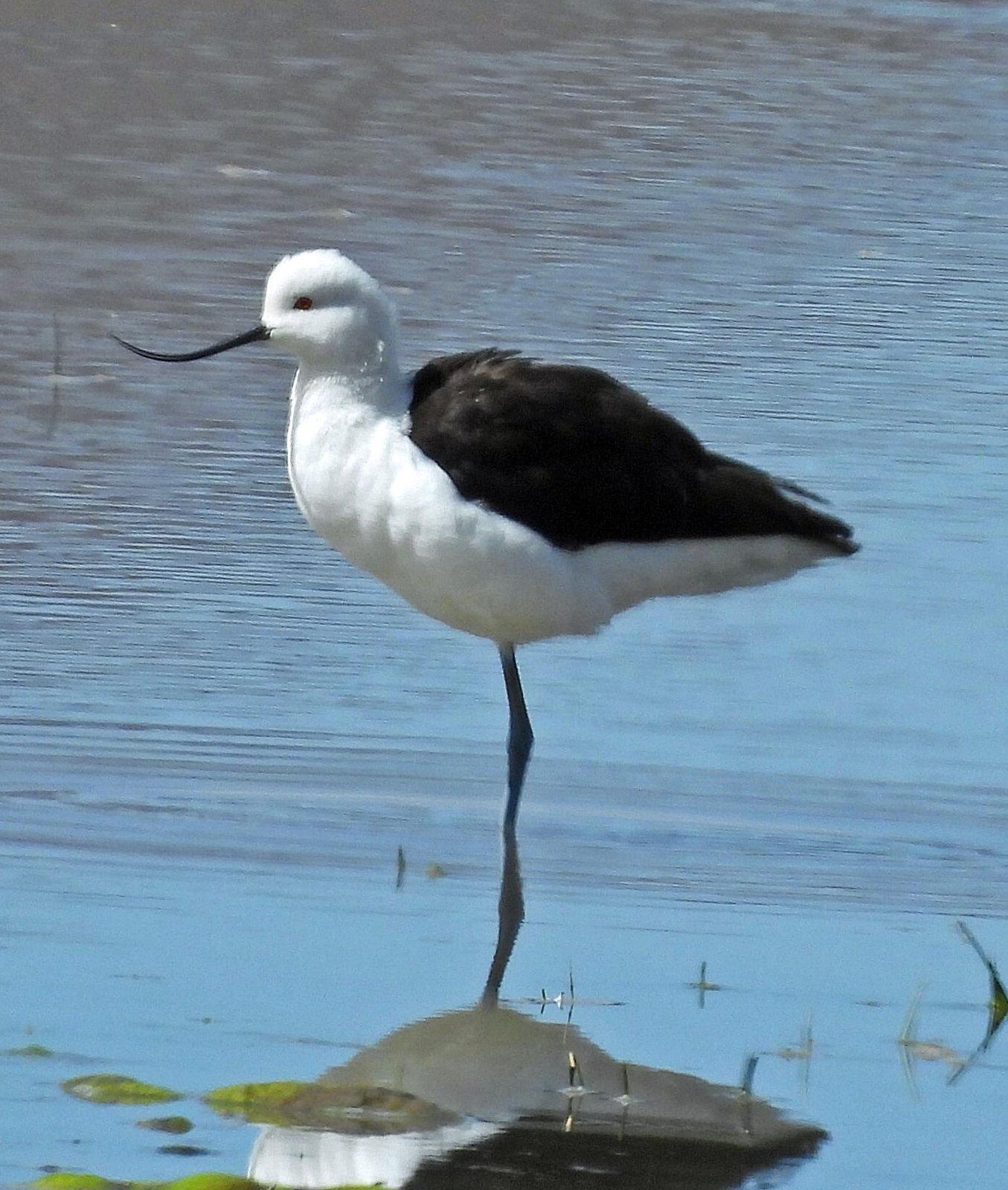
The Andean Avocet is a stocky black-and-white avocet of the salt lakes and lagoons of the high Andes. It is the only avocet that spends its entire life above about 3500 m, foraging with sideways sweeps of the bill in shallow, often saline water, often together with flamingos.
Voice
A loud, nasal, repeated call, kloot or week, mainly when disturbed and in flight, and a sharp alarm note at the nest.
Recording: Andrew Spencer — CC BY-NC-SA 3.0 · xeno-canto
Identification
43–48 cm, with a long, thin, upturned black bill and fairly short, bluish-grey legs. The head, neck, belly and rump are white; the back, wings and tail are wholly black, without a white wing pattern. The eye is red. The sexes are almost alike, the female having a slightly more curved bill. Juveniles have brownish fringes to the black feathers.
Confusion species
American Avocet Recurvirostra americana, a rare vagrant in the lowlands, has a black-and-white wing pattern, longer legs and an orange-buff or grey head and neck. Black-necked Stilt Himantopus mexicanus has a straight bill, long pink legs and a black hindneck and head.
Habitat
Shallow saline and brackish lakes, lagoons, salt flats with pools and marshy lake shores on the puna and altiplano, roughly between 3500 and 4600 m, sometimes in bofedales. It feeds on small crustaceans, insect larvae and other invertebrates. It breeds singly or in loose groups; the nest is a scrape on an islet or bare shore, sometimes with some plant material.
Where the bird is most at home, classified by the vegetation units of the Andes and the west coast.


Range and movements
In Peru in the high Andes of the centre and south, mainly from Junín and Huancavelica south to Puno and Tacna. In Bolivia on the altiplano and in the salt flats of the south-west. Absent from Colombia, Ecuador and the Galápagos. Outside the guide area in northern Chile and north-western Argentina.
- Resident
- dark = core range, pale = thinly spread
How and when to look
On the salt lakes and lagoons of the altiplano, such as around Lake Junín, Salinas y Aguada Blanca near Arequipa and the lagoons of south-western Bolivia, often among flamingos and other waterbirds. Birds are present all year, but move between lakes as water levels change.
Conservation status
Least Concern. The species depends on shallow high-Andean lakes, which are sensitive to mining, water extraction and drought.
Scientific name
Recurvirostra andina | Philippi & Landbeck, 1861
Philippi & Landbeck described the species in 1861 and placed it straight away in the genus where it still stands. The genus Recurvirostra was introduced in 1758 by Linnaeus. The genus name comes from Latin recurvus, 'curved backwards', and rostrum, 'bill'. The specific name andina refers to the Andes; this is not necessarily the type locality. The specimen the first description was based on came from Laguna Parinacota, Arica y Parinacota, Chile.