All species › Waders, gulls and terns › Stilts and avocets › Black-necked Stilt
Black-necked Stilt | Himantopus mexicanus
Amerikaanse steltkluut | Candelero americano | Pernilongo-de-costas-negras
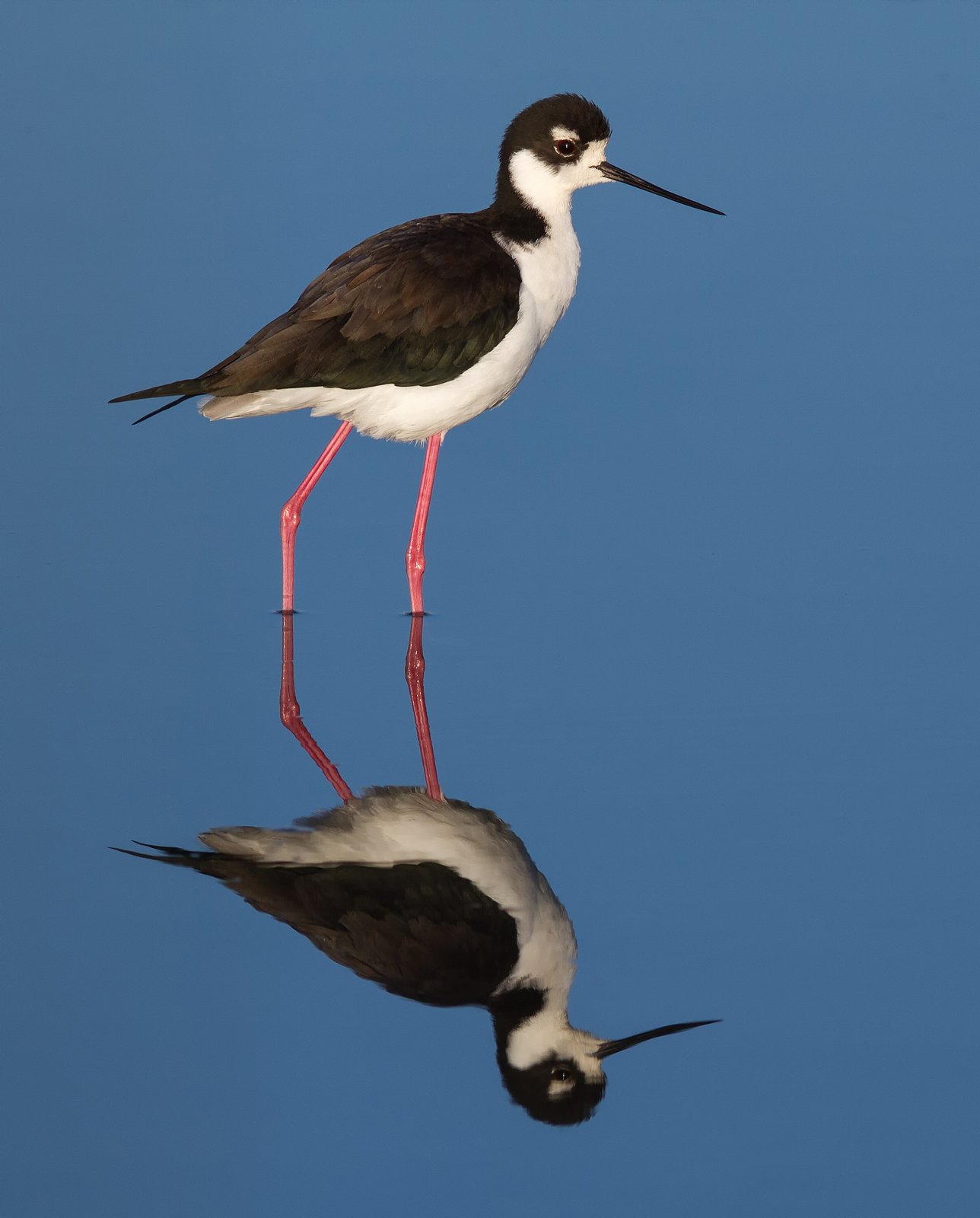
The Black-necked Stilt is a slender black-and-white shorebird with exceptionally long, pink legs and a needle-thin, straight bill. It is the most widespread stilt in the guide area and breeds from the mangrove coast to the lakes of the altiplano and on the Galápagos. In the south the white-backed form melanurus occurs.
Voice
A loud, sharp, yapping call, kek-kek-kek or keep, repeated constantly when disturbed, often by several birds at once.
Recording: José María Loaiza B. — CC BY-NC-SA 4.0 · xeno-canto
Identification
35–39 cm, with very long pink to red legs, a long, thin, straight black bill and a small head. The upperparts, hindneck and head are black, with a white spot above the eye; the foreneck, breast and belly are white. The male is glossy black, the female has a brownish tinge on the back. In the southern form melanurus a white band runs across the hindneck between head and back and the head is whiter. Juveniles are browner, with pale feather fringes.
Confusion species
Andean Avocet Recurvirostra andina has an upturned bill, shorter, bluish-grey legs and a wholly white head and neck. American Avocet Recurvirostra americana, a rare vagrant, has an upturned bill, bluish-grey legs and a white wing pattern. Other black-and-white shorebirds in the guide area have much shorter legs.
Habitat
Shallow fresh, brackish and salt water: lagoons, salt pans, estuaries, marshes, rice fields, sewage ponds, flooded pastures and lake shores, from sea level to over 4000 m on the altiplano. It picks insects, small crustaceans, worms and small fish from the water surface or the mud. It breeds in loose colonies; the nest is a scrape or a mound of plant material on a shore or islet.
Where the bird is most at home, classified by the vegetation units of the Andes and the west coast.


Range and movements
In Colombia in the Caribbean lowlands, the Magdalena valley, the Cauca valley, along the Pacific coast and locally in the Llanos and on the Bogotá plateau. In Ecuador mainly along the coast and in the western lowlands, locally in the highlands. In Peru along the entire coast, locally in the highlands and scattered in the Amazonian lowlands. In Bolivia in the lowland savannas and on the altiplano. On the Galápagos a small resident breeding population. Outside the guide area from the United States to Argentina and Chile.
- Resident
- dark = core range, pale = thinly spread
How and when to look
Along the coast of Peru and Ecuador at lagoons, salt pans and sewage ponds, where birds forage all year. On the Galápagos on the lagoons near Puerto Villamil and Punta Cormorant. At the nest they fly at the observer, calling loudly.
Conservation status
Not Evaluated as a separate species. In this taxonomy it has not been assessed separately on the Red List; the species group as a whole is widespread and not threatened. Locally it loses breeding sites to the drainage and development of lagoons.
Scientific name
Himantopus mexicanus | (Müller, 1776)
Müller described the species in 1776 as Charadrius Mexicanus; because it was later moved to another genus, the author and year stand in brackets. The genus Himantopus was introduced in 1760 by Brisson. The genus name comes from Greek himantopous, 'strap-leg', from himas 'strap' and pous 'foot', after the long, thin legs. The specific name mexicanus refers to Mexico; this is not necessarily the type locality. The specimen the first description was based on came from Mexico.