All species › Waders, gulls and terns › Stilts and avocets › American Avocet
American Avocet | Recurvirostra americana
Amerikaanse kluut | Avoceta americana | Alfaiate-americano
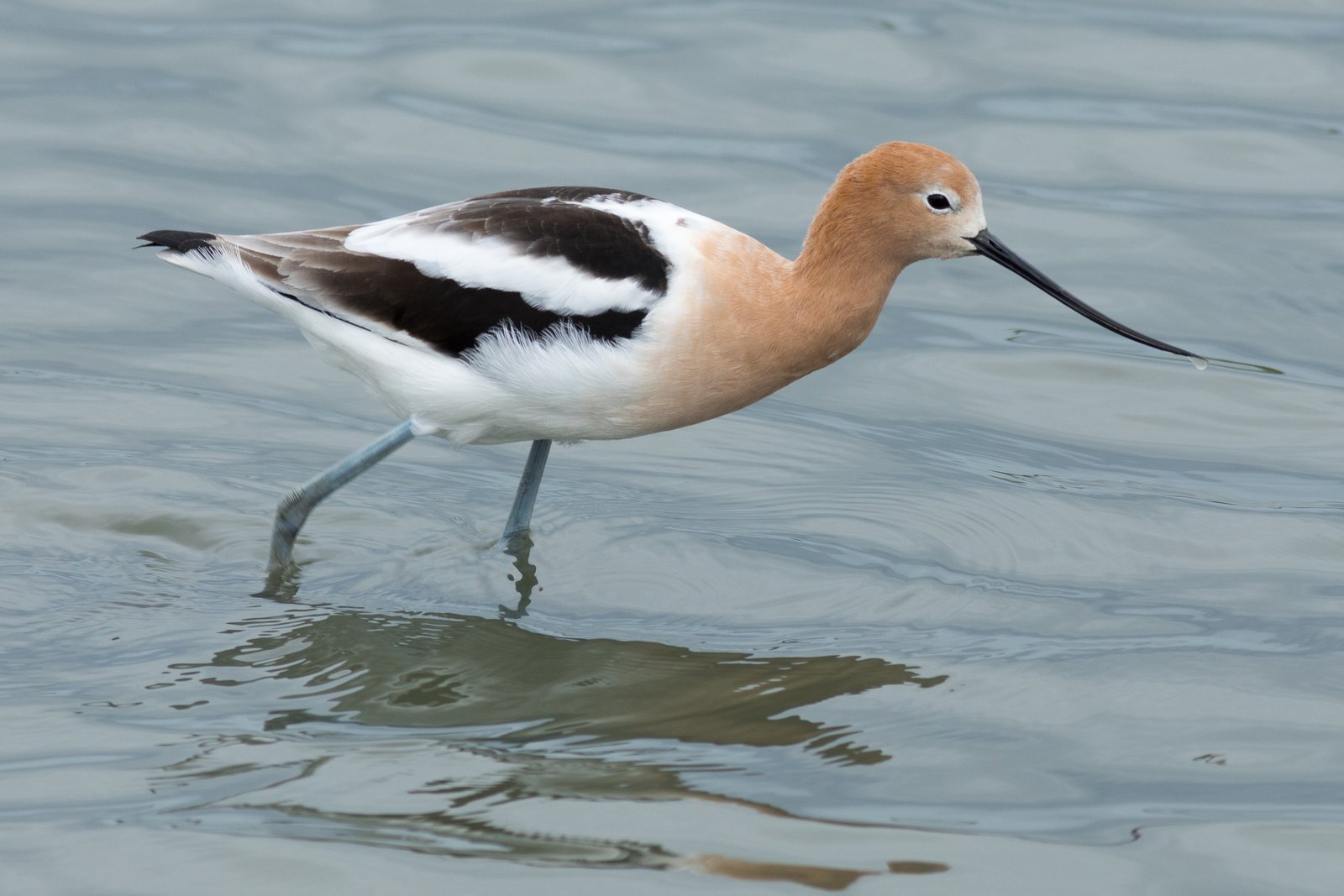
The American Avocet is a large black-and-white shorebird with a long, thin, upturned bill that breeds in western North America and has been recorded in the guide area only as a very rare vagrant. It forages by sweeping its bill sideways through shallow water.
Voice
A loud, shrill, repeated call, kleep or pleet, mainly when disturbed. Vagrants rarely call.
Recording: Craig Robertson — CC BY-NC-SA 4.0 · xeno-canto
Identification
43–47 cm, with long bluish-grey legs and a long, thin, strongly upturned black bill, shorter and more strongly curved in the female. The back and wings show a pattern of black and white. In breeding plumage the head and neck are warm orange-buff, in non-breeding plumage pale grey. The belly and rump are white. In flight the legs project far beyond the tail.
Confusion species
Andean Avocet Recurvirostra andina has wholly black wings and back, a white head without orange or grey and shorter legs, and lives only in the high Andes. Black-necked Stilt Himantopus mexicanus has a straight bill, pink legs and black upperparts without a white pattern.
Habitat
Shallow, open waters: salt pans, lagoons, tidal flats, shallow lakes and sewage ponds. It feeds on small crustaceans, insect larvae and other invertebrates, which it sifts from the water with sideways bill movements. In North America it breeds on bare shores.
Where the bird is most at home, classified by the vegetation units of the Andes and the west coast.


Range and movements
Recorded in the guide area only as a very rare vagrant, mainly in the north; there is no regular place or time of occurrence. Breeds in western and central North America and winters on the coasts of the southern United States, Mexico and Central America. Absent from the Galápagos.
How and when to look
A vagrant may turn up among other shorebirds on salt pans, lagoons and shallow lakes along the coast, mainly in the northern winter. The upturned bill and the black-and-white wing pattern are distinctive.
Conservation status
Least Concern. Numbers are large, but depend on shallow wetlands in arid regions, which are sensitive to water extraction and drought.
Scientific name
Recurvirostra americana | Gmelin, 1789
Gmelin described the species in 1789 and placed it straight away in the genus where it still stands. The genus Recurvirostra was introduced in 1758 by Linnaeus. The genus name comes from Latin recurvus, 'curved backwards', and rostrum, 'bill'. The specific name americana refers to America; this is not necessarily the type locality. The specimen the first description was based on came from North America.