All species › Waders, gulls and terns › Oystercatchers › Blackish Oystercatcher
Blackish Oystercatcher | Haematopus ater
Zuid-Amerikaanse zwarte scholekster | Ostrero negruzco | Piru-piru-preto
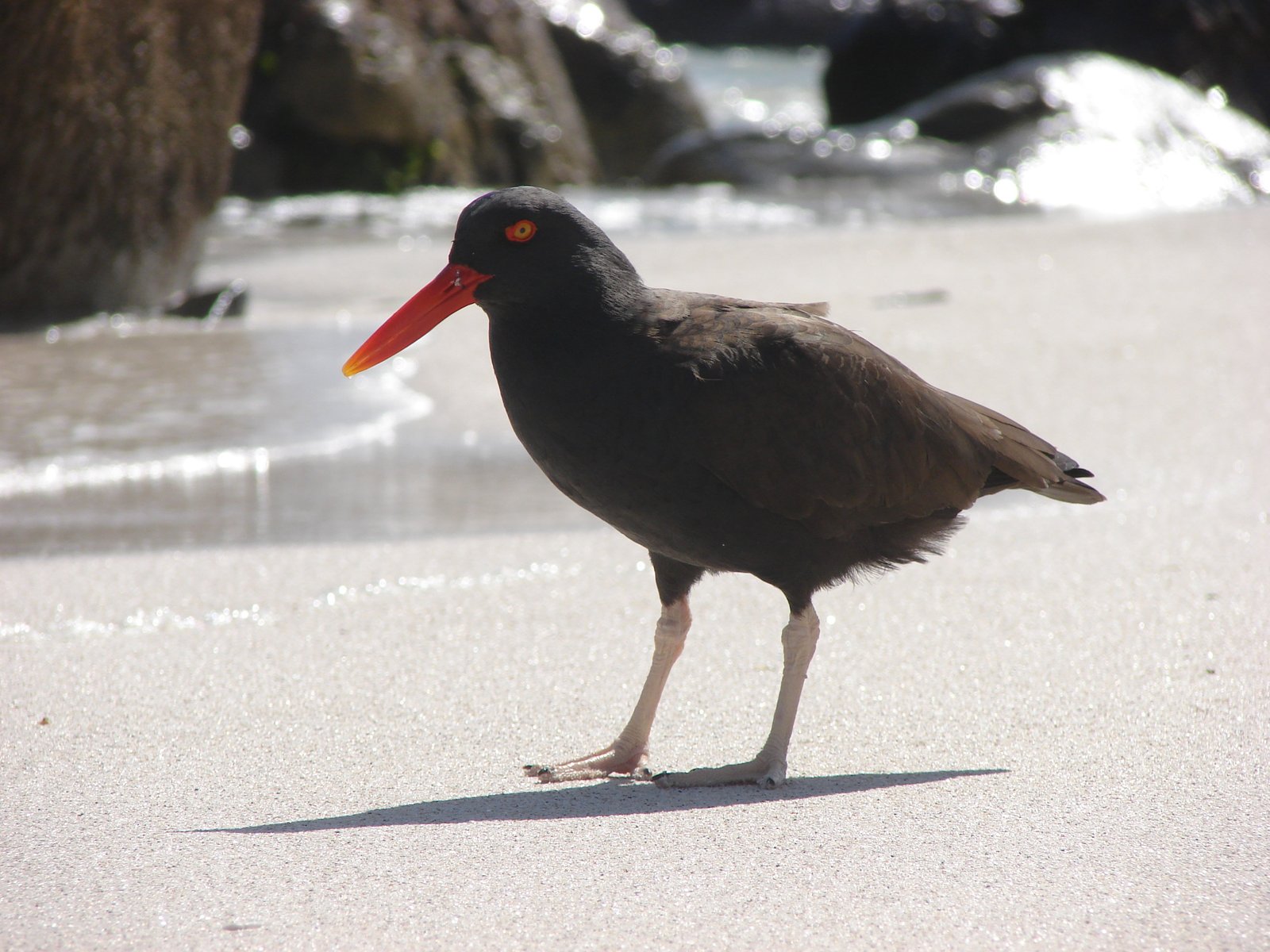
The Blackish Oystercatcher is an all-dark oystercatcher of rocky Pacific coasts, with a bright red bill and pale legs. It lives in pairs on cliffs and rocky beaches and in the guide area is almost restricted to the coast of Peru.
Voice
Loud, piercing whistles, kleep or week, often accelerating into a shrill trill in displaying or territorial pairs.
Recording: Cristian Pinto — CC BY-NC-SA 4.0 · xeno-canto
Identification
42–45 cm, stocky, with a long, straight, laterally compressed orange-red bill, a yellow iris with a red eye-ring and thick, pale pink legs. The plumage is entirely blackish brown, blacker on the head and neck, without white in the wing or tail. The sexes are alike; the female has a slightly longer bill. Juveniles are browner, with a duller, dark-tipped bill.
Confusion species
American Oystercatcher Haematopus palliatus has a white belly, a white wing bar and white rump, and favours sandy beaches. Outside the guide area the Black Oystercatcher Haematopus bachmani of North America is the most similar species.
Habitat
Rocky coasts, cliffs, rocky islets and boulder beaches, sometimes also shingle beaches, along the cold coast of the Humboldt Current. It feeds on mussels, limpets, sea urchins and other invertebrates from the rocks in the intertidal zone, which it knocks loose or prises open with its bill. The nest is a scrape among rocks or on shingle above the tideline.
Where the bird is most at home, classified by the vegetation units of the Andes and the west coast.


Range and movements
In Peru along the rocky coast from the north (from about La Libertad) south to Tacna, including the offshore islands. In Ecuador at most very rare in the south. Absent from Colombia, Bolivia and the Galápagos. Outside the guide area along the coasts of Chile and Argentina to Tierra del Fuego and the Falkland Islands.
- Resident
- dark = core range, pale = thinly spread
How and when to look
On rocky coasts and cliffs south of Lima, such as at Pucusana, on the Paracas peninsula and along the coast of Arequipa and Moquegua, often in pairs on the rocks just above the surf.
Conservation status
Not Evaluated. The species is widespread along the rocky coast, but locally sensitive to disturbance by people and dogs and to shellfish collecting.
Scientific name
Haematopus ater | Vieillot, 1825
Vieillot described the species in 1825 and placed it straight away in the genus where it still stands. The genus Haematopus was introduced in 1758 by Linnaeus. The genus name is from Greek haima, 'blood', and pous, 'foot', after the red legs. The species name is Latin ater, 'black', after the all-dark plumage. The specimen the first description was based on came from Strait of Magellan, Chile.