All species › Waders, gulls and terns › Oystercatchers › American Oystercatcher
American Oystercatcher | Haematopus palliatus
Amerikaanse bonte scholekster | Ostrero americano | Piru-piru
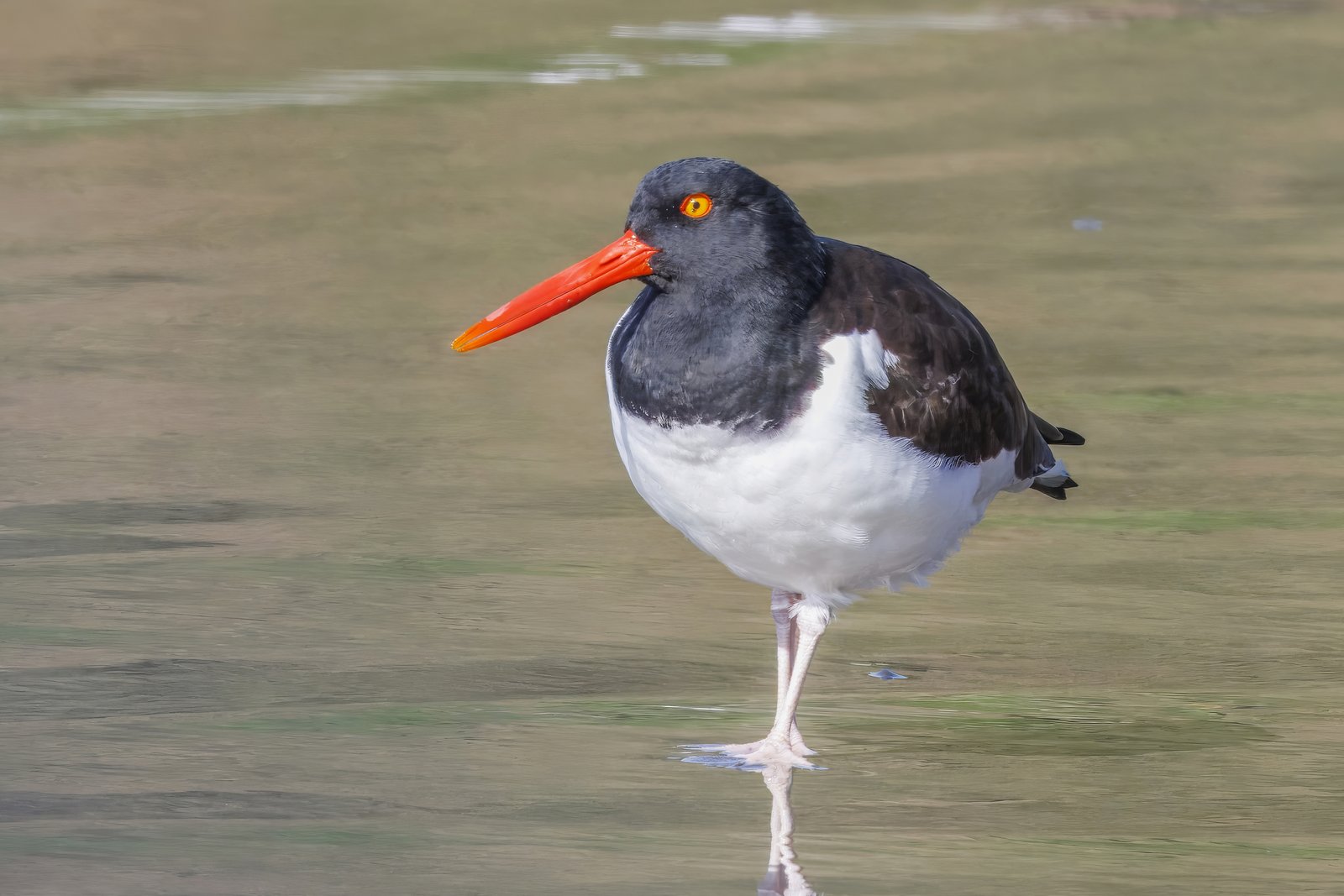
The American Oystercatcher is a large black, brown and white oystercatcher with a bright red bill that lives on sandy beaches, tidal flats and rocky shores of both oceans. In the guide area it breeds along the Caribbean and Pacific coasts and on the Galápagos, where the birds are notably tame.
Voice
Loud, clear whistles, week or kleep, often in an accelerating series; pairs call together in a shrill trill during display.
Recording: Jonas Nilsson — CC BY-NC-SA 4.0 · xeno-canto
Identification
40–44 cm, with a long, straight orange-red bill, a yellow iris with a red eye-ring and thick, pale pink legs. The head and neck are black, the back and wings dark brown, and the breast and belly white, with a sharp border on the breast. In flight a broad white wing bar and a white base to the upper tail stand out. The sexes are alike. Juveniles have brown feather fringes and a duller, dark-tipped bill. Birds of the Galápagos (galapagensis) are darker and show less white in the wing.
Confusion species
Blackish Oystercatcher Haematopus ater is entirely blackish brown, without a white belly or wing bar, and lives on rocky coasts in Peru. Other black-and-white coastal shorebirds lack a red bill.
Habitat
Sandy beaches, tidal flats, estuaries, shell banks, mangrove edges and rocky shores, on the Galápagos also lava coasts. It feeds on mussels, oysters, crabs, lugworms and other invertebrates, which it prises open or pulls from the sand with its bill. The nest is a scrape on a beach, dune or shell bank above the tideline.
Where the bird is most at home, classified by the vegetation units of the Andes and the west coast.


Range and movements
In Colombia along the Caribbean coast, including the Guajira, and locally along the Pacific coast. In Ecuador along the coast, mainly in the south-west. In Peru along the coast, mainly on sandy beaches and in estuaries, scarcer in the south. On the Galápagos widespread along the coasts of all larger islands. Absent from Bolivia. Outside the guide area from the United States and Mexico along both coasts to Chile and Argentina.
- Resident
- dark = core range, pale = thinly spread
How and when to look
On wide sandy beaches and at estuaries along the coast, at low tide on mudflats and shell banks. On the Galápagos pairs forage on lava rocks and beaches and allow close views.
Conservation status
Least Concern. The species is sensitive to disturbance of breeding beaches by recreation, vehicles and dogs; on the Galápagos the population is small.
Scientific name
Haematopus palliatus | Temminck, 1820
Temminck described the species in 1820 and placed it straight away in the genus where it still stands. The genus Haematopus was introduced in 1758 by Linnaeus. The genus name is from Greek haima, 'blood', and pous, 'foot', after the red legs. The species name is Latin palliatus, 'cloaked', from pallium, 'cloak', after the dark upperparts. The specimen the first description was based on came from Venezuela.