All species › Waders, gulls and terns › Skimmers, noddies, terns and gulls › Andean Gull
Andean Gull | Chroicocephalus serranus
Andesmeeuw | Gaviota andina | Gaivota-andina
Andean Gull is the gull of the high lakes and bogs of the Andes, from Ecuador to Chile and Argentina. It breeds on high plateaus between roughly 3000 and 4800 m and is often the only gull there. Outside the breeding season part of the population moves to the coast of Peru and Chile.
Voice
Hoarse, laughing and grating calls such as kee-arr and ka-ka-ka, especially around breeding sites.
Recording: Cristian Pinto — CC BY-NC-SA 4.0 · xeno-canto
Identification
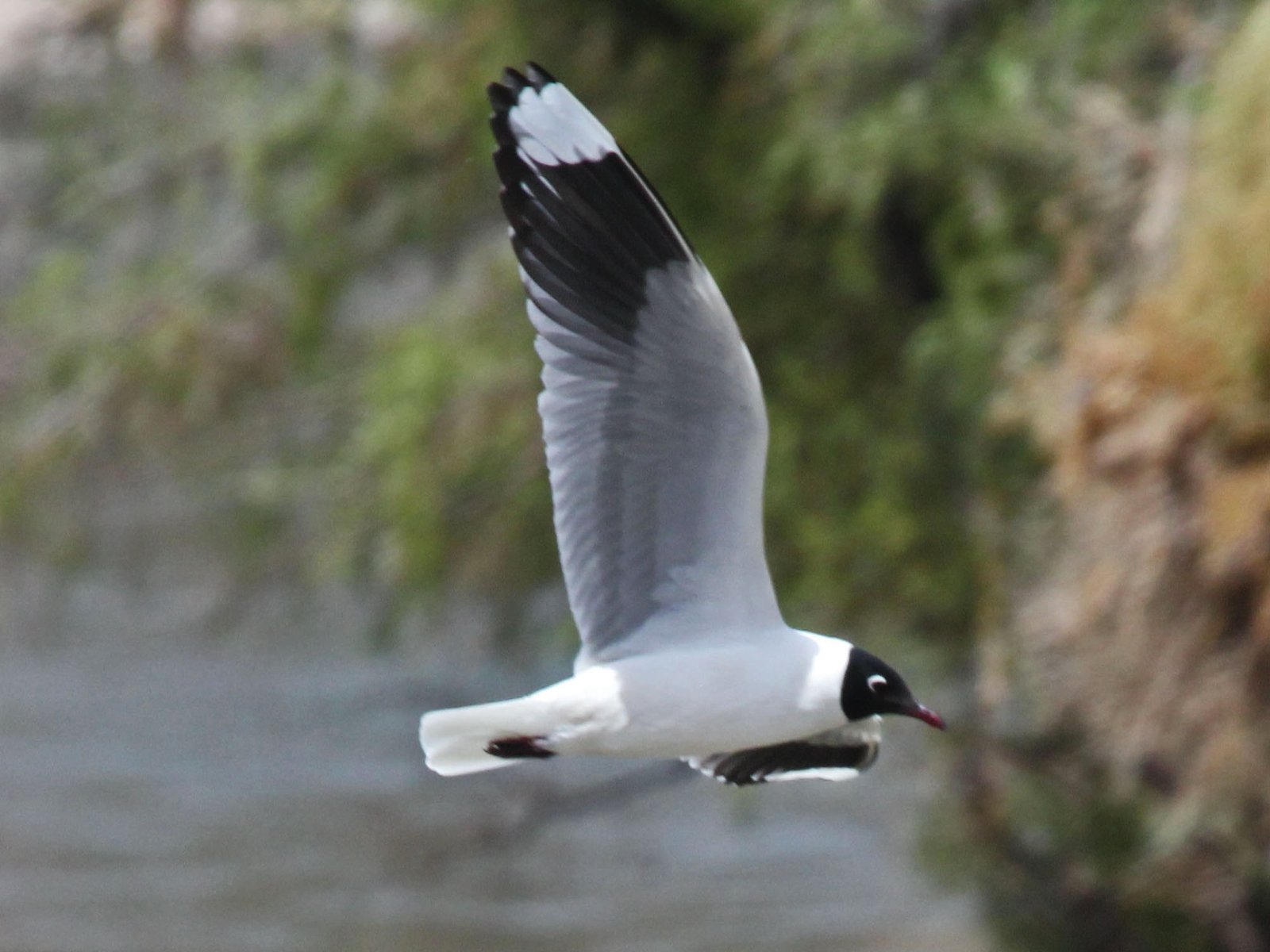
44–48 cm, a bulky hooded gull with a dark red bill, dark red legs and a dark iris with narrow white eye crescents. Adults have a mid-grey mantle and a large white wedge in the outer wing, with black tips to the outer primaries; on the underwing the primaries are largely dark with a white patch. In breeding plumage a blackish brown hood; in non-breeding plumage a white head with a dark ear spot. Juveniles have a brown-mottled upperwing, a black tail band and a pale bill with a dark tip. The sexes are alike.
Confusion species
Brown-hooded Gull Chroicocephalus maculipennis is smaller and slimmer, with a browner hood, and is a very rare vagrant in the guide area. Franklin's Gull Leucophaeus pipixcan is smaller, with a darker mantle, a black wingtip with white tips and a broad white eye-ring, and occurs in the Andes only as a passage migrant. Grey-headed Gull Chroicocephalus cirrocephalus has a pale iris and a pale grey hood in breeding plumage, and lives on the coast.
Habitat
Lakes, lagoons, bogs and bofedales on high plateaus and in the páramo and puna, roughly between 3000 and 4800 m; also along rivers, in fields and at rubbish dumps in the highlands. Outside the breeding season also on beaches, estuaries and harbours on the coast. It eats insects, larvae, small fish, frogs and refuse and follows farmers ploughing. It breeds singly or in loose colonies on islets or in marsh vegetation; the nest is a heap of plant material.
Where the bird is most at home, classified by the vegetation units of the Andes and the west coast.


Range and movements
In Colombia scarce in the far south. In Ecuador on lakes in the Andes, especially in the páramo. In Peru on lakes and bogs throughout the Andes and outside the breeding season also along the coast. In Bolivia on the altiplano, including around Lake Titicaca. Absent from the Galápagos. Outside the guide area in northern Chile and north-western Argentina.
- Resident
- dark = core range, pale = thinly spread
How and when to look
Search lakes and bogs in the páramo of Ecuador or on the altiplano of Peru and Bolivia, where the gulls fly along the shores and over the bofedales. On the coast of Peru they can be found outside the breeding season among other gulls on beaches and in harbours.
Conservation status
Least Concern. The population appears stable; disturbance of breeding sites and pollution of lakes may play a role locally.
Scientific name
Chroicocephalus serranus | (Tschudi, 1844)
Tschudi described the species in 1844 as Larus serranus; because it was later moved to another genus, the author and year stand in brackets. The genus Chroicocephalus was introduced in 1836 by Eyton. The genus name is from Greek khrōikos, 'coloured', and -kephalos, '-headed', after the coloured head in breeding plumage. The species name means 'of the mountains', from Spanish sierra, after its high Andean habitat. The specimen the first description was based on came from Jauja Valley, Junín, Peru.