All species › Waders, gulls and terns › Skimmers, noddies, terns and gulls › Grey Gull
Grey Gull | Leucophaeus modestus
Grijze meeuw | Gaviota gris | Gaivota-cinzenta
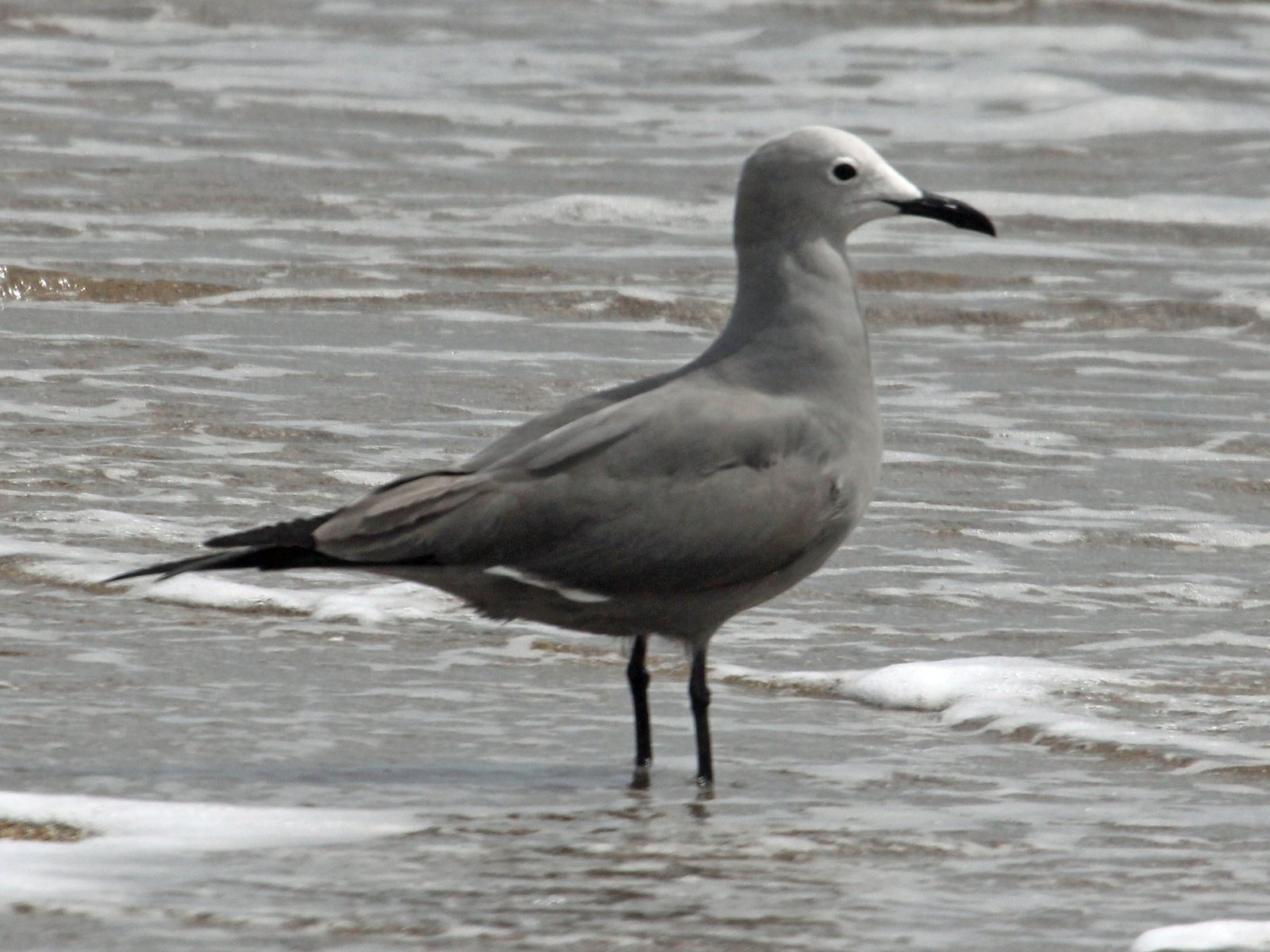
Grey Gull is a plain grey gull of the cool coast of the Humboldt Current. It breeds deep in the barren Atacama Desert, tens of kilometres from the sea, and commutes daily to the coast to feed. On the sandy beaches of Peru it is one of the most numerous gulls.
Voice
A soft, mewing kweh and short, harsh calls; mostly heard from flocks on the beach.
Recording: Barry Edmonston — CC BY-NC-SA 4.0 · xeno-canto
Identification
43–46 cm, with a black bill and black legs. Adults are almost entirely grey, with darker wings, a blackish wingtip, a broad white trailing edge to the secondaries and a grey tail with a black terminal band and a white edge. In breeding plumage the head is whitish; in non-breeding plumage the head is brownish grey, like the rest of the body. Juveniles are uniform greyish brown with pale fringes to the feathers of the upperparts and a dark tail. The sexes are alike.
Confusion species
Belcher's Gull Larus belcheri is larger, with a black mantle, white underparts and a yellow bill with a red and black tip. Lava Gull Leucophaeus fuliginosus is darker, with a blackish head and white eyelids, and lives only in the Galápagos. Juvenile Franklin's Gulls Leucophaeus pipixcan and Laughing Gulls Leucophaeus atricilla have white underparts and a white rump.
Habitat
Sandy beaches, especially where the waves run out, and also estuaries, harbours and inshore waters. It runs after retreating waves and picks mole crabs (Emerita) and other invertebrates from the wet sand; it also eats fish waste. It breeds in loose colonies on bare ground in the inland desert, and the parents take turns flying to and from the coast.
Where the bird is most at home, classified by the vegetation units of the Andes and the west coast.


Range and movements
In Peru along the entire coast, especially numerous in the centre and south. In Ecuador along the coast, mainly outside the species' breeding season. In Colombia rare on the southern Pacific coast. Absent from Bolivia. The known breeding colonies are in the Atacama Desert of northern Chile; breeding in the far south of Peru is possible. Outside the guide area along the coast of Chile.
- Resident
- dark = core range, pale = thinly spread
How and when to look
Walk the sandy beaches south of Lima or along the south coast of Peru, where flocks of Grey Gulls follow the surf. Look for the plain grey colour, the black bill and legs and the white trailing edge of the wing.
Conservation status
Least Concern. The desert breeding colonies are sensitive to disturbance by vehicles and mining, and numbers fluctuate with food availability during El Niño.
Scientific name
Leucophaeus modestus | (Tschudi, 1843)
Tschudi described the species in 1843 as Larus modestus; because it was later moved to another genus, the author and year stand in brackets. The genus Leucophaeus was introduced in 1855 by Bruch. The genus name comes from Greek leukos, 'white', and phaios, 'dusky'. The species name comes from Latin modestus, 'modest' or 'plain', for the plain grey plumage. The specimen the first description was based on came from Lurín, Lima, Peru.