All species › Waders, gulls and terns › Skimmers, noddies, terns and gulls › Laughing Gull
Laughing Gull | Leucophaeus atricilla
Lachmeeuw | Gaviota guanaguanare | Gaivota-alegre
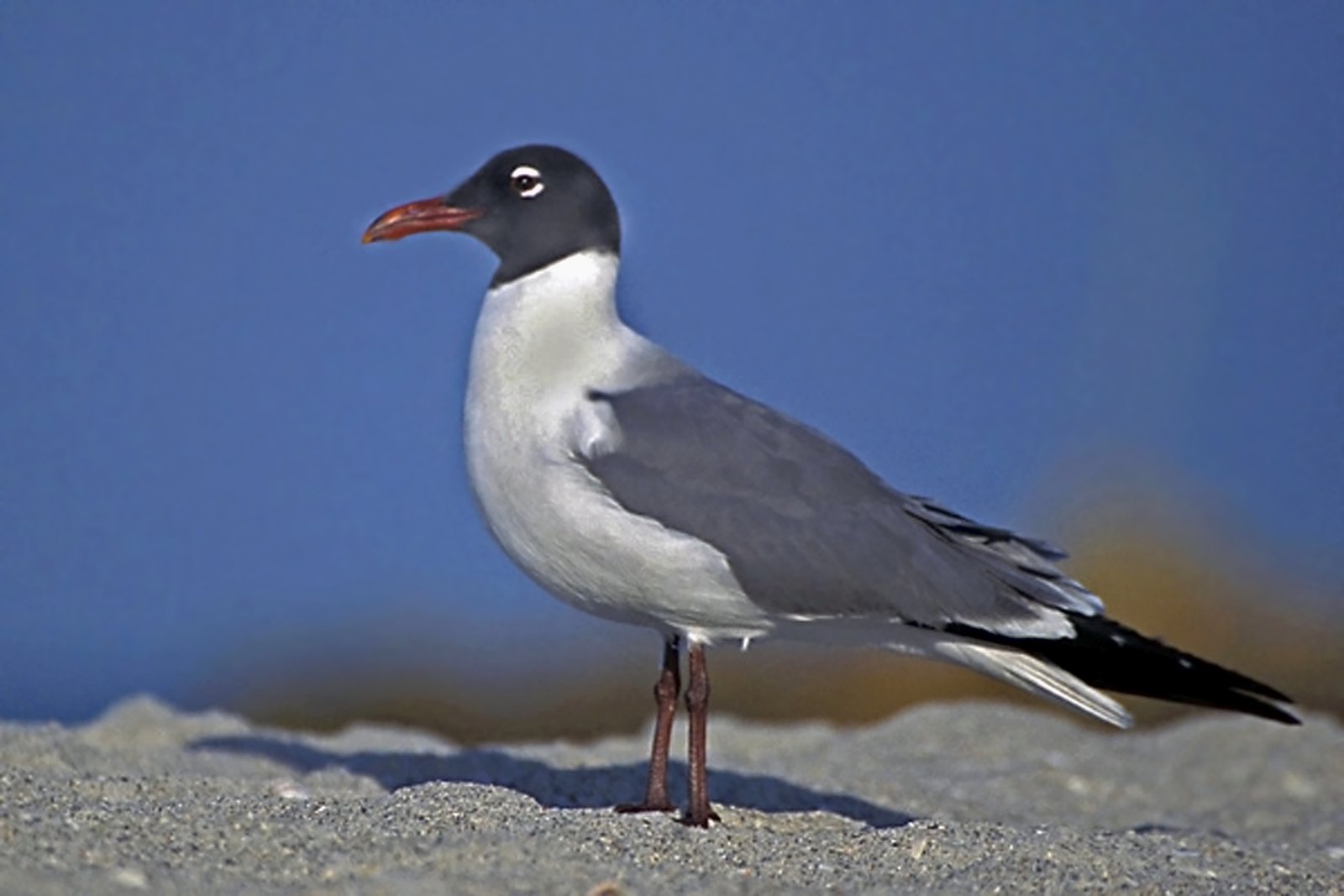
Laughing Gull is a medium-sized hooded gull of the coasts of North and Central America and the Caribbean, named after its laughing call. In the guide area it is mainly a winter visitor along the Pacific coast of Colombia, Ecuador and northern Peru, where it gathers in flocks in harbours and estuaries. Some immatures also stay through the northern summer.
Voice
A high, laughing series ha-ha-ha-haah-haah and a plaintive kee-ah; in the wintering areas mostly short calls from flocks.
Recording: David Darrell-Lambert — CC BY-NC-SA 4.0 · xeno-canto
Identification
39–43 cm, a slender hooded gull with long, narrow wings and a long, slightly drooping bill. Adults have a dark grey mantle and upperwing that blend without a sharp border into black wingtips with few or no white tips, and a narrow white trailing edge. In breeding plumage a black hood, narrow white eye crescents and a dark red bill and legs; in non-breeding plumage a white head with a grey smudge behind the eye and a blackish bill. Juveniles are greyish brown, with a grey breast and flanks, a complete black tail band and a dark underwing; they take three years to reach adult plumage. The sexes are alike.
Confusion species
Franklin's Gull Leucophaeus pipixcan is smaller, with a shorter bill, broader white eye crescents, a white band between the grey and the black wingtip and large white tips to the primaries; in non-breeding plumage it keeps a dark half-hood. Lava Gull Leucophaeus fuliginosus is larger and entirely sooty grey and lives only on the Galápagos. Grey Gull Leucophaeus modestus is plain grey, with a whitish head in breeding plumage and a black bill and black legs.
Habitat
Coasts, harbours, estuaries, lagoons, mangroves and sandy beaches; also at fishing villages, shrimp farms and rubbish dumps, rarely inland. It eats fish, crustaceans, insects and refuse and sometimes steals food from pelicans. It breeds in colonies on the ground, on islands and in salt marshes in the Caribbean and North America; the nest is a cup of plant material.
Where the bird is most at home, classified by the vegetation units of the Andes and the west coast.


Range and movements
In Colombia along the Caribbean and Pacific coasts; present year-round on the Caribbean coast. In Ecuador along the whole coast, most numerous from October to April, and scarce on the Galápagos. In Peru along the coast, especially in the north, south to about Lima and rare farther south. Absent from Bolivia. Outside the guide area it breeds along the east coast of North America, around the Gulf of Mexico, in the Caribbean south to Venezuela and on the Pacific coast of Mexico.
- Resident
- dark = core range, pale = thinly spread
How and when to look
In the northern winter, search harbours and fishing beaches in south-western Ecuador, for example around the Gulf of Guayaquil and on the Santa Elena peninsula, or the coast of Tumbes and Piura in northern Peru. In March and April many birds already acquire a black hood.
Conservation status
Least Concern. The population is large; in North America it recovered after a steep decline in the nineteenth century caused by egg collecting and hunting for feathers.
Scientific name
Leucophaeus atricilla | (Linnaeus, 1758)
Linnaeus described the species in 1758 as Larus Atricilla; because it was later moved to another genus, the author and year stand in brackets. The genus Leucophaeus was introduced in 1855 by Bruch. The genus name comes from Greek leukos, 'white', and phaios, 'dusky'. The species name comes from Latin ater, 'black', and New Latin cilla, which Linnaeus took to mean 'tail'. The specimen the first description was based on came from The Bahamas.