All species › Waders, gulls and terns › Skimmers, noddies, terns and gulls › Franklin's Gull
Franklin's Gull | Leucophaeus pipixcan
Franklins meeuw | Gaviota de Franklin | Gaivota-de-franklin
Franklin's Gull is a small hooded gull that breeds in the prairie marshes of North America and spends the northern winter largely on the Pacific coast of South America. Along the coast of Peru and Chile it then gathers in flocks of hundreds to thousands of birds. On migration part of the population crosses the Andes and rests on high-plateau lakes.
Voice
A high, nasal kuk or wee-a; flocks give a soft chatter.
Recording: Dante Buzzetti — CC BY-NC-SA 4.0 · xeno-canto
Identification
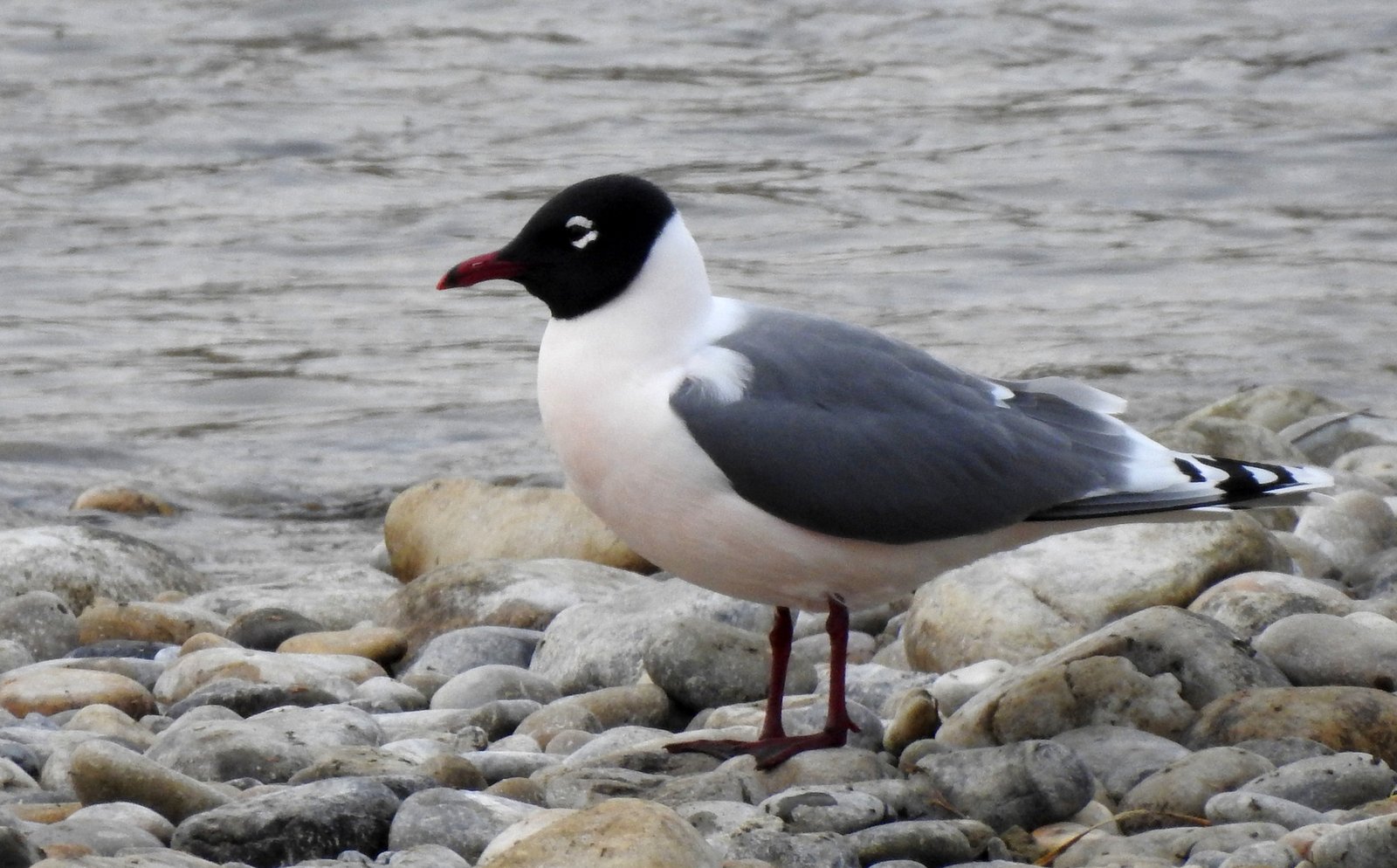
33–36 cm, a compact hooded gull with a short bill and fairly rounded wings. Adults have a dark grey mantle, a white band between the grey and the black wingtip and large white tips to the primaries. In breeding plumage a black hood, broad white eye crescents, a red bill and dark red legs, often with a pink flush on the underparts; in non-breeding plumage a dark half-hood over the hindcrown and ear coverts, a white forehead and a blackish bill. First-year birds have white underparts, a dark half-hood, a grey mantle and a black tail band that leaves the outer tail feathers white. The sexes are alike.
Confusion species
Laughing Gull Leucophaeus atricilla is larger, with a longer bill and longer wings, black wingtips without a white band and in non-breeding plumage only a grey smudge behind the eye; first-year Laughing Gulls have a grey breast and a complete tail band. Andean Gull Chroicocephalus serranus is larger, with a paler grey mantle and a large white wedge in the outer wing. Grey Gull Leucophaeus modestus is entirely grey, with a black bill and black legs.
Habitat
Sandy beaches, estuaries, harbours, lagoons and inshore waters, also over the sea, where it picks insects and small fish from the surface; inland in fields and irrigated farmland. On migration also on lakes in the Andes, such as Lake Titicaca. It eats insects, small fish, crustaceans and refuse. It breeds in colonies with floating nests of plant material in reed marshes of the North American prairies.
Where the bird is most at home, classified by the vegetation units of the Andes and the west coast.


Range and movements
In Colombia scarce as a passage migrant and winter visitor, mainly on the Pacific coast and locally in the Andes. In Ecuador along the coast, mainly on passage, and regularly in small numbers on the Galápagos. In Peru numerous along the whole coast from November to April, with migrants on lakes in the Andes. In Bolivia as a passage migrant on the lakes of the altiplano. Outside the guide area it breeds in the interior of Canada and the northern United States and winters mainly along the coast of Peru and Chile.
- Resident
- Winter visitor (c. Oct–Mar)
- dark = core range, pale = thinly spread
How and when to look
Between November and March, check gull flocks on the beaches and in the harbours of the Peruvian coast, for example around Lima and Paracas. In October and April flocks move along the coast and over lakes in the Andes.
Conservation status
Least Concern. The population fluctuates with water levels in the prairie marshes; drainage of breeding areas is the main threat.
Scientific name
Leucophaeus pipixcan | (Wagler, 1831)
Wagler described the species in 1831 as Larus Pipixcan; because it was later moved to another genus, the author and year stand in brackets. The genus Leucophaeus was introduced in 1855 by Bruch. The genus name comes from Greek leukos, 'white', and phaios, 'dusky'. The species name is a Nahuatl name for a kind of gull. The specimen the first description was based on came from Mexico.