All species › Waders, gulls and terns › Skimmers, noddies, terns and gulls › Lava Gull
Lava Gull | Leucophaeus fuliginosus
Lavameeuw | Gaviota de lava | Gaivota-de-lava
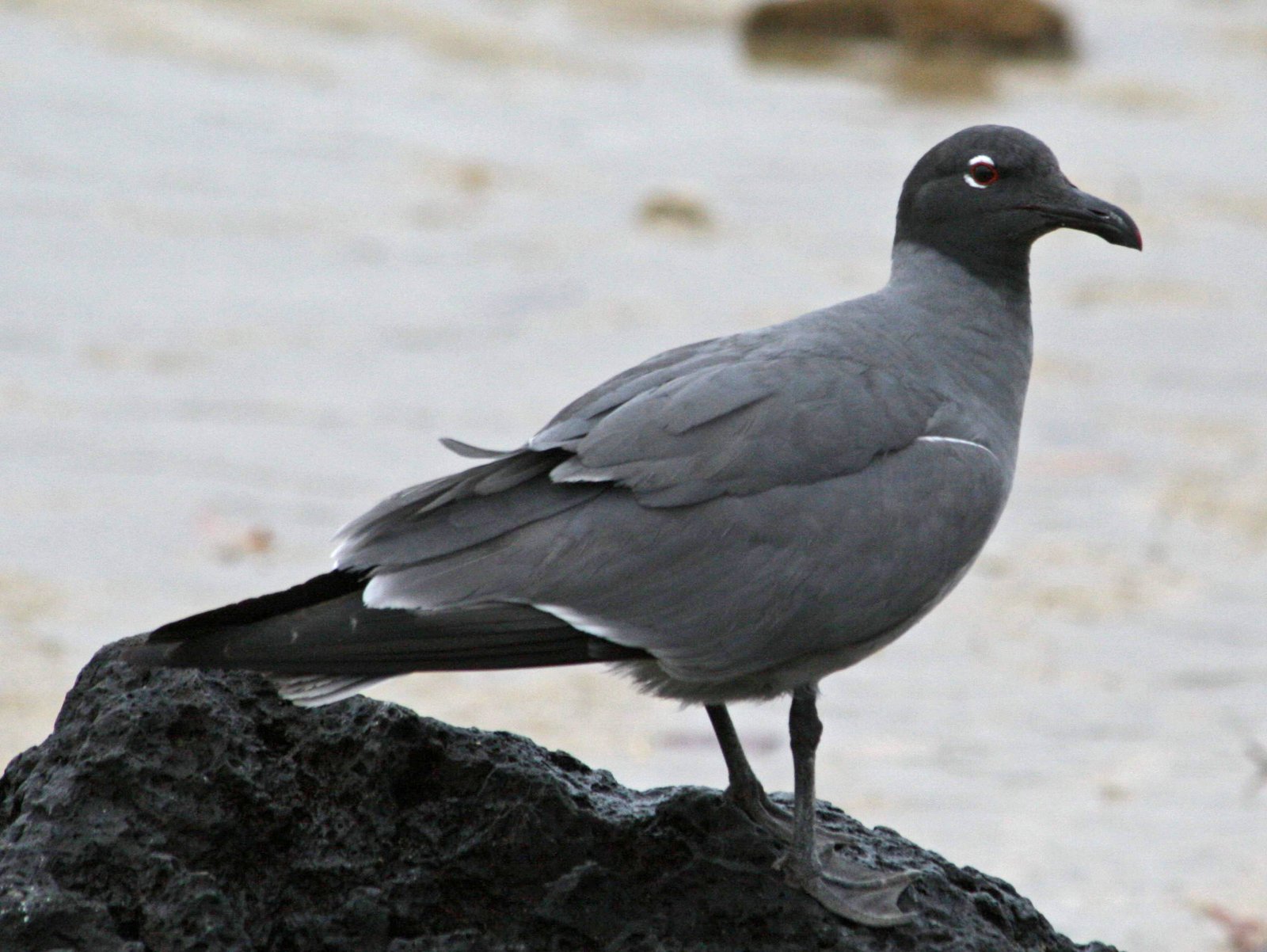
Lava Gull is endemic to the Galápagos and, with a population of a few hundred pairs, one of the rarest gulls in the world. It breeds scattered in single pairs rather than in colonies. Its dark sooty grey plumage matches the black lava shores of the islands.
Voice
A high, laughing call resembling that of Laughing Gull, and short, raw kee-ow calls.
Recording: Leander Khil — CC BY-NC-SA 4.0 · xeno-canto
Identification
51–55 cm, a dark gull with a black bill with a red mouth lining and black legs. Adults are sooty grey, with a blackish head and neck, white upper and lower eyelids that show as white crescents around the eye, a slightly paler grey belly and a paler grey rump and tail; the wings are dark grey with blackish tips. Juveniles are uniform dark brown with pale fringes on the upperparts and reach adult plumage in about three years. The sexes are alike.
Confusion species
Laughing Gull Leucophaeus atricilla, scarce on the Galápagos, is smaller, with a white belly and tail and a red bill in breeding plumage; young Laughing Gulls have paler underparts and a white rump. Swallow-tailed Gull Creagrus furcatus has white underparts, a forked tail, a tricoloured wing and a red eye-ring. Franklin's Gull Leucophaeus pipixcan, a scarce winter visitor to the islands, is smaller and has white underparts.
Habitat
Lava shores, rocky coasts, sandy beaches, lagoons and mangroves, and especially harbours and fish markets in the villages. It eats fish, crabs, eggs and chicks of other seabirds, carrion and fish scraps, and steals food from other birds. It nests solitarily, usually close to water on a small beach, a lava rock or an islet in a lagoon; the nest is a shallow scrape, usually with two eggs.
Where the bird is most at home, classified by the vegetation units of the Andes and the west coast.


Range and movements
Only on the Galápagos (Ecuador), scattered over the islands with suitable shores, including Santa Cruz, San Cristóbal, Isabela, Santiago and Genovesa, and also on other islands such as Fernandina, Floreana and Española. It does not occur on the mainland of Colombia, Ecuador, Peru or Bolivia.
- Resident
How and when to look
Search the harbours of Puerto Ayora (Santa Cruz) and Puerto Baquerizo Moreno (San Cristóbal), especially at the fish market and the jetties, where it looks for fish scraps among pelicans and sea lions. Along lagoons and beaches there are usually single birds or pairs.
Conservation status
Vulnerable. The population numbers only a few hundred pairs and appears stable, but its small size makes it sensitive. Possible threats are introduced predators such as rats and cats, disturbance, food shortage in El Niño years and pollution in harbours.
Scientific name
Leucophaeus fuliginosus | (Gould, 1841)
Gould described the species in 1841 as Larus fuliginosus; because it was later moved to another genus, the author and year stand in brackets. The genus Leucophaeus was introduced in 1855 by Bruch. The genus name comes from Greek leukos, 'white', and phaios, 'dusky'. The species name comes from Latin fuliginosus, 'sooty'. The specimen the first description was based on came from Isla Santiago, Galápagos.