All species › Waders, gulls and terns › Skimmers, noddies, terns and gulls › Belcher's Gull
Belcher's Gull | Larus belcheri
Simeonsmeeuw | Gaviota peruana | Gaivota-de-belcher
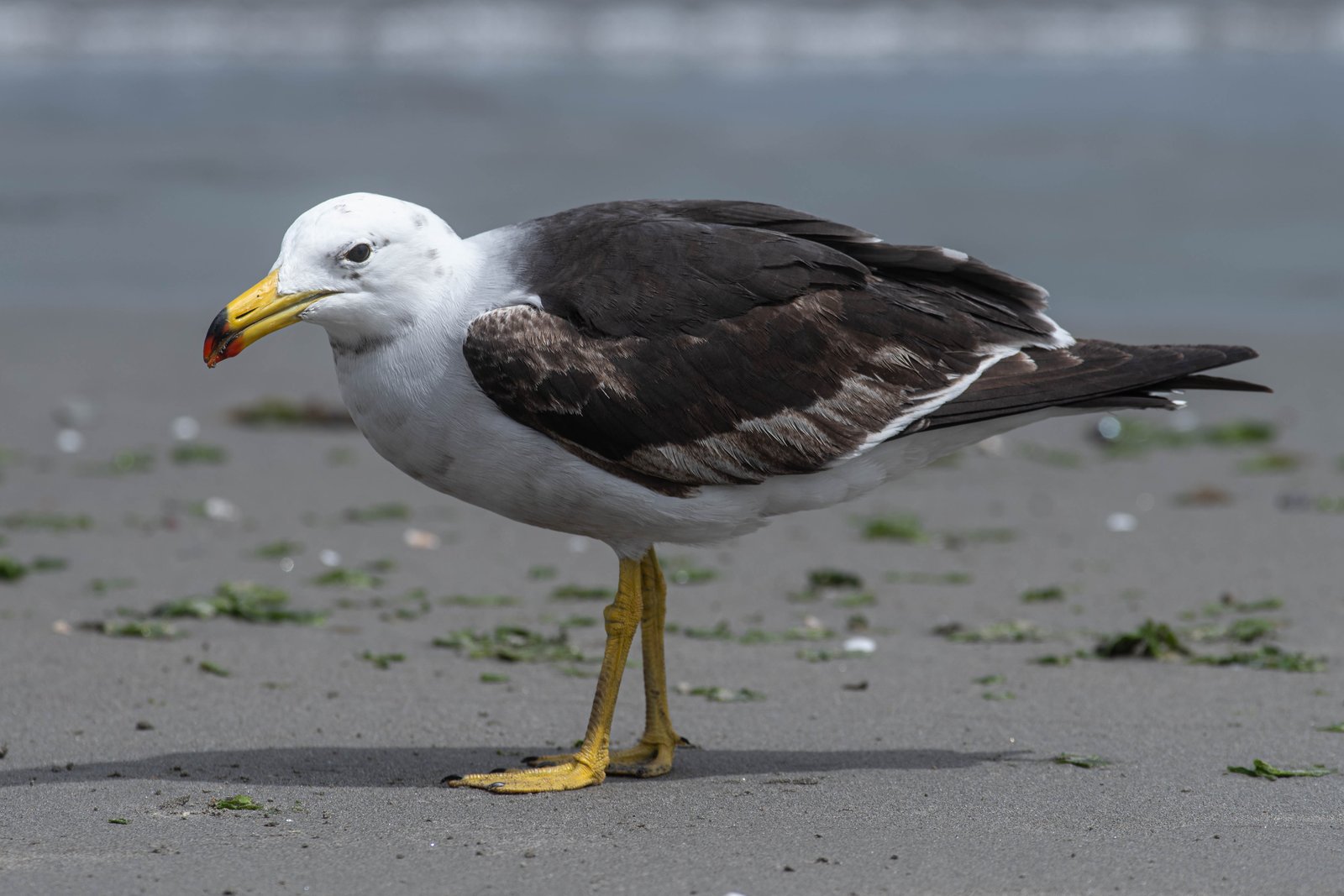
Belcher's Gull is a large black-backed gull of the cool coast of the Humboldt Current, from northern Peru to northern Chile. It is one of the permanent residents of Peruvian fishing harbours and rocky shores. Even adults have a black tail band, which is unusual among large gulls.
Voice
Deep, laughing series kow-kow-kow and a long kyow.
Recording: Jacek Betleja — CC BY-NC-SA 4.0 · xeno-canto
Identification
48–52 cm, a heavy gull with a thick yellow bill with a black band and a red tip, and yellow legs. Adults have a blackish mantle and upperwing with a white trailing edge, white underparts and a white tail with a broad black terminal band. In breeding plumage the head is white; in non-breeding plumage it has a dark brown hood with white eye crescents. Juveniles are brown with pale fringes, with a brown head and breast, a black tail and a pale bill with a black tip; they reach adult plumage in three years. The sexes are alike.
Confusion species
Kelp Gull Larus dominicanus is larger, with a white tail without a black band, a yellow bill with only a red spot near the tip, greenish yellow legs and a nearly white head even in non-breeding plumage. Grey Gull Leucophaeus modestus is smaller and entirely grey, with a black bill and black legs. Laughing Gull Leucophaeus atricilla is smaller and slimmer, with a dark grey mantle and a dark bill.
Habitat
Rocky shores, cliffs, sandy beaches, harbours, estuaries and guano islands, rarely more than a few kilometres from the coast. It eats fish, crabs, molluscs, eggs and chicks of seabirds, carrion and fish scraps. It breeds in loose colonies or single pairs on islets, cliffs and rocky shores; the nest is a scrape with some plant material.
Where the bird is most at home, classified by the vegetation units of the Andes and the west coast.


Range and movements
In Peru along the whole coast, from Tumbes and Piura to Tacna. In Ecuador rare on the coast of the south-west. Absent from Colombia, Bolivia and the Galápagos. Outside the guide area along the coast of northern Chile. Olrog's Gull Larus atlanticus of the Atlantic coast of Argentina was formerly included in the same species.
- Resident
- dark = core range, pale = thinly spread
How and when to look
Search the fishing harbours of the Peruvian coast, such as Callao, Pucusana and Paracas, and the adjacent rocky shores, where it waits for fish scraps among pelicans and cormorants.
Conservation status
Least Concern. The population fluctuates with food availability in El Niño years; disturbance of breeding sites may play a role locally.
Scientific name
Larus belcheri | Vigors, 1829
Vigors described the species in 1829 and placed it straight away in the genus where it still stands. The genus Larus was introduced in 1758 by Linnaeus. The genus name comes from Greek laros or Latin larus, a word for a gull or another large seabird. The species name honours Sir Edward Belcher (1799–1877), British naval officer and explorer who surveyed the Pacific coast of South America. The specimen the first description was based on came from (per the description).