All species › Waders, gulls and terns › Skimmers, noddies, terns and gulls › Ring-billed Gull
Ring-billed Gull | Larus delawarensis
Ringsnavelmeeuw | Gaviota de Delaware | Gaivota-de-bico-manchado
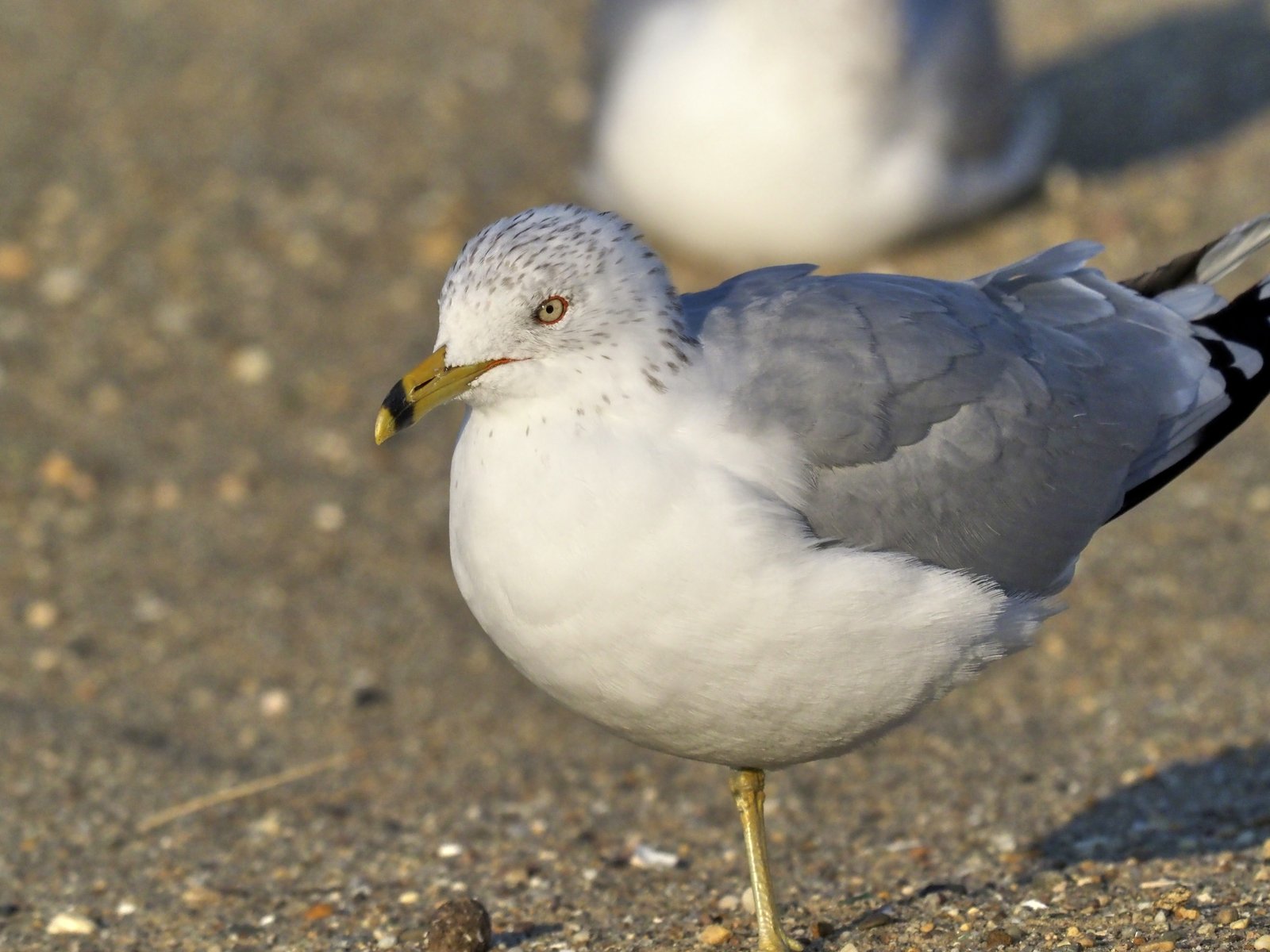
Ring-billed Gull is a medium-sized gull of North America, named after the black band around its yellow bill. There it is one of the most numerous gulls, also far inland. In the guide area it is a rare winter visitor, mainly on the Caribbean coast of Colombia.
Voice
A high, shrill kyow and laughing series, higher in pitch than those of larger gulls.
Recording: Richard E. Webster — CC BY-NC-SA 4.0 · xeno-canto
Identification
46–51 cm. Adults have a pale grey mantle, black wingtips with small white spots, a yellow bill with a complete black band, a pale iris and yellow legs; in non-breeding plumage the head is streaked brownish grey. First-year birds have a pale grey mantle, brown-mottled wing coverts, a pink bill with a black tip, pink legs and a narrow, irregular black tail band; second-year birds are greyer, with a yellowish bill base. They reach adult plumage in three years. The sexes are alike.
Confusion species
Laughing Gull Leucophaeus atricilla is smaller and slimmer, with a dark grey mantle, entirely black wingtips and a dark bill. Kelp Gull Larus dominicanus and Belcher's Gull Larus belcheri are larger and have a blackish mantle; they live on the Pacific coast. Young birds of larger gulls are darker brown and have a heavier, dark bill.
Habitat
Beaches, harbours, estuaries, lagoons and rubbish dumps; in North America also on lakes, fields and in towns inland. It eats fish, insects, earthworms, rodents, seeds and refuse. It breeds in colonies on islands in lakes in the interior of Canada and the northern United States; the nest is a cup of plant material on the ground.
Where the bird is most at home, classified by the vegetation units of the Andes and the west coast.


Range and movements
In Colombia a scarce winter visitor on the Caribbean coast, mainly in the north. In Ecuador and Peru only a few records as a vagrant on the coast. Absent from Bolivia and the Galápagos. Outside the guide area it breeds in Canada and the northern United States and winters south to Mexico, Central America and the Caribbean.
- Resident
- Winter visitor (c. Oct–Mar)
- dark = core range, pale = thinly spread
How and when to look
In the northern winter, check flocks of Laughing Gulls and terns on the beaches and in the harbours of the Caribbean coast of Colombia; a pale grey gull with a yellow, ringed bill and yellow legs is probably this species.
Conservation status
Least Concern. The population is large and increased strongly in the twentieth century, partly owing to the availability of refuse.
Scientific name
Larus delawarensis | Ord, 1815
Ord described the species in 1815 and placed it straight away in the genus where it still stands. The genus Larus was introduced in 1758 by Linnaeus. The genus name comes from Greek laros or Latin larus, a word for a gull or another large seabird. The species name refers to the Delaware River in the United States. The specimen the first description was based on came from Delaware River near Philadelphia, Pennsylvania, United States.